





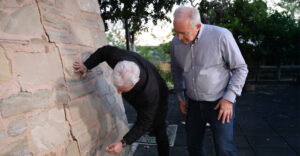
Scientists are focusing on four different scenarios as they examine the cracking of roads, houses, the church and other infrastructure in the village of Voutes, at Heraklion, Crete. The president of the OASP, Ethymios Lekkas, has been at the site since yesterday, whose team, using special equipment and drones, has been “mapping” the area and the two fractures, each 150 meters long, since 7 this morning.
“We are dealing with two territorial ruptures about 150 meters long each. They are in different places in the village. Have these these ground ruptures caused failures in structures, houses, public places and networks. It is purely a geological phenomenon, which is ongoing,” Lekkas explained.
But what are the key scenarios that scientists are considering? What is the phenomenon about?
1. Sedimentation
That the cracks – and uplift – in 10 houses, St George’s Church, roads and pavements are due to extensive settlement of the ground is the most likely scenario. If this is confirmed, another question will have to be answered: where the subsidence occurred, as scientists – who believe it is more likely that the ground beneath the village collapsed over a 150-metre stretch – do not rule out the possibility that subsidence occurred on the mountain and that the phenomenon affected the subsurface of the village.
This is not a particularly rare phenomenon, both for our country and for this particular region. In Nea Alikarnassos, two months ago, the local high school was closed due to subsidence, while two years ago, the road connecting Heraklion with Messara was closed, as cracks were caused by subsidence in the adjacent mountain.
The most typical such case in our country is the village of Ropoto in Trikala, which has been moved 40 meters lower than where it was, and due to the 2012 landslides, has become uninhabitable.
2. No sedimentation, but…elevation!
There’s another scenario about the cracks in the Voutes. It is the exact opposite. As seismologist Akis Tselentis said, the area is not sinking, but rising!
In a post on Facebook, Mr. Tselendis explains that “at Geodynamic for 3 years we have been doing a detailed seismological/geophysical/study of Heraklion. We found many non-active faults which we studied with electrical, seismic, satellite and Georadar methods. In the wider area at Voutes there are several (non-active) faults with N-S directions which we identified but did not give any publicity so as not to scare people. We had found that the wider area in Boutes is rising very little while the harbour area is falling.
3. Water leakage cracks
Another scenario that has been “put on the table” by scientists as water seepage has been observed in the fractures, geologists are looking for the answer to the question of whether water seepage caused them, or whether the fractures caused the seepage.
In the first case, which however does not seem particularly likely, the water seepage (we do not know its origin) weathered the subsoil and caused it to retreat, resulting in damage. If it turns out, however, that the water leak was caused by the cracks (e.g., a pipe broke) then the scenario of the water having something to do with the subsidence would be ruled out.
4. Differential sedimentation
This scenario is very similar in essence to the first scenario. As of yesterday, an engineer from the Metrology Department has been in the area, who believes that it is possible that all of the above is due to differential sedimentation. This is a phenomenon in which the ground subsides unevenly, usually resulting in the creation of many large cracks, usually with different slopes and directions, causing an increase in the moments at the bearing points.
Today, however, after the final assessments and scientists and after the recommendation of the president of the OASP, it will be decided whether the village will be declared in a state of emergency, as requested by the mayor of Heraklion Alexis Kalokairinos.
“Of course it is at the discretion of the Ministry of Civil Protection through the president of the OASP who is with us today to assess whether this will happen. We think there is a practical dimension to this declaration. That is, all the procedures can proceed more quickly and appropriate measures can be taken in time for a phenomenon that – as you have heard – is underway. Therefore, we must be proactive. That is, it is obvious that we are fighting a battle against time even if the expansion of these break-ins is not visible every second. But time cannot be wasted and of course above all we are interested and concerned with the safety of life, the safety of people and beyond that of course the property and the public space that has been damaged.”
However, Mr. Lekkas pointed out that the important thing is to determine how the phenomenon will move and whether it will spread to neighboring ones, so that answers can be given about the houses – some of which were not occupied yesterday until further notice: “The phenomenon is ongoing, so it could expand. This will be seen tomorrow and in the next few days whether or not the phenomenon will expand. Beyond that there are some structures which have suffered major failures from the burglary. But these structures were old and not inhabited, so there is no problem. In some structures that are occupied, the recommendation is for tonight is that they are not occupied, that another space be found. So that we can get a very good picture tomorrow to see what action we can then take. Of course, whether the dwellings are safe or not, that’s a matter for the ADF, which will send out engineers so that they can assess whether a structure is at risk or not.”
Ask me anything
Explore related questions




