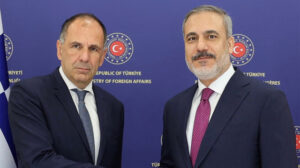
Greek Foreign Minister Giorgos Gerapetritis and his Turkish counterpart Hakan Fidan outlined the next steps in Greek-Turkish relations during a private dinner in Istanbul, ahead of Turkish President Recep Tayyip Erdoğan’s upcoming visit to the Turkish-occupied part of Cyprus. The key goal is to set a date for the next meeting of the High-Level Cooperation Council, even as internal tensions rise in Turkey over issues such as maritime spatial planning and the laying of the Crete–Cyprus electricity cable.
Athens seeks to establish a new balance in bilateral relations, especially after Greece’s approval of its Maritime Spatial Plan (ΘΧΣ), which has triggered a cautious initial reaction from Ankara. Although that reaction was measured, it doesn’t necessarily reflect Turkey’s overall stance.
The foreign ministers’ meetings—set to continue at the NATO ministerial summit in Antalya (May 14–15)—aim to maintain a tone of normalcy in the relationship, despite ongoing disputes. Both sides are working toward convening the High-Level Cooperation Council before summer, to avoid the impression that bilateral mechanisms are stagnating.
Erdoğan’s visit to northern Cyprus is expected to further harden Ankara’s stance, as he is set to reject a federal solution and demand a two-state model for the island. This, along with growing internal criticism over Greece’s ΘΧΣ, raises concerns in Athens that Turkey may respond with actions in the field.
Following the Greek approval of the ΘΧΣ during Holy Week, Turkish media and opposition parties reacted strongly, accusing Erdoğan of surrendering to Greek claims in the Aegean and Eastern Mediterranean. Critics argue that the Greek ΘΧΣ legitimizes the “Seville Map,” recognizes Greece’s rights over disputed islets, and implies a 12-nautical-mile territorial sea—despite the latter not being explicitly depicted.
Greece’s recent defense initiatives, including the “Achilles’ Shield” program, stronger defense ties with the U.S., and coordination with Israel and Cyprus, have also stoked Turkish unease. Ankara, meanwhile, has finalized its own maritime spatial plan based on the “Blue Homeland” doctrine and plans to submit it to the UN.
In the coming period, the restarting of work on the Crete–Cyprus undersea cable and the designation of marine parks will be critical flashpoints. Although these projects are expected to proceed, the Greek government appears to favor a slower pace to avoid escalating tensions.
The High-Level Cooperation Council remains a central diplomatic goal for Athens, even as Turkey faces internal political pressure and attempts to push back against growing international recognition of the Republic of Cyprus. This includes Central Asian Turkic states opening embassies in Nicosia and signing declarations aligned with UN resolutions condemning the “TRNC.”
Erdoğan is expected to use his visit to the occupied territories on May 4 to inaugurate the new “presidential palace” and government buildings funded by Ankara, reaffirm support for the “TRNC,” and advocate the two-state solution. Simultaneously, the “TEKNOFEST” tech expo will be held in northern Nicosia to demonstrate closer integration with Turkey.
Ask me anything
Explore related questions