





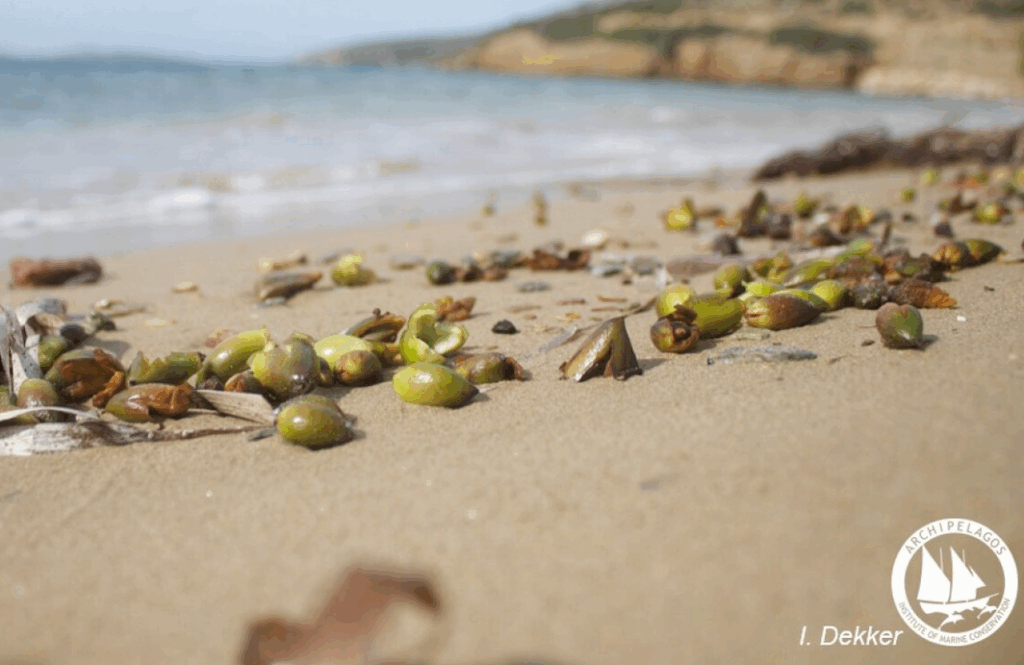
The Institute of Marine Conservation “Archipelagos” refers to a “rare phenomenon” occurring in many coastal areas of Greece, especially in the Ionian Sea, with large concentrations of Posidonia fruits.
“This rare phenomenon, which is recorded every few years, deserves our attention, as it represents a unique opportunity for research and action, as well as for filling some of the many knowledge gaps related to the fruiting of Posidonia oceanica meadows. Our previous recordings of similar events were in the spring of 2023 and the spring of 2013,” the institute’s announcement states.
As experts explain, “the large concentration of Posidonia fruits along the coast is a result of the flowering that took place the previous autumn. The fruiting of Posidonia is rare, as it depends on a combination of favorable environmental conditions. Posidonia oceanica meadows are truly unique marine plants. They are not algae, but higher plants, similar to those found on land, from which they originally evolved. They flower and produce fruit, form deep root systems, and are the foundation for the productivity and cleanliness of our seas.”
The last time a similar concentration of fruits was observed on the coasts, coastal ecology researchers from the “Archipelagos” Institute collected more than 12,000 fruits and seeds from various islands in the eastern Aegean, which were used in experimental underwater gardens.
Due to the uniqueness and difficulty of this endeavor, very few similar Posidonia restoration efforts have been undertaken worldwide. Planting underwater gardens requires careful preparation of the fruits, both in the lab and at sea, followed by planting in marine sediments with a specific nutrient composition. A specific depth is also necessary—not too shallow, but not too deep—and long-term care of the gardens over the following years is essential. This includes regular work by divers, sometimes on a monthly basis throughout the year.
Given the significant difficulty of establishing underwater gardens, it is important to emphasize that this effort is not suitable for greenwashing environmental actions—another “phenomenon” that, unfortunately, is on the rise in our country (and beyond), and one that should concern us seriously in the near future.
What Are Posidonia Meadows?
The institute reminds us that “Posidonia meadows are a valuable ally that can limit or even reverse the impacts of climate change. They can absorb up to 35 times more carbon compared to tropical forests. The productivity of our seas and fisheries depends on these marine meadows, as they are home to more than 300 species of algae and over 1,000 species of marine animals.”
Their extent in the Mediterranean has already decreased by at least 34%, mainly due to unregulated anchoring, which increases year by year, as well as certain destructive fishing practices and intensive aquaculture operations near Posidonia meadows. The destruction of a Posidonia meadow results in the loss of an entire ecosystem and the release of all the “blue carbon” it had stored over centuries.
To understand the scale of destruction caused by uncontrolled yacht anchoring, consider this: in a long-term study near just one heavily anchored area, divers from the Archipelagos Institute collected about 500 fragments of destroyed Posidonia root systems every hour during the summer months.
At a time when human activity continues to destroy one natural resource after another—and we keep creating more problems instead of solving them—the Archipelagos Institute emphasizes the urgent need to move beyond mere recognition and documentation of these problems toward their resolution or at least mitigation, using evidence-based knowledge and practical solutions.
Ask me anything
Explore related questions




