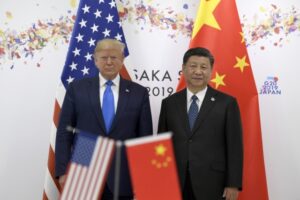
US President Donald Trump today hailed the “great progress” made in talks between US and Chinese officials in Geneva on tariffs, claiming they negotiated a “complete reset” in trade relations between Washington and Beijing.
In a post on the Truth Social platform, Trump states: “A very good meeting today (yesterday Saturday) with China in Switzerland. Many issues were discussed, many were agreed upon. Negotiated a complete reset in a friendly, but constructive, way. We want to see, for the good of both China and the United States, an opening of China to American business. Great progress has been made!”
Talks between US and Chinese officials in Geneva are expected to continue today. The U.S. delegation is led by Treasury Secretary Scott Bessent and White House trade representative Jamison Greer. Chinese Vice Premier He Lifeng is leading the Beijing delegation.
Tariffs as leverage
Since his return to the White House in January, Donald Trump has used tariffs as leverage with US trading partners. He has imposed additional 145% customs duties on imports from China, with Beijing responding with 125% tariffs on US goods.
As a result, bilateral trade has been effectively suspended, and major turbulence has been caused in global markets.
On Friday, Trump hinted that he could cut customs tariffs on Chinese goods to the 80% level.
“The president would like to settle the problem with China. As he has said, he would like to calm the situation down,” U.S. Commerce Secretary Howard Latnick noted, speaking to Fox News.
The gesture is seen as symbolic, since at this level customs tariffs would still be prohibitive for most Chinese imports to the United States.
WTO: Positive and constructive step towards de-escalation
The talks in Geneva are “a positive and constructive step towards de-escalation”, World Trade Organization (WTO) Director-General Ngozi Okonjo-Iweala assessed.
In mid-April, the WTO chief had expressed “grave concern” about the US-China trade dispute. She estimated that although trade between the two nations “accounts for only about 3% of world trade”, the disconnection of these two major economies “could have significant consequences”.
The global economy would then be divided into “two isolated blocs” based on geopolitical interests, he explained.
“Tariffs will not return to reasonable levels”
The Chinese vice premier came to the negotiating table with a trump card: China on Friday reported an 8.1% increase in its exports in April, four times what analysts had predicted, but its exports to the US fell by nearly 18%.
Donald Trump “is not going to unilaterally cut tariffs on China. We need to see concessions on their side as well,” warned White House spokeswoman Caroline Levitt.
“A possible outcome of the talks in Switzerland would be an agreement to suspend most, if not all, of the tariffs imposed this year throughout the bilateral negotiations,” assessed Bonnie Glazer, head of the Indo-Pacific program at the Washington-based German Marshall Fund think tank.
Su Bin, a professor at the China Europe International Business School (CEIBS) in Shanghai, does not think tariffs will return to “reasonable levels”: “Even if they are reduced, they will probably be halved. But even at that level they will be too high” for trade to return to normalcy.
Ask me anything
Explore related questions