





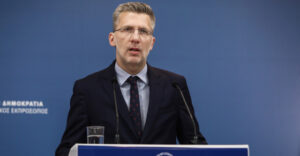
Ten policies for addressing the demographic issue in our country were presented by Minister of State Akis Skertsos in his speech, representing the Prime Minister, at the “Demographic 2025” conference. In his speech, the Minister also cited international data and approached the issue from a philosophical perspective.
Specifically, he stated: “We are facing a paradox that repeats itself in every developed country: it is called the ‘demographic paradox of prosperity.’ What does this practically mean? It means that as income, economic stability, and life expectancy increase, primarily in the Western world, the desire—or ability—of people to have children decreases. And this is not only a Greek phenomenon. It is global, with particular intensity in what is known as the developed world. We are concerned about the demographic trends in our country, and rightfully so. The downward indicators should mobilize all of us to discuss, plan, and decide what we can do better and more of,” he noted at the outset.
From there, he focused on Greece, pointing out that “for the first time in its history, our country has a dedicated ministerial structure for the demographic issue, for family support, as well as a long-term national plan that was developed and approved in 2024 to address the demographic issue. Twenty billion euros, about two billion annually, have been committed to support families for the next decade.”
At this point in his speech, Akis Skertsos made a brief aside, noting that “over the past ten years, the five richest countries in the world—the Luxembourg, Switzerland, Ireland, Norway, and Singapore—based on per capita income, that is, from 90 to 135 thousand dollars per person per year, have all recorded a continuous decline in birth rates.”
So, he raised the question: “Does the comfort of modern life create an invisible stress? Is insecurity not just economic, but existential? The absence of meaning, disconnection from the community, the ever-present fear of climate change turning into a climate crisis that threatens future generations, narcissistic individualism… all these contribute to an environment in which childbearing is seen as an added stress, not as hope.”
Consequently, “Greece, therefore, is not an exception but part of a larger phenomenon. And we must react not only with economic measures but with a new cultural narrative that restores value to life, care, and the creation of bonds. Karl Popper once said, ‘Optimism is a moral duty.’ Hope is not a feeling—it’s a stance in a world that is becoming increasingly complex and difficult. Not because we are sure we will succeed, but because only if we believe we can, will we have the slightest chance of succeeding,” the Minister of State added. “Thus, perhaps, primarily regarding the demographic issue, our greatest responsibility is to build a world where hope returns—where young people will not feel that they are growing up to survive, but to create.”
In conclusion, “If the demographic problem is the visible tip of the iceberg, its root lies in our internal distancing from the concept of ‘enough.’ We have learned to live for ‘more,’ not for ‘enough’ and ‘better,'” the Minister of State remarked.
And, posing the well-known question, “Why did our parents and grandparents, with far fewer comforts, money, or state support, have many more children?” he shared his opinion that “they were less absorbed by themselves and the effort to continually accumulate more goods. Therefore, the answer to the problem that concerns us cannot be another numerical target. The answer is moderation.”
Closing, according to A. Skertsos, “We need policies that support families, yes—but also a new cultural narrative where motherhood and fatherhood, positive parenting, creativity, care, and ecological balance are acts of moral wealth and meaning for life. It’s not just about economic capacity or state support. It’s primarily about worldview, culture, priorities. We need to speak more and louder about the miracle of life and the experience of having children.”
And, in a very personal tone, he continued, “I regret that my wife and I only had one child at a later age. In our effort to accumulate skills, knowledge, and professional experiences, we put off having our son, who ultimately made us happier, fuller, and more content than anything else we have done or achieved in our lives so far. And this is something we, as parents, need to say.”
Furthermore, recognizing that “the average person does not reject creating a family just because they lack resources—but because they feel they don’t have time, space, community, a sense of purpose, or support. They do not see structures around them that encourage them to belong and continue to do what they want and dream,” he continued, presenting “what we can do more of and what we are already doing as a State:
1. National strategy for the major housing problem we face. More than 40 measures, amounting to 7 billion euros, aim to stimulate both the supply of housing and support the incomes of both tenants and owners of older properties. One and a half million tenants will receive support through a rent refund.
2. Special tax incentives for the repatriation of the thousands of Greeks who left the country during the crisis years.
3. Active employment policies to balance professional and family life and a fairer distribution of burdens between father and mother. With special leave and maternity support benefits that cumulatively exceed 10,000 euros for the first 9 months.
4. Emphasis for the first time on public health, primary care, prevention, and the management of long-term conditions. We live longer, but we must also live better. The quality of life at every age can be significantly improved with the free diagnostic programs the government is implementing for the first time.
5. New care policies and support for the vulnerable from new challenges and threats. Such as the strategy for child abuse or digital addiction, as well as the national network of structures for addressing domestic violence. We are providing modern tools to Greek families that help protect children.
6. Priority for increasing the employment of young people, women, people with disabilities, and retirees to fill gaps in the labor market, as well as financing the increasing needs in the health system from an aging population.
7. Focus on controlled migration so that Greece becomes a country where we finally choose whom and how many migrants we need, with skills and for specific activities and areas of the country. Greece is not an open field, and it must invest more in securing its borders to prevent illegal migration, but also in bilateral agreements to encourage legal migration where necessary.
8. Policies for our common home, the environment, and regional cohesion. Our economic policy is based on the principles of sustainability, circular economy, and respect for our country’s precious and unique natural and cultural environment. We support development projects worth over 60 billion euros nationwide, so that Greece is not just Athens and to escape the Athens-centric development model.
9. Confrontation with the deep state of incompetence and the absence of structure, service, and staff evaluations. The state must finally serve the citizens, not its employees. And this is what we are doing with steady and bold steps forward.
10. Finally, continuation of economic policies that are grounded in fiscal responsibility, generate safe surpluses, dynamic growth rates, and attract more and better investments. Our country should never again experience a painful and humiliating bankruptcy like that of the last decade, which deprived the dream from younger generations of Greeks.”
The answer, concluded the Minister of State, is “complex, just like the problem itself. It is not only in the numbers or in the benefits. It lies in the way we live. We need to reflect and collaborate—optimistically—towards this direction,” he concluded.
Ask me anything
Explore related questions




