


Hello, you’ve surely followed the stir caused by the opposition regarding the amendment by the Ministry of Justice concerning the restrictive framework on the financial activities of close relatives of ministers, members of parliament, and other elected officials. But let’s take a look at what exactly the regulation does (and doesn’t do), why it was introduced, what its problematic past is, and who is responsible for it. So, the amendment allows spouses and children of politicians to participate in companies abroad, provided the country where they are based is not a “tax haven” and transmits any tax information whenever and for whoever Greece requests it. A simple example might make the change more understandable. The child of an MP who wants to set up a startup or work as a freelancer can now have a company—even a sole proprietorship (something like a freelance tax ID)—in the UK, Italy, or Sweden but not in the Virgin Islands, Panama, or the Seychelles, countries that offer tax privileges and complete confidentiality. Until recently, there was a blanket ban, and this raised issues of restricting constitutional and EU economic freedoms for individuals who are personally related to politicians but have not chosen a political career themselves.
(II) The objections…
So far, so good. After all, reading the announcements of the parties reacting—mainly SYRIZA and the New Left (remember this, as we’ll need it later)—I note that they don’t have an issue with the legislator’s intent. What they denounce is the absence of an additional clause that would prevent these companies from being connected to others based in tax havens. Seriously now, are you kidding us? The relatives of politicians are free to have companies in Greece. Until today, has there been a corresponding clause prohibiting these companies from being connected to others abroad? And don’t tell me that Greece’s oversight mechanisms work better than those of the U.S. or France.
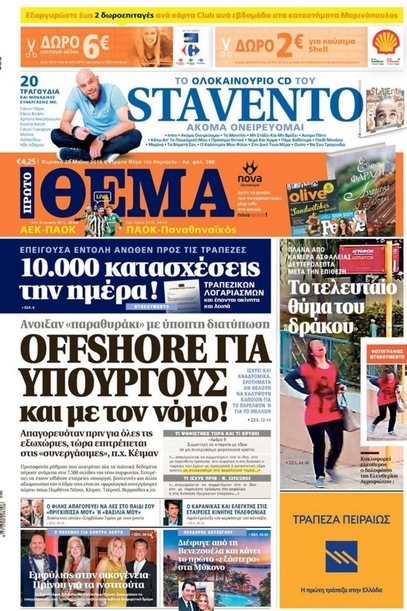
The revelation about the SYRIZA arrangement, on May 29, 2016
(III) And the sinful past
And just so we don’t forget! Surely we here at “Proto Thema” can’t forget, but I believe the story I’m about to tell you is also unforgettable for SYRIZA and the New Left. Let me take you back to the most painful bailout years. Sunday, May 22, 2016, and the then SYRIZA government passes through Parliament one of the harshest bailout omnibus bills. Among other things, it provided for the creation of the infamous Superfund. In the 7,500 pages of harsh fiscal measures, Article 178 “slipped in.” It had been written in such an elaborate way that no party understood what it introduced, resulting in no one protesting, no one denouncing it, and ultimately it being passed. We discovered it and revealed it the following Sunday, May 29. You will have noticed that this column doesn’t brag, but I must say this was one of the reports that caused a political earthquake, as the provision allowed for the first time ministers, MPs, general secretaries, and other officials to hold offshore companies in tax havens like the Cayman Islands, Jersey, Bermuda, etc. The clause retroactively amended the original 2003 law—which had stipulated a general prohibition on participation in offshore companies—granting absolution to those who perhaps had not been “legal” until then and were at risk of very severe penalties. Note, it liberated not only the relatives, but the political figures themselves. The then government, after initially trying to justify the unjustifiable, was eventually forced to withdraw the provision and introduce a new, stricter one, imposing a blanket ban on all from engaging in financial activities in any foreign country. And to end as I began, the new amendment attempts to partially reinstate the framework that was in effect from 2003 to 2016, and I say “partially” because it only frees the so-called related proxy persons and not the politicians themselves. As for why ND, as the government, took about six years to amend the provision, don’t ask me why because I (as well too) don’t have an answer either.
Storm within ND…
A little earlier, storm INES broke out within ND. I hear that on Thursday noon, while the Attic sky remained sunny, in the Senate chamber of Parliament—where ND MPs had gathered to be briefed by the leadership of the Ministry of Environment and Energy on zoning issues of small settlements—a stormy atmosphere prevailed. One after the other, MPs from the provinces and from all political stripes took the floor and protested the Presidential Decree that turns buildable plots into mere fields. I’m not referring only to the usual suspects like Giorgos Vlachos, Miltos Chrysomallis, and Babis Athanasiou who often publicly express their views on matters they believe are moving in the wrong direction, but also to beyond-all-suspicion members of the blue parliamentary group, like Spyros Kyriakis, Giorgos Kotsos, Giorgos Vrettakos, Kostas Kefalogiannis, and Lefteris Avgenakis, who “gave them a piece of their mind.” Among other things, they protested that the Presidential Decree “came at night during Easter,” “appeared suddenly,” and they all concluded by saying “we’re getting beaten up by the public. We’re getting more flak than we did over the same-sex issue.” Now, yesterday, Minister Papastavrou listened to the complaints, took notes, and stated that he would return to the matter. But to be fair, you can’t expect everyone to always be happy with government decisions.
Whom PASOK is targeting
Most likely today or by Monday at the latest, PASOK will present its proposal for the establishment of a Preliminary Investigation Committee regarding Kostas Ach. Karamanlis. I hear that PASOK’s proposal will, of course, not refer only to Karamanlis but will cover the entire political leadership of the ministry since 2019. This means it includes, among others, the current Minister of Climate Crisis and Civil Protection, Giannis Kefalogiannis, who for a period served as Deputy Minister of Transport in the first Mitsotakis government. This doesn’t mean that PASOK believes Kefalogiannis did something grave—he was simply a recipient of documents, based on their reasoning. There will also be reference to the Spirtzis period, although they say that the statute of limitations has likely been reached.
The ND-Karamanlis reaction
Both ND and former minister Kostas Ach. Karamanlis are waiting for the opposition parties to lay out their proposals and charges. They will respond afterward, likely following Mitsotakis’ return from the U.S. (next Wednesday), while insisting on the logic of misdemeanor-level prosecution. Some within the Maximos Mansion believe PASOK’s proposal could be referred to Parliament’s Advisory Council, but as I wrote earlier this week, I give that scenario very slim odds.
Messages to Rectors and meetings
The message sent by K.M to the rector of the University of Athens, Makis Siatos, via TikTok yesterday afternoon was no coincidence. The government has “locked onto” universities that are dysfunctional and is “pressuring” the rectors to do more in terms of safety mechanisms. Yesterday, for example, the Minister of Education, Sofia Zacharaki, met with the rector of the National Technical University of Athens, Giannis Chatzigeorgiou, who is also facing issues. It’s not just that the cafeterias are under occupation—it’s that time is running out for everyone, as the universities must submit their security plans by the end of July.
Fast-track procedures for land registry disputes between the State and citizens
Following the Tempi tragedy, the government had committed to promoting a legislative framework to ensure that the State would not exhaust all legal remedies against citizens or their relatives to counter claims arising from natural disasters and accidents. Ministers Pierrakakis and Floridis undertook the implementation of this initiative, and yesterday another step was taken in that direction with the aim of faster resolution of land registry disputes between the State and citizens. According to a provision passed yesterday in Parliament by the Ministry of Justice—in cooperation with the Ministry of Finance—the State, local government organizations, and public legal entities are now required to follow the Mediation procedure in case of a dispute with property owners, instead of filing mass legal appeals as has been the case until now. Under the new provision, before the lawsuit is heard, the parties are required to attend a mandatory initial Mediation session before a cadastral mediator registered in the special registry of the Ministry of Justice. The State will be represented in the process by legal advisors who will safeguard its interests by submitting all necessary documents. In the event of failure to provide the documents, it will be presumed that the State does not assert any rights, while the relevant public servant will be considered to have committed a specific offense, for which disciplinary penalties will be imposed. In this way, land registry disputes will be resolved in an out-of-court and reliable manner while also relieving the courts. The new framework will come into effect on September 16, 2025, to allow time for the involved persons and services to prepare.
A conference from Wood
Foreign analysts appeared more well-informed about Greek banks yesterday at Wood’s Greek Retreat 2025, which concludes today in Athens and in which 33 listed companies are participating. Regarding the banks, analysts particularly focused on loan portfolios. The banks responded to concerns about the impact of falling interest rates by saying they would cover the revenue gap through strong credit expansion. The questions centered mainly on which sectors the new loans will come from, how much RRF funding is being leveraged per sector, and there was persistent interest specifically in shipping loans, as the declining dollar has affected their yield. Beyond interest income, there were also several questions about dividends, the possibility of adjusting business plans for 2026 and 2027, and of course interest in acquisitions. From the meetings held, the conclusion is that lending is currently booming in energy, manufacturing, construction, tourism, and shipping.
SRB in Athens (are changes coming?)
A small delegation from the Single Resolution Board (SRB) of the European Central Bank is currently in Athens. The officials from Frankfurt (a German and a Czech) are visiting the management teams of the banks as well as the Bank of Greece. Truth be told, they are expressing great satisfaction with the compliance and outward-looking stance of Greek systemic banks, their stable and very good communication with the markets, and of course, the strong performance of their key figures. At the same time, however, they are voicing concerns about the broader supervision of the European banking system. It appears that Jerome Powell and Christine Lagarde are preparing a historic loosening of banking rules. The Trump administration is pushing, and the Fed is getting ready to drastically reduce capital requirements for banks. This would be the most significant change since the 2008 crisis. The European Central Bank seems to be following suit, as the €800 billion ReArmEU program and other European development initiatives—especially in the fields of technology and artificial intelligence—require abundant financing under more relaxed rules. European supervisors aren’t pleased when regulatory standards are eased. However, in Frankfurt they are even discussing securitization of assets rated below AAA. The goal is to channel substantial liquidity that will boost economic activity and competitiveness in the eurozone.
A tough Autumn ahead in telecommunications
“The OTE results are more boring than watching paint dry,” remarked an institutional investor, and the stock market seemed to agree, with a second consecutive drop (-0.99%) after the results announcement, settling at €16.93. At the moment, OTE resembles a limited “Greek play” trying not to lose market share. On the other hand, K. Nempis has launched major changes in the management team, replaced the Marketing Director, is changing the Communications department, and is preparing for a big push in the autumn—right when PPC and Vodafone are also set to begin aggressive campaigns, while NOVA and Orizon (from Volton) have already launched advertising efforts as the fourth mobile network operator. The battle in telecommunications begins this Fall.
Strange balances at the Port of Thessaloniki (OLTH)
All’s well that ends well? The stock market seemed to think so, with the share rising (+0.88%) to €34.3. But the details of yesterday’s general assembly suggest “maybe not.” For example, the main shareholder—the company of Ivan Savvidis—who increased his stake to 72.1% in an effort to counter the Swiss challenge from the Dreyfus family, did not vote in favor of approving the management’s performance, except for the auditors. In other words, he did not endorse the actions of the Liagos administration. However, he did approve the board’s remuneration (!). Meanwhile, the State’s representative voted against the extra compensation proposed by the board for itself. Today, the share goes ex-dividend with a €2 payout, but the saga of shareholder balances and the implementation of mandatory investments looks set to continue.
OPAP and the JP Morgan catalyst
Although OPAP’s stock was largely overlooked by analysts and top picks lists for 2025 (possibly because last year it delivered a meager 2.1% return), this year it has surprised on the upside, already up 28% since the start of the year. Its rally accelerated over the past month, with brokers attributing this to a recent JP Morgan report on European gaming, which placed OPAP on a positive catalyst watch list. Ahead of Q1 2025 results, to be announced on May 28, the investment bank raised its price target for the stock to €22.5, with the share already holding steady above €20. JP Morgan highlights the stability of OPAP’s business model, its resilience to macroeconomic pressures, and its consistent dividend policy. According to the report, OPAP is one of the most attractive defensive plays in European gaming, with strong fundamentals and limited exposure to regulatory risk. Analysts favor OPAP over Entain, Evoke, Evolution Gaming, Flutter Entertainment, and Lottomatica for three key reasons: strong organic growth and resilient revenue, a generous dividend model, and limited exposure to both regulatory and macroeconomic risks.
At the helm of ABB
Developments are moving fast regarding the new leadership at Aegean Baltic Bank (ABB), with a Greek executive already selected for the top role, as this column had previously reported. A shortlist of four candidates is in place, with Aristidis Vourakis, current CEO of AstroBank—which is soon to be acquired by Alpha Bank—leading the race. Vourakis previously spent 18 years at JP Morgan in London and three years as Deputy CEO at Audi Bank in Lebanon. As Head of Investment Banking for Financial Institutions across Central and Eastern Europe, Africa, and the Middle East at JP Morgan, Vourakis led successful deals across Europe and helped multiple issuers of Greek securities—including the Hellenic Republic—regain capital market access after the 2012 debt restructuring.
Qualco
Great success was recorded at yesterday’s party on the occasion of Qualco’s stock market debut. After ringing the opening bell of the stock exchange session, Chairman Orestis Tsakalotos and CEO Miltiadis Georgantzis saw the stock start calmly with a rise of +5.68%, it paused, then immediately rose +10%, paused again and finally closed with a rise of +12.09% at €6.12, with transactions totaling €14.8 million, blatantly ignoring the negative sign of the General Index. This showcased the good work done by the underwriters (UBS also represented PIMCO) in allocation and public subscriptions, leaving promise for a good course for the stock. Qualco announced yesterday that its share capital amounts to €70,029,804 and is divided into 70,029,804 common, registered, dematerialized voting shares, with a nominal value of €1 each. The market capitalization rose to €428.5 million on the first day of trading, a performance that placed it 38th on the capitalization board.
Alpha Bank at a 9-year high – +58% this year
Even though it paused its “chase” of the 1,800-point level and peaks not seen in 15 years, the Athens Stock Exchange hid some new records for stocks that either returned to an upward trajectory or continued unabated on their previous course. Alpha Bank hit a new 9-year high, trading above €2.57, recording the highest turnover on the board, over €32 million with volume exceeding 12.5 million shares. The bank is “running” this year at a pace above +58%, having reached €6 billion in terms of valuation. PPA (OLP) set “sail” for €46 for the first time ever. At the same time, Quest continued its explosive rally for a 9th consecutive day, reaching the peak of €7. New all-time record also for Kri Kri, which reached close to €17.5 at the day’s highs. Europe Holdings hit a 15+ year high, in the wake of the double acquisition, reaching €1.85 for the first time since January 2010, when the stock was trading as Kloukinas-Lappas. One of the notable events of yesterday’s session was the Sarantis stock. It started down again yesterday, as in the previous 5 sessions, reaching €13.48 (-1.75%), but at session close it impressively rebounded to €13.78 (+0.44%), at a market cap of €921 million. Today is a waiting-session ahead of FITCH and Derivatives.
The contenders at the Hellenic-American Chamber of Commerce
The elections at the Hellenic-American Chamber of Commerce are approaching and support from certain (European) chambers and businesses for the candidacy of Giannis Sarakakis is becoming noticeable. On the other hand, the will of top American and Greek players aiming to strengthen bilateral relations with the new Trump administration is also becoming clear—something seemingly offered by the experience and connections of the other presidential candidate and current Secretary General of the Chamber, Alexandros Kostopoulos. According to the bylaws of the Hellenic-American Chamber of Commerce, members coming to the polls will elect a 25-member Board of Directors, which in turn will elect the new president and the governing committee. So, we still have a way to go…
The bond market doesn’t believe Trump
The PotUS keeps issuing orders to lower dollar interest rates and reduce the cost of servicing the U.S. Public Debt, which has exceeded $1 trillion for fiscal year 2024 and has reached the same level as defense and Medicare spending. The bond market does not comply. The yield on the 30-year U.S. Treasury bond has returned to 5% and mortgage interest rates are back above 7%. Trump’s ambitious international trade deals, the official inflation figures which appear to be dropping while prices rise, create a general economic uncertainty that does not allow for a drop in bond interest rates. The promise that “soon everyone will cave and sign a deal on tariffs” is not enough to convince the market.
Ask me anything
Explore related questions