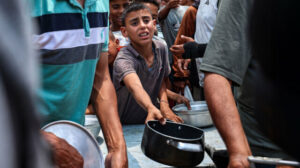
Survival for Palestinians living in the Gaza Strip has always been very difficult, but nearly 18 months of relentless Israeli bombings and the recent cutoff of humanitarian aid have brought the situation to a critical, potentially irreversible point.
If immediate—and especially uninterrupted—relief does not arrive for those living in Gaza, the survival of hundreds of thousands of people, primarily thousands of children, is now directly threatened.
Since October 7, 2023, the death toll in Gaza has reached 53,655—a number generally accepted, but likely lower than the real figure. Just today, over 80 people have died, including a one-week-old infant.
People wait for hours at food distribution points under harsh conditions, but many say they return home empty-handed.
In recent days, about 100 trucks with humanitarian aid have entered, but aid organizations say this is just a “drop in the ocean.”
Even the UN states that the amount of aid is insufficient and that “only a few trucks” have reached the residents. More urgently, the UN has warned that 14,000 babies risk dying in the coming days if emergency aid does not arrive immediately.
Officially, Israel says it will facilitate the provision of aid but will ensure it does not fall into the hands of Hamas—however, in practice, the latter obstructs or even nullifies the aid.
The Netanyahu government has blocked all aid entry into Gaza since March 2, arguing that sufficient humanitarian aid was provided during a six-week ceasefire and that Hamas was stealing the supplies.
The suffering of Palestinians in Gaza grows worse with the sense that aid is just out of reach. The UN Relief and Works Agency for Palestine Refugees (UNRWA), in a video posted recently, says it has “food for 200,000 people, medicine for 1.6 million, blankets, hygiene and other supplies” waiting for green light in Jordan to distribute.
And it’s not just food: hospital supplies are extremely limited, making even simple surgeries difficult—not to mention the many injuries caused by the ongoing fighting, many of which are severe.
A case in point is little Nivin, just seven months old. Born with a heart condition amidst the war, she underwent open-heart surgery in Jordan during the ceasefire. Jordanian authorities then sent her back to Gaza. Her mother wonders, “How can they send us back when the war continues?” She says her daughter “cannot keep living in a tent; she frequently has seizures and turns blue.”
Nasser Hospital, the largest remaining hospital in Gaza, may have to evacuate as it is just four blocks from the conflict zone. If that happens, “hundreds of patients will die,” since Al-Aqsa Hospital, which has similar capacity, is blockaded.
Meanwhile, voices inside Israel criticizing the government’s stance are growing louder. Former Prime Minister Ehud Olmert said what Israel is doing in Gaza “is very close to a war crime.” He described the ongoing Israel-Hamas war as “a pointless war, without the possibility of achieving anything that could save the hostages’ lives.”
Yet even this pressure is insufficient against Netanyahu’s government, which remains entrenched in its very hardline position.
Ask me anything
Explore related questions