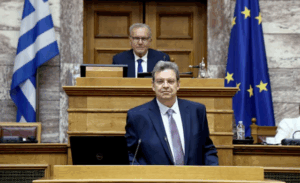
At a special meeting of the Standing Committee on Cultural Affairs of the Parliament, convened by the Chairman of the Committee, Samos MP, Professor Christodoulos Stephanadis, on “Greek Higher Education, present situation and prospects”, the President of the National Committee for Higher Education (NECE), Professor Pericles Mitkas (in the photo with President Chr. Stefanadis) , presented in detail with data on the country’s higher education, on the educational, post-educational and research work carried out and referred to prospects.
The Deputy Minister of Education, responsible for higher education, Nikos Papaioannou, presented the development of universities, the increase in funding, and the legislative interventions planned by the Ministry, regarding the better functioning of universities. Today, about 68,000 undergraduate students study at the country’s universities, and 1307 postgraduate programmes operate, of which the vast majority (97.70%) have international quality accreditation.
The majority of the total number of graduates have a high standard of quality.
In 16 Greek Universities, 188 foreign language postgraduate programmes operate in cooperation with foreign universities. It is also important that 7 Greek universities have applied to open undergraduate branches in foreign countries (e.g., the oldest Greek University, the EKPA, which was founded 188 years ago, intends to open a branch in Cyprus). Regarding the operation of foreign universities in our country, 12 applications have been submitted. The applications are examined by the NCHAE with strict criteria to ensure the quality of the education provided and to monitor the continuous control of the curriculum. The prospect is that, if accreditation is granted, some will be operational with the new academic year.
The future challenges of our higher education, relate to internationalization, the obligation of face-to-face education, the use of artificial intelligence, the demographic problem of the country (which also has an impact on the reduction of students), the interconnection with the labor market, and the orientation of research to the needs of Greece. Finally, as regards the operational issues of the HEIs, the government intends, in addition to increasing funding, to make corrective legislative interventions. During the special session of the Committee, the representatives of the political parties developed their views and positions and submitted questions to the Deputy Minister and the President of the NTHAE.
Ask me anything
Explore related questions