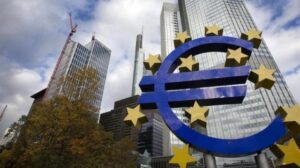
The European Central Bank (ECB) is close to another interest rate cut, as it meets on Thursday (5 June) and is likely to decide to further ease its monetary policy.
If, indeed, that happens, the deposit acceptance rate will be cut, for the eighth time, by 25 basis points to 2% from 4% last June.
For those with floating-rate euro loans, such a development will mean a new easing of their monthly payment as the euribor will also be pushed down.
Although relatively few ECB Governing Council members have spoken, directly or indirectly, ahead of Thursday’s meeting, most have pointed in the direction of a rate cut.
“I believe we will cut rates one more time in June and then I see a pause (at the July meeting),” Bank of Greece Governor Giannis Stournaras, said in an interview with Kathimerini.
In the same vein were statements by the central bankers of France, François Villeroy de Gallo, Finland, Oli Ren and Lithuania, Gedimina Simkus.
Villeroy said there has not yet been a normalization of ECB monetary policy and this will likely be seen at the upcoming meeting. Olli Ren noted that if the latest data and the central bank’s new quarterly forecasts, which will be presented on Thursday, confirm that inflation (which was running at an annual rate of 2.2% in April) is running low and that economic growth is sluggish, “the appropriate reaction in June would be to continue monetary easing and cut interest rates.”
Simkus believes it is certain that inflation will move below and below the central bank’s 2% target due to the appreciation of the euro, stressing that he therefore sees a significant chance of a rate cut. Indeed, he said he expects another cut this year, which could come in July or later.
On the other hand, two members of the ECB’s governing council came out against a rate cut: the Austrian Robert Holzmann, who is considered a hawk because of his stance on hard monetary policy, and the German, Isabel Schnabel, who is also among the hawks.
Holzman said there was “no reason to cut interest rates in June and July”, adding that a further cut would probably have no effect on growth, which is limping along because of uncertainty rather than tight monetary policy. Snabel noted that the ECB should keep interest rates steady because turmoil in the global economy could lead to further price increases and thus inflation in the medium term.
It should be noted that the two hawks were also against cutting rates at the April meeting, but their position was apparently in the minority.
It is also clear that most ECB officials do not share the fears of rising inflation, instead they believe it will fall to 2% this year and may then fall much lower than that level.
This majority position has been expressed in recent statements by both the ECB’s president, Christine Lagarde, and its chief economist, Philip Lane, who is the person responsible for recommending the central bank’s policies.
Lane said he was confident that inflation would fall, citing among other things the easing of wage increases, and said that as long as inflation continued to fall, interest rate cuts would continue. Interestingly, he hinted that interest rates could fall as low as 1.5%, saying that for them to fall below that level there would have to be very negative developments on the growth front, which is not currently on the horizon.
There are three key factors that are creating confidence among ECB officials, as well as analysts and investors, that inflation in the eurozone will continue to fall. All three are related to the US President’s tariff policy:
First, the appreciation of the euro against the dollar has lowered the cost of imports, particularly of raw materials priced in the U.S. currency.
Second, the significant decline in oil prices due to the slowdown in the global economy from the trade war.
Third, the decline in demand due to slowing growth.
Analysts take it for granted that growth will slow in the eurozone, as it will around the world and particularly in the US, even ifPresident Trump were to roll back the tariffs he has imposed.
And that’s why they think the ECB will cut rates in June and further to 1.75% this year, with Morgan Stanley seeing a bottom at 1.5%.
Ask me anything
Explore related questions