





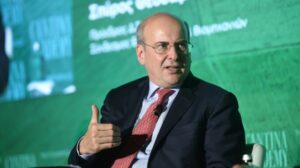
The need to draw up and implement a national plan for water management was underlined by the Vice Prime Minister of the Government, Kostis Hatzidakis, from the podium of the 2nd Cantina Academy, noting that Greece ranks 19th in the world in terms of vulnerability to water scarcity.
As he said, 80% of the country’s water resources end up in irrigation, which makes it imperative that integrated interventions, such as the construction of dams and the rationalization of networks, are needed. He stressed that this project is being developed and will be a strategic priority, especially for primary production.
Hatzidakis began his statement by pointing out that, despite the long-standing pathologies of the Greek production model, domestic food production manages to cover 80% to 90% of the needs of the population, both households and businesses, and tourism. If non-edible products such as cotton are added, the country’s trade balance in the agri-food sector has been positive for 4-5 years now. As he said, as of 2019, manufacturing activity in this sector has increased by 73%, while along with the pharmaceutical industry, agri-food businesses are “one of the surprises” of the Greek economy.
However, he noted that significant challenges remain, such as the small size of farms – among the lowest in the European Union – which negatively affects productivity. He stressed that the government is attempting to address these weaknesses through a policy based on four pillars: boosting the sector’s growth, protecting the environment, reducing the country’s dependence on imports and the social character of agri-food with an emphasis on youth participation.
Referring to the structural weaknesses of the sector, he stressed that the demographic ageing of the rural population is a serious problem, as, according to studies,the country will need 200,000 additional workers in the coming years. At the same time, he noted that the cooperative sector no longer shows the dynamics and size of the past, so that coordinated support actions, both institutional and financial, are needed.
The Deputy Prime Minister referred to the interventions that have been made, including tax incentives for farmers, a new institutional framework for PDO products, as well as tools to support investment projects with the use of European funds. He stressed, however, that “a lot needs to be done in a short period”, as – he said – Greece has more reasons than many other EU countries to invest in its agri-food sector.
On the issue of the management of the OPEKEPE, Hatzidakis said frankly that “it is not a history to boast about,” but recalled that the government abolished subsidies that should not have been given and promoted the absorption of the agency by the AADE. He also said that similar fiscal corrections were recorded in many EU member states, such as Italy, signalling that although not everything was done properly, there was political will to provide solutions.
On the need to cover the shortage of labour in the agricultural sector, he pointed out that the government is also trying to provide a solution through legal immigration. However, he acknowledged that the procedures involved are too complicated, with 39 stages and stakeholders, which he said must be changed. At the same time, he made it clear that Greece will not be turned into a “sealed vineyard”, as the control of illegal immigration will be strengthened, while emphasis will be placed on the education of domestic farmers.
Hatzidakis particularly focused on the issue of education, citing as an example the American Agricultural School in Thessaloniki, to underline the need to strengthen such initiatives. He said agriculture is a form of entrepreneurship and needs upgrading through knowledge, specialization and connection with the market.
He concluded by stressing the need for larger and more productive plots, renewal of the age profile of farmers, and strengthening cooperative schemes that operate using modern, dynamic methods. All these, he said, are linked to the critical issue of water, which the government now sees as an absolute priority for the future of Greek agriculture.
Ask me anything
Explore related questions




