





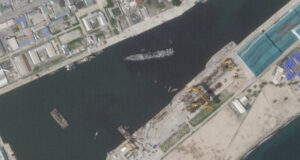
North Korea said it has managed to successfully refloat its new 5,000-ton destroyer, which was capsized during a failed launch last month, with state media reporting that the vessel will be taken to another shipyard for repairs.
According to KCNA, “after restoring the destroyer’s balance in early June, the team safely anchored it on Thursday afternoon”. Planet Labs’ satellite image from June 5 shows the ship upright and floating in the water, far from the site of the failed launch.
The destroyer, which is North Korea’s most modern warship, had been touted as the crowning achievement of the regime’s ambitious naval upgrade. However, on May 21, a malfunction in the launching mechanism led to the premature sinking of the stern, causing part of the hull to be destroyed, while the bow was left motionless on the shipyard ramp.
The state briefing at the time cited damage, but claimed it was not as severe as initially estimated. Kim Jong Un himself, who was in the city of Chongjin and witnessed the incident, reportedly called it a “criminal act”. The regime announced the arrest of four people as being responsible for the accident.
North Korea’s leader has ordered the immediate repair of the – still unnamed – ship, setting a deadline of late June, saying it was a matter of national honor.
“The next phase of detailed restoration will be carried out at the Rajin shipyard and will take 7 to 10 days,” KCNA reported. Central Committee Secretary Jo Chun Ryong, who is leading the restoration, promised “perfect repair” ahead of the Party meeting.
The speed of the operation impressed analysts, as most estimates said the recovery process would take at least a month. “It is with sincere admiration that I admit that a solution that I thought would take four to six weeks was accomplished in two,” said analyst Carl Schuster, a former U.S. Navy officer.
According to satellite images, the prototype method used involved aerostatic balloons attached to the ship’s hull to restore its balance.
Despite initial fears of severe deformation of the hull and keel, the damage turned out to be less than estimated. “The damage was clearly less severe than was feared,” Schuster said, adding that if there is similar mobilization for the internal repairs, the ship may be ready for sea trials sooner than originally anticipated.
Ask me anything
Explore related questions




