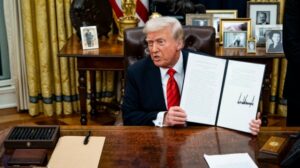
The ban on US entry for citizens of 12 countries went into effect this morning, Greece time, following an executive order signed last week by US President Donald Trump.
The decision — taken to “protect the United States from foreign terrorists and other national security threats,” as Trump said in his executive order — applies to citizens of Afghanistan, Myanmar, Chad, Congo-Brazzaville, Equatorial Guinea, Eritrea, Haiti, Iran, Libya, Somalia, Sudan and Yemen.
The U.S. government, which has a particularly strict immigration policy, explained that these countries were included on the list as they lack effective ways to ensure that proper screening of travelers is done, adding that their citizens tend to remain in the U.S. even after their visas expire.
The same order imposed visa restrictions on citizens of seven other countries: Burundi, Cuba, Laos, Laos, Sierra Leone, Togo, Turkmenistan, Togo and Venezuela.
Venezuela, Venezuela, Venezuela, Venezuela, Venezuela, Venezuela, Venezuela, Venezuela, Venezuela, Venezuela, Venezuela, Venezuela and Venezuela.
Trump compared the decision, announced on Wednesday, to “effective restrictions” he had imposed on citizens of seven predominantly Muslim countries, known by critics as the “Muslim ban”, early in his first term as US president in 2017.
Four countries are on both the 2017 list and this year’s list: Iran, Libya, Sudan and Yemen.
Yemen, Yemen, Yemen, Yemen, Yemen, Yemen, Yemen, Yemen, Yemen and Yemen.
“As president, I must act to protect the national security and national interest of the United States and its citizens,” Trump said in his executive order, adding that he wants “to protect the United States from foreign terrorists.”
The Republican cited the attack on Jews committed on June 1 in Colorado by an Egyptian whose visa had expired to illustrate “the extreme dangers of allowing foreign citizens who have not undergone proper vetting to enter the United States.”
The attack this one — with 12 wounded — targeted participants in a week-long march demanding the release of Israeli prisoners held in the Gaza Strip. Egypt, the shooter’s home country, was not on the list announced by Trump.
“We will not allow what happened in Europe to happen in America,” the US president said, referring to attacks committed by foreign nationals.
The ban is met with concern and confusion by many countries on Trump’s list.
UN High Commissioner for Human Rights Falker Turk expressed “concern regarding international law” because of the “very broad and general scope” of the ban.
Amnesty International denounced the decree as “discriminatory, racist and absolutely cruel.”
The African Union expressed “concern about the potential negative impact of such measures”, including on “diplomatic relations” with the countries involved.
One of the countries, Chad, announced that it was suspending visas for US citizens in retaliation.
“I know the pain caused by Trump’s cruel and xenophobic travel bans as my family has been hit hard,” Iranian-American Congresswoman Yasamin Ansari wrote on X yesterday (Sunday). “We will fight against this ban with all our might,” she added.
However, Trump’s ban provides exceptions for certain visa holders, diplomats and individuals whose travel to the US “serves the national interest.”
The January 2017 ban sparked protests at several major US airports.
Ask me anything
Explore related questions