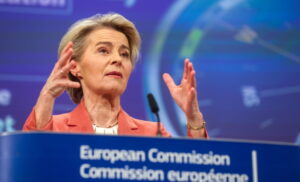
European Commission President Ursula von der Leyen, today, jointly with EU High Representative Kaya Kalas presented the Commission’s proposal for the 18th package of sanctions against Russia, which targets its energy and financial sectors.
The Commission president reiterated the EU’s call to Moscow for a “full and unconditional ceasefire of at least 30 days” in Ukraine. “Our message is very clear: this war must end. We need a real ceasefire and Russia must come to the negotiating table with a serious proposal.”
“We want peace for Ukraine, but despite weeks of diplomatic efforts, despite Ukrainian President Zelensky’s proposal for an unconditional ceasefire, Russia continues to bring death and destruction to Ukraine,” von der Leyen said, noting that “Russia does not want peace” but “to impose the law of force.” The EU will therefore step up the pressure because “power is the only language that Russia understands,” the Commission President added.
In particular, in the energy sector, the Commission for the first time proposes to launch a trading ban on the NorthStream I and II pipelines. “No EU operator will be able to engage directly or indirectly in any transaction concerning the NorthStream pipelines,” said von der Leyen.
In addition, the Commission proposes to lower the Russian oil price cap from $60 to $45 per barrel – an issue that von der Leyen said will be discussed at the G7 summit to be held in Canada at the end of the week.
In addition, the commission proposes to add to the list of already 342 tankers an additional 77 tankers belonging to Russia’s so-called “shadow fleet” that help it circumvent Western sanctions.
A ban on imports of refined products based on Russian crude oil is also proposed “to prevent some Russian crude oil from entering the EU market through the back door,” Ursula von der Leyen said.
In the banking sector, the EU’s aim is to limit Russia’s ability to raise funds and conduct transactions. The Commission is proposing that the existing ban on using the SWIFT system be converted into a full trading ban and applied to 22 other Russian banks. In addition, the Commission proposes to extend the trading ban to financial institutions in third countries that finance trade to Russia by circumventing the sanctions. It also proposes to impose sanctions on the Russian Direct Investment Fund, its subsidiaries and its investment projects. “In this way, an important channel for financing projects to modernize the Russian economy and strengthen its industrial base would be restricted,” von der Leyen said.
Finally, the Commission is proposing further export bans worth more than €2.5 billion. “This ban would deprive the Russian economy of critical technology and industrial goods,” said von der Leyen, stressing that the target sectors are machinery, metals, plastics and chemicals. It will also restrict the export of dual-use goods and technologies used to produce drones, missiles and other weapons systems to ensure that Russia does not find ways to modernize its weapons with European technologies.
Concluding, von der Leyen said that “we want sanctions to be better implemented and respected”, so the Commission proposes to broaden the scope of the trade ban that already exists to 22 Russian and foreign companies that provide direct or indirect support to Russia’s military and industrial complex. “Putin’s ability to continue the war largely depends on the support he receives from third countries. Those who support Russia’s war and its attempt to conquer Ukraine bear a great responsibility,” von der Leyen said.
Ask me anything
Explore related questions