





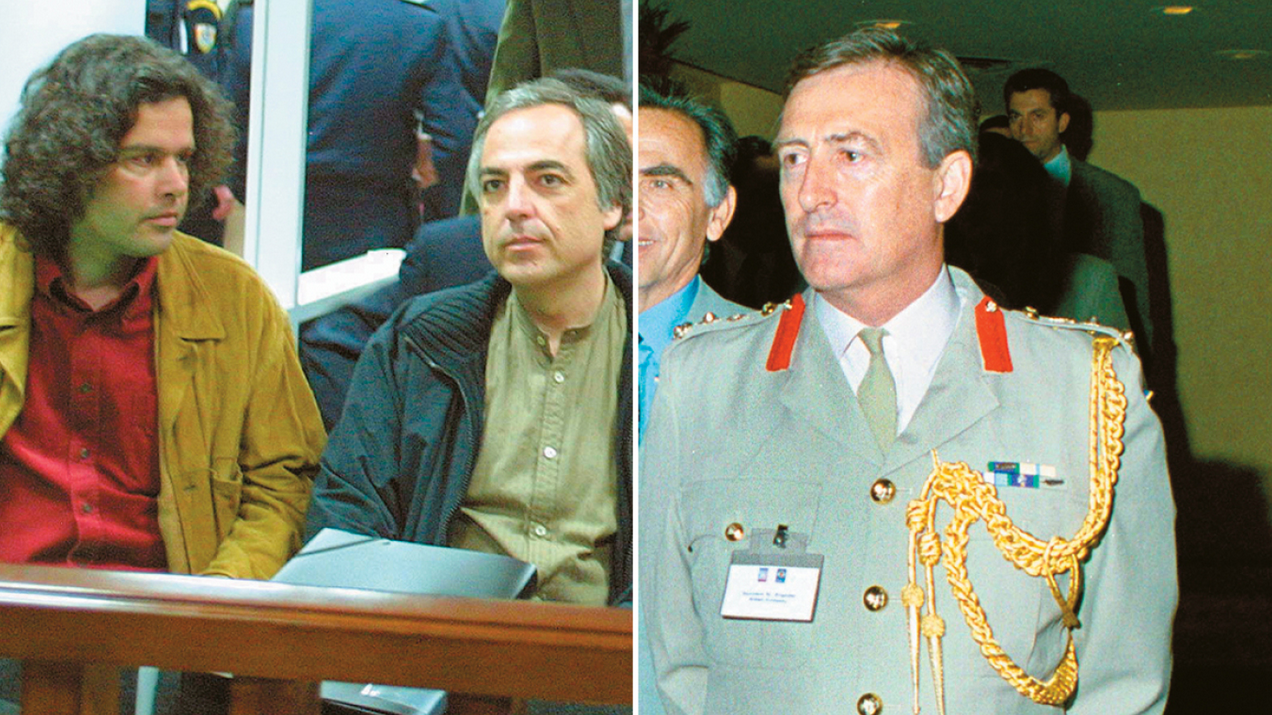
For the past 25 years, June 8 has been a day of anguish for the Saunders family.
More precisely, for those who remain from the family of the British military attaché in Athens, who on June 8, 2000, was cold-bloodedly executed by the terrorist-murderers of “November 17” (17N) on the southbound side of Kifisias Avenue, at the first traffic light in Filothei, during the morning rush-hour gridlock, in full view of many drivers and passengers in other vehicles.
It was 7:40 a.m. when 53-year-old Stephen Saunders reached the spot, having left Kifisia 40 minutes earlier, driving alone, without any security detail, in his white Rover vehicle.
The traffic light turned red. The car stopped. But it was a red light for his life. His tragic execution unfolded in mere seconds. A motorcycle carrying two people pulled up alongside the Rover on the passenger side. In just a few seconds, everything began and ended. The passenger on the motorcycle opened fire on Saunders with a G-3 rifle – which jammed.
Immediately, the driver of the motorcycle pulled out a revolver – which two years later was identified as a .45 caliber handgun, its whereabouts still unknown – and gunned down the British officer with chilling composure.
Panic and terror followed. The white car was soaked in the officer’s blood. Before the light even turned green, the two assassins had vanished. With four bullets in his abdomen and arms, the severely wounded Saunders was quickly rushed to “Red Cross” Hospital and taken to surgery, bleeding uncontrollably. Doctors could not save him. He succumbed during the operation. Later, “November 17” claimed responsibility for the execution. It was the last act of their “red” cycle.
Turning Point
However, June 8, 2000, proved to be a turning point in the authorities’ efforts to dismantle “November 17.” The choice of victim turned out to be catastrophic for the group, as it dramatically altered the investigative landscape. Then British Prime Minister Tony Blair demanded – and Greek Prime Minister Costas Simitis agreed – that British intelligence services be immediately involved in the investigation of 17N.
Almost immediately, agents from Scotland Yard and MI6 arrived in Athens, radically transforming the approach, tactics, and techniques used by the Greek Anti-Terrorism Unit. All 17N operations – assassinations, assassination attempts, robberies, bomb placements, the content of their manifestos, and the few but significant clues left behind in some attacks – were re-examined under a shared microscope. With the British perspective proving sharper and more penetrating, due to their decades of experience dealing with the IRA.
All of 17N’s attacks were reexamined in exhaustive detail, even aspects previously deemed entirely insignificant. The limited profiles of potential suspects were gradually enriched, witness statements were reassessed under broader criteria, and incidents where authorities were thought to have had close encounters with terrorists — but without concrete outcomes — were revisited. Such cases included the Louizis Riankour incident and the shootout in Sepolia.
Moreover, at the urging of the British, a concerted effort began to dismantle the supposedly “pro-people” image of terrorist organizations. Until a certain point — especially in their early years — by targeting junta-era police torturers who had escaped justice, 17N sought to lend moral legitimacy to their killings.
This led to a kind of tacit societal cover for the group, with some individuals who had knowledge of terrorist activities remaining silent, reluctant to speak to authorities. The British proposed — and the Greeks agreed — to initiate a public relations campaign against 17N, highlighting the human suffering of the victims’ families caused by their actions.
Witness “X”
The shift in public sentiment was also supported by the assertive approach of then Minister of Public Order Michalis Chrysochoidis. In his book “On the Same Road,” he recounts how this approach “pushed people who had once actively supported the terrorists to question their past beliefs and realize the whole endeavor, based on murder, led to a dead end.” He also revealed the emergence of a crucial informant — referred to as “X” — who, he says, “changed the course of history and led to the dismantling of 17N.”
This witness provided information about specific members of 17N, such as the man with the crippled hand — Pavlos Serifis — who had taken part in the murder of Welsh. More importantly, he revealed the mindset, political motives, and psychological profiles of the group, painting a picture of individuals already under suspicion by police.
As a result, Vassilis Tzortzatos was identified. He had been briefly detained in 1992 while surveilling U.S. military attaché McIntyre but was released due to lack of evidence. The informant also confirmed that the man known as “The Tall One,” believed to be the leader of 17N, was in fact Alexandros Giotopoulos.
Some insiders believe that even if Savvas Xiros had not been injured by the bomb he intended to plant at Hellas Flying Dolphins on June 29, 2002, the unraveling of 17N was already in motion. It was only a matter of time. The explosion simply accelerated what was already a foregone conclusion. By early 2002, a widespread rumor was circulating that arrests of terrorists were imminent.
A Chain of Fatal Mistakes
The decision to target Saunders was not 17N’s first mistake, but it proved to be pivotal. Though the operation was meticulously planned and executed with precision and cold-blooded efficiency, it later became clear the terrorists didn’t even know their victim’s identity. There was even doubt as to whether they had actually killed the intended target.
In court, Savvas Xiros described the horrific murder and added, “For this action, the organization issued a proclamation written beforehand by ‘Lambros’ (i.e., Giotopoulos), and typed by ‘Loukas’ (i.e., Koufontinas) on a computer. Since we didn’t know the victim’s name beforehand — we learned it from the news — ‘Loukas’ added it to the text.”
In the proclamation claiming responsibility, 17N accused Saunders of having a central role in NATO’s bombing campaign in Yugoslavia, claiming he had been stationed in Greece before the operations with specific responsibilities. In reality, Saunders had no involvement in NATO’s campaign in the former Yugoslavia.
A few days after most 17N members had been arrested, on July 24, 2002, The Times of London, citing Greek police sources, reported that one detainee had confessed that the real target of the June 8, 2000 attack was someone else.
It was an American officer with the same surname, who had in fact been involved in NATO’s aerial bombardment plans during the Kosovo campaign and was based in Aviano, Italy. He had visited Greece as part of a NATO planning team. Indicative of the terrorists’ confusion was the fact that in their proclamation, they referred to Brigadier Stephen Saunders as an “Air Force marshal,” when in fact he was an Army officer — specifically, an infantryman.
“We’ve Got November 17”
The final and most decisive mistake of 17N came on the night of Saturday, June 29, 2002. At 10:25 p.m., behind the ticket office of Hellas Flying Dolphins at the port of Piraeus, a 40-year-old man was severely injured when a bomb he was carrying exploded in his hands. That man was Savvas Xiros.
He was rushed to Evangelismos Hospital, critically wounded. Doctors managed to save his life. From that moment, the end of 17N was inevitable.
On a nearby bench, Savvas Xiros had left a backpack, inside which police found a .38 revolver. It was immediately taken to the forensic labs of the Hellenic Police. From its serial number — 100367 — officers confirmed it was the service revolver of police officer Christos Matis, who had been murdered in 1984 during a robbery at the National Bank branch in Petralona.
17N had never claimed responsibility for that murder. However, ballistic analysis revealed that this specific revolver had later been used in seven of the group’s deadly attacks. “We’ve got November 17,” was the phrase Police Chief Fotis Nasiakos said to his superior, Minister Michalis Chrysochoidis, shortly afterward.
Lingering Mysteries
The arrest of Savvas Xiros, however, was accompanied by bizarre circumstances that raised a series of questions — some of which remain unanswered to this day. That the bomb exploded in his hands was undoubtedly a catastrophic mistake, but it was within the realm of possibility.
What defied logic, though, was that Xiros had in his possession one of the group’s iconic murder weapons. Also found in his backpack was a large keyring containing dozens of keys, among them those for the safehouses on Patmou Street in Patissia and Damareos Street in Pangrati. Why was Xiros carrying items that would so clearly incriminate him — as they ultimately did?
Another enduring mystery is the fate of several emblematic objects from 17N’s history. When anti-terrorism officers raided the group’s hideouts, they found many weapons — including the G-3 rifle used in the Saunders killing — explosives, notes, proclamations, and even the 17N flag.
But they did not find:
– The historic .45-caliber pistol first used in the assassination of Richard Welch,
– The organization’s seal, or
– The first typewriter they used — which was known to be defective, as it didn’t print the full letter “P.”
These were never located, and no one knows what became of them. Additionally, it remains unclear whether some of the organization’s funds still exist, and if so, where they are hidden.
Are Members Still at Large?
Another unresolved issue is whether some members of the organization remain at large — and who they might be. A number of fingerprints collected from the two hideouts were never identified. Among them was one found in the Damareos safehouse that matched a print discovered in Alexandros Giotopoulos’s residence on the island of Leipsoi.
Moreover, two DNA samples from the hideouts — one male, one female — remain unclaimed by known suspects.
The identity of the woman involved in 17N’s first attack — the 1975 assassination of CIA Station Chief Richard Welch in Athens — also remains a mystery. In a recent interview with Proto Thema, former CIA officer John Kiriakou told journalist Dionysis Thanassoulas that he believes “there are still 4 or 5 members of 17N at large — almost all men, and at least one woman, the one involved in the Welch assassination. If she’s still alive, she would be around 75 years old today.”
Ask me anything
Explore related questions




