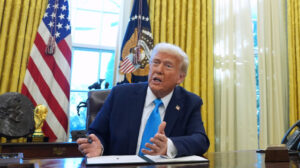
The hourglass is counting down to the two-week ultimatum issued to Tehran by the US president Donald Trump and White House, Brussels and Middle East are in full motion in the face of the possibility of direct involvement of US armed forces in a previously regional conflict.
Even if several analysts took Trump’s message to Iran as ambiguous, reading his possible dithering on the US “return” to the Middle East after its violent withdrawal from Afghanistan, nevertheless the presence of US firepower in the Eastern Mediterranean is now strong.
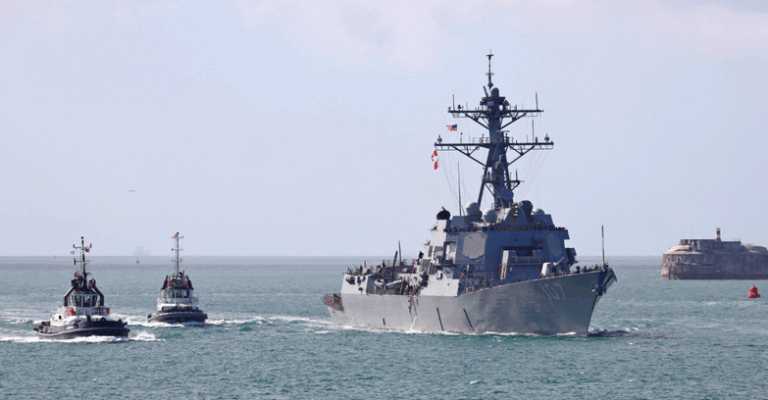
Already, three US Arleigh Burke-class destroyers, most ideally suited to provide anti-aircraft-anti-ballistic defence, are sailing in the region, while the carrier battle group USS Carl Vinson is already in the Arabian Sea.
At the same time, the battle group of the aircraft carrier USS Nimitz is transitioning from the western Pacific to the Middle East. In the meantime, flying tankers to refuel, fighter jets and transport planes are on full alert to assist Israel’s air defense.
The two scenarios
According to the assessments, there are two dominant scenarios in the event of direct US involvement in the conflict between Israel and Iran, which differ in the degree of US armed forces involvement in the operations.
The degree of involvement in the involvement of the United States in the military operations is different in terms of the degree of involvement in the military operations.
In a softer approach, tolerated also by the MAGA constituency that does not want large-scale involvement, the US armed forces would provide support to Israel’s operations, mainly at the air defense level.
In this case, US ships that have sailed to the Mediterranean will decisively assist Israeli forces to strengthen their anti-aircraft umbrella, but also by providing spare parts and ammunition for Israel’s warplanes.
Besides, the US has already moved its F-16, F-22, F-35 warplanes, as well as air refueling aircraft, to the region, and has also moved its bombers to its Indian Ocean base at Diego Garcia, which can carry the bombs to destroy nuclear infrastructure.
Although the US Secretary of Defense, Pete Hegsketh, said that the US goal is to strengthen its deterrent capability in the region, however the scenario of direct participation in military operations is still on the table, although President Trump appears “deeply cautious about the United States’ involvement in the conflict, according to CNN, fearing a rapid escalation of the conflict globally.
However, the need for the complete destruction of Iran’s nuclear infrastructure currently passes through the US military capabilities, which can completely destroy Iran’s nuclear facility at Fordo, which is buried in the mountain of the same name.
In this light, the US will be fully engaged in the conflict, possibly by dropping or delivering GBU-57A/B (Guided Bomb Unit) bombs.
Preemptive measures also at Souda
Between the two possibilities, the European leaders are attempting to settle the conflict diplomatically while taking preventive measures, especially in areas of Israeli interest, as France and Germany have already done.
In the same vein, the Pentagon is taking all precautionary measures around the country to protect facilities of military interest in case of a further escalation of the conflict, without excluding Souda from the list of sites of military interest.
Moreover, as Prime Minister Kyriakos Mitsotakis has made clear unequivocally and in all tones regarding the possible involvement of the Souda base in a Middle East conflict, this claim “has no basis”
“And I will not comment on military meetings in which the Armed Forces are considering various scenarios and are ready for any eventuality. I explicitly and categorically deny that such a thing is not seen and is not on the horizon,” he concluded.
Ask me anything
Explore related questions