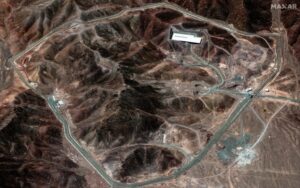
Hidden deep in a mountainside, the Fordo nuclear plant in Iran is still operating with hundreds of uranium-enriching centrifuges. Israel believes that the core of Iran’s nuclear weapons program is located there, although Tehran flatly denies that it is pursuing such a project.
The plant is protected by tons of rock and dirt, making it a difficult target for even modern airstrikes. However, after recent Israeli attacks that left parts of Iran’s air defenses in ruins, attention has turned back to the Fordo.
The only Iranian uranium plant near the bomb threshold
Fordo is one of the three key sites in Iran’s nuclear infrastructure, along with Natanz and Isfahan. It was built in secret in 2006 and officially announced in 2009. It currently hosts more than 1,000 centrifuges, and in 2023 uranium particles enriched to 83.7% purity were detected there – extremely close to the 90% required to make a nuclear bomb.
According to a Washington Post report in June 2024, Iran is further expanding Fordo, placing nearly 1,400 new centrifuges at the underground facility.
Will Israel attempt an attack on Fordo?
The destruction of Iran’s nuclear program is a long-standing strategic goal of Israel. As Dr. Alexander Bollfrass of the International Institute for Strategic Studies notes, “the really big piece remains at Fordo.” However, such a strike is considered extremely difficult operationally.
There is the possibility that the diplomatic route could be preferred before developments reach a military escalation, but Israel is keeping all options on the table.
The “bunker buster bombs” and the technical challenge
So-called “bunker busters” – bombs that penetrate the ground and explode at depth – are under consideration. Israel used them in the raid that killed Hassan Nasrallah in September 2024, but he was only 10-15 metres deep. Fordo, by contrast, is about 80 meters below the surface.
As Martin Sampson, a former Air Force officer, said, “it would require a huge number of aircraft and multiple strikes,” making the operation nearly unfeasible without U.S. assistance.
The US has the GBU-57 super-bomb, capable of penetrating deeper, but even that may not be sufficient with a single strike.
From sabotage to raid: Israel’s alternative scenarios
Israeli officials have hinted that they may act without the use of air strikes. Former Mossad director Zohar Pali said “we know how to handle situations on our own.”
Israel’s ambassador to the US, Yechiel Leiter, recently said his country has “a range of contingencies” for dealing with Fordo, suggesting possible special forces operations or electronic sabotage.
A similar operation is believed to have taken place in 2021 in Natanz, where a power outage was reportedly caused that destroyed thousands of centrifuges without directly affecting the facility.
Fordo at the heart of a dangerous equation
As tensions rise and Israel’s war machine remains on alert, Fordo is now a symbol of the technological advances and strategic challenge posed by Iran’s nuclear program. Its outcome may determine not only the fate of Iran’s centrifuges but also the balance of power in the entire Middle East.
Ask me anything
Explore related questions