





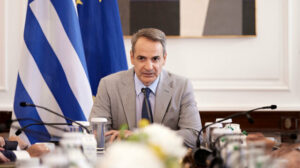
With the Middle East equation having more unknowns than known variables, Athens keeps a low profile, though concern is clear at the highest levels of government about the prospect of broader turmoil from a large-scale war. In any case, as Kyriakos Mitsotakis has stated, Greece will stay out of the frame, despite its strategic relationship with Israel and the NATO bases operating on Greek soil. Souda base, where refueling tankers have been stationed, appears to have been a key stopover point for refueling the B2 bombers that struck Iranian nuclear facilities with penetrating bombs.
The Greek government, following the European line, did not condemn the American strike on Iranian bases, although it avoided aligning fully with the position of complete support. In his Sunday message, Mitsotakis referred to the need to return to the diplomatic table.
In yesterday’s KYSEA (Government Council for Foreign Affairs and Defense) convened at Maximos Mansion, Chief of General Staff Dimitris Choupis provided a detailed briefing on the situation on the ground. The internal security situation was also assessed based on measures decided at the previous meeting ten days ago. Sources told protothema.gr that no worrying activity has been recorded according to intelligence services, though this does not permit complacency. A relief for the Greek authorities is that many Israeli tourists who had been “stranded” in Greece have found ways to return home. There was also discussion on the security status of critical infrastructure, like the aforementioned Souda base and other NATO bases in Greece, which are now heavily fortified.
The Hormuz puzzle
The toughest challenge relates to the status of Greek-flagged ships or Greek-owned ships sailing in the Strait of Hormuz area. Although Iran’s parliament decided on its closure, this has not yet been implemented, so no formal ban exists for ships transiting, apart from the increased risk. It’s clear that Iran brandishes the closure of the strait as a weapon, although the assessment is that any mining or blocking of the passage would also harm Iranian-owned tankers exporting oil to China and across Asia.
The situation in the area, according to Ministry of Shipping sources, is dynamic. Last night, 3 Greek-flagged ships were near the strait. Other ships in the vicinity had active charters requiring entry into the Persian Gulf, accepting the associated risks (the ships are insured regardless). In any case, the operations center of the Ministry of Shipping is in constant contact with vessels in the area, updating NOTAMs every six hours, and advising them to seek the safest possible port to minimize risks.
NATO meeting
With the “fire” in the Middle East overshadowing domestic political developments, it is certain that Mitsotakis will make an extensive reference to the situation in today’s meeting with President of the Republic Kostas Tasoulas. Meanwhile, Foreign Minister Giorgos Gerapetritis is in Brussels, participating in the emergency meeting of EU Foreign Ministers.
On Sunday noon, Mitsotakis departs for the NATO Summit in The Hague, where President Trump will also participate, with developments in the Middle East drastically changing the agenda of the discussion. So far, the main topic has been increasing defense spending to 5% of GDP over the coming years. According to NATO Secretary General Mark Rutte, the target consists of 3.5% purely on defense spending and 1.5% on security and defense-related investments, such as infrastructure, industry, and resilience. The initial timeline for meeting this commitment is 2035, though this is not yet finalized and will also be discussed by the leaders.
According to government sources, Greece agrees with the Secretary General’s proposal, as it already spends over 3% of GDP on defense and is part of the core group of NATO countries that have exceeded the current 2% of GDP commitment. Recently, the Prime Minister presented Greece’s 12-year defense procurement program worth €28 billion. In his intervention at the summit, Mitsotakis will stress that Greece, despite economic challenges, has consistently met its commitments and will highlight the urgent need for Europeans to invest more and more wisely in collective European defense and to shape a strong European defense pillar complementary to NATO.
Ask me anything
Explore related questions




