





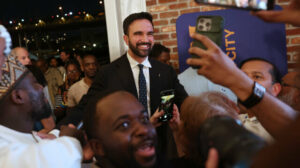
When Zochran Mamdani announced his candidacy for the mayor with the Democrats at New York, few believed that the young Muslim socialist from Uganda would manage to outshine former governor, Andrew Cuomo. A few weeks and a few hundred thousand votes later, Mamdani is officially the Democratic candidate for mayor of the most populous city in the U.S.
His victory in yesterday’s primary election marks a profound political and social breakthrough: it is the first time a Muslim of Indo-Ugandan descent has won a ticket to the mayoralty of New York City. What’s more, his victory comes at a time when Donald Trump is expanding his rhetoric against illegal immigrants, liberals and politicians associated with the left.
From Kampala to Queens
Mamdani was born in Uganda, grew up in New York and studied political science at Brown University. He is the son of internationally renowned filmmaker Mira Nair, known for films such as “Monsoon Wedding” and “Salaam Bombay!”, and intellectual Mahmoud Mamdani, an influential political scientist with work on colonialism and conflict in Africa. He grew up amid books, scripts and political debates that crossed continents, and carries in his baggage a life between three worlds: Africa, Asia, America.
Before being elected as a New York State Assemblyman in 2020, he worked as a housing counselor, helping tenants avoid evictions and foreclosures. At the same time, he was a rapper (!) under the stage name Mr. Cardamom, writing lyrics in Luganda (the most widely spoken language in Uganda) and English. This experiential politicisation, full of hip-hop, multiculturalism and social struggles, remains at the core of his ideology.
He is also…freshly married to Rama Dwazi, an artist and illustrator from Syria, whom he met through the Hinge app. They live together in Astoria.
The campaign that toppled Cuomo
Although Cuomo sought a political comeback after his forced retirement due to scandals, he failed to shake off the image of the “old system”. Mamdani, by contrast, bet on the younger people, the delivery workers, the residents of social housing, the immigrants who see New York not as a luxurious showcase but as a harsh everyday life.
His campaign was built from the ground up, involving thousands of volunteers and neighborhood assemblies. Under the slogan “Buses, Babies and Bread,” he proposed:
– Free public transportation for all
– Public daycare for all children under five
– State-run grocery stores with controlled prices on basic goods
One of the distinctive elements of his campaign is the use of food as symbolism. The slogan “Roti and Roses” (a variant of the famous “Bread and Roses” – meaning, essentially, “Food and Dignity”) sums up the need for material sufficiency and emotional care – with references from Indian cuisine to worker poetry.
Another Travesty, Another New York
The rise of Mamdani cannot be interpreted independently of the national context. While US President Donald Trump invests in fear, nationalism and conservation, a Muslim with roots in Uganda and India and a socialist agenda is claiming the “heart” of the American metropolis. The contradiction is acute and indicative of the profound social and political fracture in the US of 2025.
The 34-year-old politician, however, is not apologizing for his origins. Instead, he is projecting it: “I’m a Muslim, I’m an immigrant, I’m a child of New York. And this city deserves a mayor who knows what it means to live on the margins.”
The run-up to the November general election is expected to be explosive. Outgoing Mayor Eric Adams is reportedly considering running as an independent, while Republicans are backing conservative Curtis Slia. For Mamdani, however, the stakes have already gone beyond an election battle: it’s an entire generation’s attempt to bring politics back to the neighborhoods – from Astoria to the Bronx and from Harlem to Brooklyn.
Mamdani’s campaign is expected to focus on:
– Validating his political identity as a representative of the excluded
– On building coalitions with Latino, African-American and Asian communities
– And most importantly, in maintaining his authenticity – without distorting his message in fear of the general election.
As he stated at an internal meeting of his group: “We didn’t get here to compromise. We came here to win – and to change what power means in this city.”
Whether New York City is ready to trust its helm to a candidate who talks about “socialized housing” and “police without repression” remains to be seen. What is certain is that Mamdani is not just a new candidate-he is a political icon. And in the United States of 2025, symbols matter more than ever.
It still shocking for the American society the fact that in the city that suffered the most horrific Islamic terrorist attack of September 11th 2001, a Muslim is candidate for mayor with fairly good chances of winning too…
Ask me anything
Explore related questions




