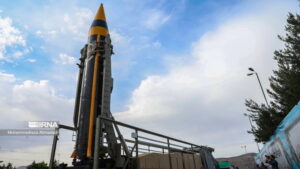
His name is almost unknown to the general public, but in military staff circles, it causes concern. It is the most powerful ballistic missile Iran has developed to date… The Khorramshahr is a weapon of massive power that was not activated during the 12-day war with Israel — and fortunately so. Because had it been used, the consequences could have shifted the geopolitical balance of the entire Middle East.
The Khorramshahr is one of the most advanced weapons in Iran’s missile arsenal. The latest version, the Khorramshahr-4, is named “Kheibar” — a symbolic title referencing a historic Islamic battle, reinforcing Tehran’s ideological and strategic narrative.
The missile features:
A range of up to 2,000 kilometers, enabling it to strike targets across the Eastern Mediterranean, the Persian Gulf, and Central Asia.
A high-precision delivery system with radar evasion technology and terminal phase maneuvering capabilities.
A warhead weighing up to 1,500 kilograms, either conventional or — potentially in the future — nuclear, if Iran’s nuclear program evolves into a militarized form.
High-thrust liquid fuel, allowing for rapid acceleration and quick response to warnings.
The Khorramshahr was not used during the 12-day war with Israel. Analysts believe this decision was not due to technical limitations but rather political calculation. Its non-use signals strategic restraint — perhaps to preserve it as a deterrent, or because Iran wished to avoid a full-scale confrontation with the United States and its allies.
The fact that this weapon remains in storage, at a secret location, only heightens uncertainty about the future. It is Tehran’s “untouched trump card,” kept in a state of readiness. And every time tensions rise in the region, it resurfaces in international analyses as a potential tool of “final warning.”
Ask me anything
Explore related questions