





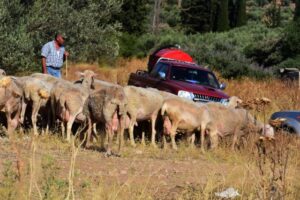
Last year around this time, sheep pox crossed the country’s borders for the first time. The result was the destruction of a large part of the country’s livestock industry in productive regions such as Thessaly, Evros, and areas of the Peloponnese. Entire regions were quarantined for a long time. Special measures were imposed prohibiting slaughtering. In these areas, thousands of sheep and goats were culled and buried in the hope of eradicating the disease.
The zoonosis subsided in the following months, but the damage to the country’s livestock sector was done. Almost 10 months after the first outbreak of sheep pox, the country is now experiencing a second wave of the disease which, according to data, in many cases affects the same regions again. For example, Magnesia, which is once again under quarantine with measures in place, has recorded several new cases in Kanalia and surrounding areas. Similarly, in the Larissa region, which is also quarantined, the disease has reappeared in areas of the Tempi municipality.
The data presented about a week ago in Parliament by the responsible minister Kostas Tsiaras reflects the situation. According to the data, the “red” zones are Aetolia-Acarnania Regional Unit (23 cases), Larissa Regional Unit (12 cases), Magnesia Regional Unit (23 cases), Xanthi Regional Unit (36 cases), Phocis Regional Unit (45 cases), and Chalkidiki Regional Unit (13 cases). Additionally, cases have appeared in Evros, Evia, Heraklion, Thessaloniki, Kavala, and Rhodope. Mapping these cases shows that the situation has not changed much from what the livestock sector experienced in August 2024.
What caused the new wave of sheep pox that is again leading to the culling of thousands of animals
Deficiencies and omissions sustained the virus in the environment
With the help of Professor of Veterinary Medicine at Aristotle University of Thessaloniki Giorgos Arsenos, we try to explain why the disease reappeared. According to the professor, the surprise is not that there is a second wave, but what causes curiosity and requires investigation is the intensity and extent of the spread.
He mentions that deficiencies and omissions, mainly from measures announced but not adequately implemented by all parties, sustained the virus, resulting in the reappearance of sheep pox. He especially points to understaffing in veterinary services and stresses that vaccination of animals is not the solution because “sheep pox will also become endemic throughout the country with consequences that will affect livestock farmers.”
See in detail Professor Giorgos Arsenos’s statement to protothema.gr:
“The return of sheep pox in various parts of the country is not surprising, considering that the disease usually appears in two waves, as is known to older, experienced but now fewer veterinarians of the regional veterinary services. What is surprising is the intensity and spread of the disease’s reappearance, and the issue is to investigate the causes and possible mistakes or omissions made.
Today, with the new cases being continuously announced, there is an impression that control has been lost and the situation is becoming uncontrollable. This is a wrong approach. We observe that there is updating of restrictive measures and almost daily announcements for prevention and biosecurity measures. The question that arises is which factors hinder the implementation of the above and make them ineffective. The answer is probably simple. The measures are announced but are poorly implemented without horizontal application of biosecurity measures. Moreover, the veterinary services are understaffed and lack the logistical infrastructure and support from the Ministry of Rural Development and Food for effective monitoring of farms and controls on animal movements within the country and imports, so that timely detection of suspicious animals and taking of the prescribed actions is achieved. A significant role also lies with livestock farmers, who must maintain close cooperation with veterinary services to promptly detect suspicious cases—a fact that was probably not the norm in the previous period and where there may have been foci where culling and disinfections were not done properly, and with the help of weather conditions, the virus survived in the environment or on farm equipment.
The case of sheep pox, like other epizootics in the country, did not receive the proper attention and there was no coordination through a realistic and implementable emergency plan. Theoretically, a relevant committee of experts was formed, but it never convened. There was no substantial risk analysis or epidemiological investigation communicated to the country’s scientific community so that with transparency and access to available information by all stakeholders, an objective evaluation of the situation could be made. This is especially important considering the ‘proposals,’ ‘opinions,’ and ‘recommendations’ made by domestic and European ‘experts’ for ‘targeted vaccination and creation of zones.’
Our opinion is that the implementation of vaccination initially in zones with disease outbreaks will certainly be followed by vaccination of the entire livestock population of the country. It is noteworthy that similar opinions were expressed decades ago regarding brucellosis. Then vaccination was proposed as an emergency solution and of course led to ‘national brucellosis control programs’ that have had no results to date. Our opinion is that the same will happen if vaccination is decided for the prevention and control of sheep pox. Sheep pox will also become endemic throughout the country with consequences that will affect livestock farmers and businesses exporting feta cheese to third countries. Therefore, the solution is one: cooperation of all stakeholders in the milk and meat value chain for identification of suspicious animals and taking of the prescribed actions.”
Ask me anything
Explore related questions




