Angela Merkel discusses the 2015 crisis, Greece’s place in the Eurozone, and today’s European challenges
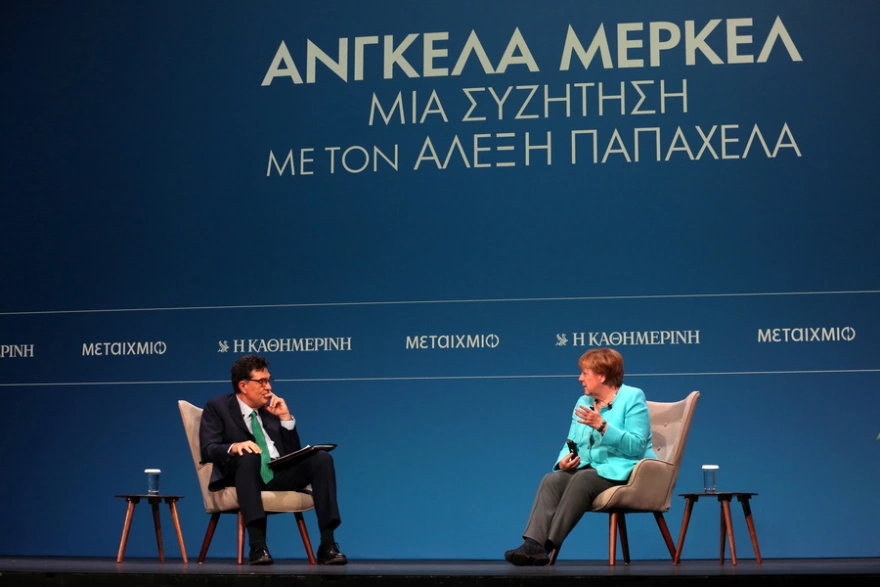
Former German Chancellor Angela Merkel is currently speaking at the Stavros Niarchos Foundation Cultural Center (SNFCC) in a conversation with Kathimerini’s editor-in-chief, Alexis Papachelas, addressing the 2015 crisis, Greece’s position in the Eurozone, and the challenges Europe faces today.
“In February 2010, it became clear that the problem was indeed serious. I was told that Greece needed money,” said Merkel. She added that, due to the euro’s “no bailout clause,” “I could not just hand over money.”
She recalled asking then-Prime Minister Giorgios Papandreou, “What do you want?” he responded with a rather reserved position. Throughout the session, Papandreou adopted a discreet posture, as Merkel’s explanation of her inability to extend financial help prompted an exchange of views. European Council President Herman Van Rompuy interrupted the session to draft a short statement: Greece would take necessary measures, Europe would offer support, and the euro was a shared currency.
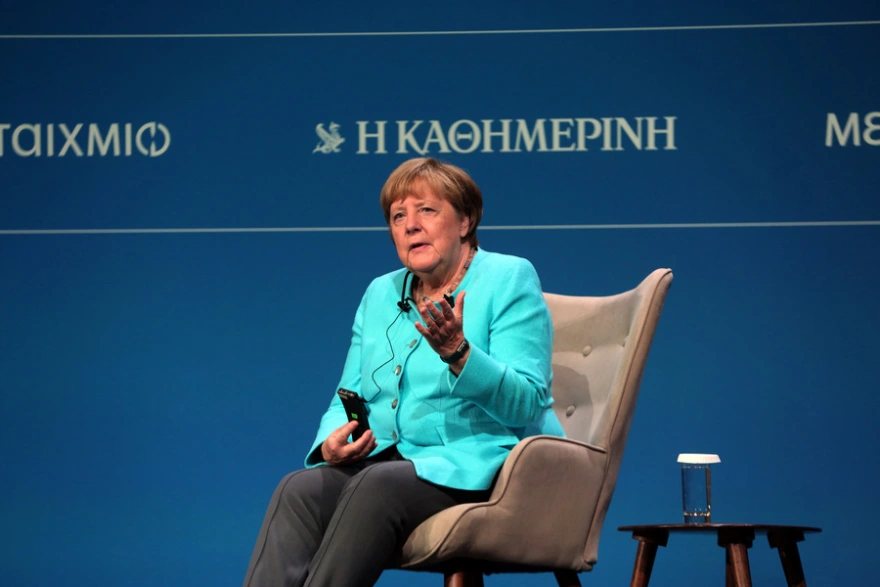
“I decided in 2011 that everything possible had to be done to keep Greece in the eurozone,” Merkel noted, acknowledging the extreme difficulty of negotiations, especially after Alexis Tsipras’s referendum.
“Knowing that [Finance Minister] Wolfgang Schäuble wanted Greece out of the euro, I called him constantly to update him on the situation—I wanted those decisions to be made jointly,” she said.
Referring to Antonis Samaras, she added: “I was the bad cop at the time—not out of hostility, but because I believed the country needed to get on the right track.”
“We were political and party allies, but we often had opposing views. I stood by Samaras because I believed a debt haircut was necessary, as did Schäuble. But [ECB President] Mario Draghi said that such a move would shake the financial world’s trust in the eurozone.”
Merkel concluded: “I believed Greece needed relief from that burden, but the other side also had valid arguments.”
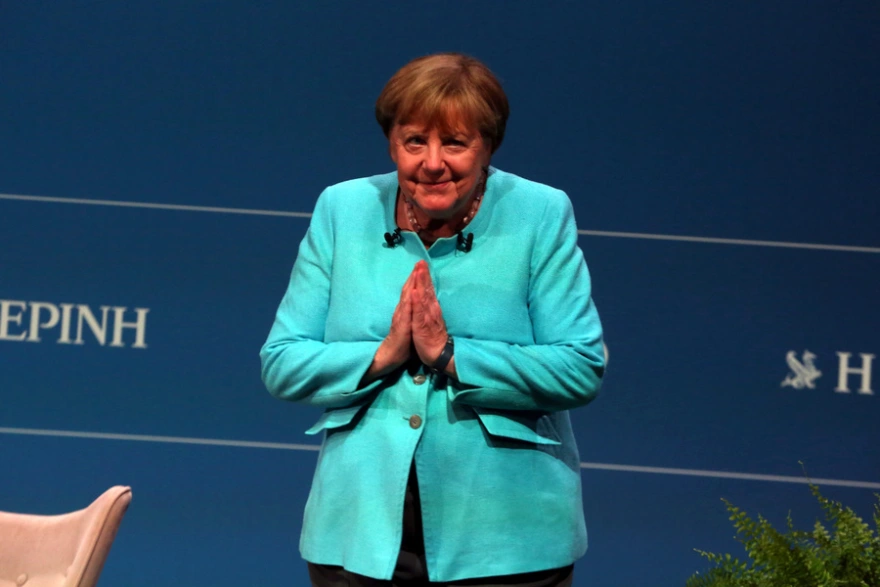
Merkel: When I saw Tsipras, I thought, “God help us.”
Referring to her first impressions of Alexis Tsipras, Angela Merkel said:
“I don’t think our first meeting was particularly remarkable, as it was in Brussels. Later, I invited him to Berlin, where the atmosphere was tense. He attended a demonstration outside the Chancellery and greeted his party comrades… I thought to myself, ‘God help us!’”
“We hoped he would come around eventually. He did, and as we walked past the honor guard, I told him, ‘That was bold.’ He replied that one must stay close to their supporters.”
“We gradually got to know each other better. He viewed privatizations as something evil — it wasn’t easy.”
The 17-hour negotiation
“I didn’t want Greece to leave the euro, and he (Tsipras) didn’t want a bailout. It was the most unexpected and one of the quietest phone calls of my political career,” Merkel said, recalling how Tsipras informed her of the planned referendum.
Earlier that day, Tsipras had refused to agree to the creditors’ terms. Merkel asked him what he intended to do. He replied, “I’ll return to my country and speak with my government and party.”
“And what will be the outcome?” Merkel asked.
“I don’t know,” Tsipras answered.
That conversation led to the decision to hold a referendum in Athens.
“And what is your recommendation?” Merkel asked.
“Of course, ‘No,’” Tsipras responded.
“That’s when I lost my voice,” Merkel recalled.
The phone call ended quickly. Hollande asked, “And now?” We agreed that a “No” would mean Greece was exiting the euro. Greece had not agreed to the terms, and we maintained that one democracy cannot decide for all others.
After the Referendum
Merkel later reflected on what followed, reiterating her appreciation for the professionalism of the Greek negotiation team that finalized the third bailout agreement.
“I was impressed by how the Greeks endured with only 60 euros a day. I wondered whether the Germans could have withstood that.”
“I cried under the pressure”
“President Obama didn’t fully understand the legal framework or the ECB’s mandate — the Federal Reserve has different responsibilities. He didn’t know all the details. At one point, I cried — I was under immense pressure.”
“He wanted us to tell the ECB to provide more liquidity. But my advisors insisted I couldn’t do that — it wouldn’t be legally acceptable in Germany. I explained this to Obama.”
“Draghi, as ECB President, launched the ‘bazooka’ and said, ‘whatever it takes.’ He did that on his own initiative.”
The Migration Crisis – “The situation in Greece was dramatic”
“Ten thousand new refugees were arriving in Greece daily. Something had to be done.”
“We could have stopped them in Austria or Germany, but that wasn’t enough. That’s why I supported the EU-Turkey plan. The situation in Greece was dire. Turkey was doing nothing.”
“95% of the refugees weren’t entering the EU legally. In exchange, Turkey received funding. It was a period of enormous pressure.”
“I was invited to Istanbul. The palace was impressive — especially the chairs — but something had to be done. Politics is realpolitik. I had to speak with Erdoğan.”
“I’m pleased that the EU has since moved forward and created a common asylum system. Those not granted asylum must return to their countries. Fighting traffickers is a necessary goal.”
Crisis with Turkey
“We must always talk with our neighbors. Especially with maritime borders — Frontex alone cannot protect them.”
“Was a Greek-Turkish conflict averted? There were many tensions. We often tried to mediate.”
“In these talks, I understood how hard it was to find common ground. At times, relations between Greece and Turkey were very confrontational.”
“I tried to contribute, but success can only come in small steps.”
Putin, the USSR, and the War in Ukraine
“For Putin, the collapse of the Soviet Union was the greatest catastrophe of the 20th century. I told him that for me, it was the happiest moment of my life. Our perspectives were completely different.”
“Putin still believes Russia should dominate countries like Ukraine and Belarus. From the perspective of international law, what he did in February 2022 violated every legal principle.”
“Together with Sarkozy, I opposed NATO’s expansion to Ukraine and Georgia — in Bucharest, in 2008.”
“Russia won’t disappear from the map. It remains the world’s largest nuclear power. I can’t ignore that.”
“We wanted a partnership with Russia and made that effort. But with the invasion in February 2022, a new era began.”
“I have no contact with Putin now. We always had major differences, but after Crimea, he lied to me once or twice — that changed our relationship.”
On Trump: “For him, everything is a deal”
“Trump was elected by the American people — we must deal with that. We Europeans must not underestimate ourselves — we are also a force.”
“For him, everything is a deal. But the world doesn’t work like that.”
“It was extremely difficult to reach agreements with Trump. That’s not good news — I’m convinced of it.”
“He always said something to draw attention. I made the mistake of suggesting we shake hands — and he didn’t. He was always trying to dominate the spotlight.”
Merkel: I was amazed the Greeks endured on 60 euros — Germans would not have lasted
Asked what she would say to the average Greek citizen today, Merkel replied:
“I wouldn’t apologize. I’ve explained my motives. I would say: we achieved a lot. I can’t imagine the EU without Greece.”
“I was truly impressed — especially during the hardest time, around the referendum, when people could only withdraw 60 euros a day. I said to myself: the Germans couldn’t have handled that.”
Ask me anything
Explore related questions