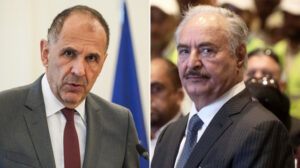
The Greek Minister of Foreign Affairs, Giorgos Gerapetritis, held a one-hour meeting on Sunday afternoon with General Khalifa Haftar in Benghazi, Libya. Present at the meeting were two of Haftar’s sons, Saddam and Al Sadiq. The former is a lieutenant general of ground forces, while the latter is involved in political affairs.
After the one-on-one meeting, the Greek Foreign Minister also met with another of the general’s sons, Belkacem Haftar, who is responsible for the economic sector and investments.
In a statement following the meetings, Mr. Gerapetritis said: “With the leader of Eastern Libya and members of his family in institutional roles, we discussed migration, maritime zones, and bilateral cooperation.”
The Greek Foreign Minister emphasized: “Greece and Libya share common historical traditions, a commitment to international law, and a vision of a prosperous Mediterranean.”
“We will continue our unbroken relationship and hope in the near future to achieve tangible results in advancing our bilateral ties,” Gerapetritis concluded.
At the beginning of the meeting with Khalifa Haftar, the Foreign Minister conveyed a message from the Greek Prime Minister, Kyriakos Mitsotakis, stating: “The bonds remain fraternal, geography unites us, our cultural ties go back to antiquity, and our aim is to further develop these relations.”
It is noted that Belkacem Haftar is in charge of Libya’s reconstruction and rebuilding efforts, and he extended an invitation to Greek companies to participate in this plan.
The commander of the Libyan National Army (LNA), who holds dual Libyan and American citizenship, is the strongman of Eastern Libya. Once a pariah to the international community, he has now become a dialogue partner of the Americans, Europeans, Russians, and, notably, the Turks, successfully navigating a diplomatic balancing act to secure strategic returns.
As previously reported by protothema.gr, with this visit Athens is reestablishing the thread of Greek-Libyan relations, in an effort to prevent new faits accomplis within the context of the Turkey-Libya memorandum and to manage migration flows, all while the internal situation in the North African country remains highly volatile and dangerous.
Ask me anything
Explore related questions