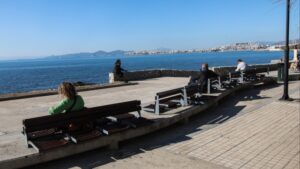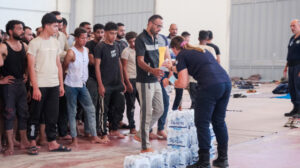
The problem of the flows of illegal migrants from Libya to Crete is becoming a difficult equation, as the island is suffocating, bringing the local community, the local government and the relevant authorities and ministries to the limits of endurance. The numbers are frightening since in just two 24-hour periods arrivals exceeded 1,600 (996 on Sunday and 650 on Monday).
At the same time, the problem appears to be complex and beyond the scope of Greece-Libya bilateral relations, as both smuggling rings, the situation on the Egyptian-Libyan border and the war-torn Sudan are involved in the equation.
Local communities are being suffocated
The Ministry of Immigration and Asylum, which does not have the responsibility of guarding borders but managing the flows with procedures such as asylum application processing and allocation to structures, is looking for the right formula in the logistics of distributing the arrivals; the numbers, however, make the situation difficult. Speaking to protothema.gr Rethymnon Mayor George Marinakis yesterday made it clear that the local government has exceeded its limits and cannot manage the situation. It is noted that in the centre of Rethymnon alone there are more than 450 illegal immigrants who are waiting to be transferred to the Malakasa facility.
The circuits are getting richer, running to catch up
According to competent sources, the circuits of smugglers are following a double tactic. On the one hand, as THEMA has already described, they use large and old caravans in which they cram hundreds of people, hence the large numbers of arrivals. At the same time, seeing the political processes, they seem to want to “catch up” with the developments and send as many of those they have “imprisoned” in their warehouses as possible.
At the same time, it is important to note that the difficulty in getting local authorities in the Libyan hinterland to cooperate is great, since the money being moved by the smuggling rings is staggering. According to reports, the “tariff” is estimated at 3,000 to 5,000 or even 7,000 euros for each illegal immigrant to go to Europe (many of them do not even know they are sailing to Greece). Thus, at a rough calculation, the almost 9,000 illegal immigrants who have arrived in Greece since the beginning of the year have brought in more than 45 million euros to these circuits.
In Libya, Thanos Plevris
However, bilateral contacts with Libya are intensifying in an attempt to find a political formula to manage the issue.
Philippines are now working on a political solution to the problem.
On Sunday, Foreign Minister Georgos Gerapetritis was in eastern Libya, which is controlled by Khalifa Haftar, and met with the marshal and discussed all issues, from migration to the Turcolibian memorandum.
Today another Greek delegation will be in the North African country, but the discussion will focus on migration. The Greek Minister for Migration and Asylum, Thanos Plevris, will visit eastern Libya, accompanying the European Commissioner for Migration and Home Affairs, Magnus Bruner. The mission will also include the Interior Ministers of Italy and Malta. The aim is to strengthen diplomatic cooperation with the Libyan authorities to stem the flow of migrants to Europe and to seek common European solutions.
According to sources at the Ministry of Migration and Asylum, Thanos Pleyris is travelling to Tripoli and Benghazi to examine possibilities for effective cooperation with local authorities in terms of preventing departures.
At the same time, the Libyan side is reportedly looking forward to the mission as it is an important visit for them, as it is the first time a European official is going to the country after many years.
According to competent sources, the Greek side has no illusions about Libya’s intentions since there is a great interest in the influx of European funds to support Libya in infrastructure. At the same time, the Europeans are discussing the scenario of an asylum processing center in Libya, so that the sorting would be done there and only the legal ones would come to Europe. This discussion is not easy, as the Libyans are under pressure mainly from Sudan and other African countries.
However, the pressure on Libya is great as there is a problem in guarding the border with Sudan, from which people are coming in waves to escape the war conflicts. Similarly, there is a big problem at the Egyptian-Libyan border, with the cooperation between the two countries not being the best in terms of crossings from Egypt.
In this context, as much as there is concern about the number of Sudanese, reportedly almost two million people have already arrived in Libya who would potentially like to be in Europe, the reality of the numbers is far from the truth. As THEMA wrote last Sunday, 70% of those arriving are Egyptians, with the remaining 30% being mostly citizens of Pakistan and Bangladesh and far fewer from Sudan.
If those arriving from war-torn Sudan are excluded, 98% of the remainder do not have what is called a “refugee profile”, with Egypt, Pakistan and Bangladesh included in the list of safe countries for Greece.
Although asylum applications are examined individually, data so far show that in these cases, 98% of applications are rejected, with the natural consequence of starting deportation procedures.
Ask me anything
Explore related questions