






To the question, “Would you agree with the withdrawal of medical support for a patient in a deep coma with no chance of recovery?”, 6 out of 10 Greeks answer “yes,” thereby consenting to the deliberate, artificial ending of the life of someone so gravely ill that they are considered more dead than alive.
This indicates, albeit schematically, that modern Greek society exhibits a strong tendency toward acceptance and support of so-called “passive euthanasia,” interpreting this ultimate and irreversible act as one of solidarity and compassion.
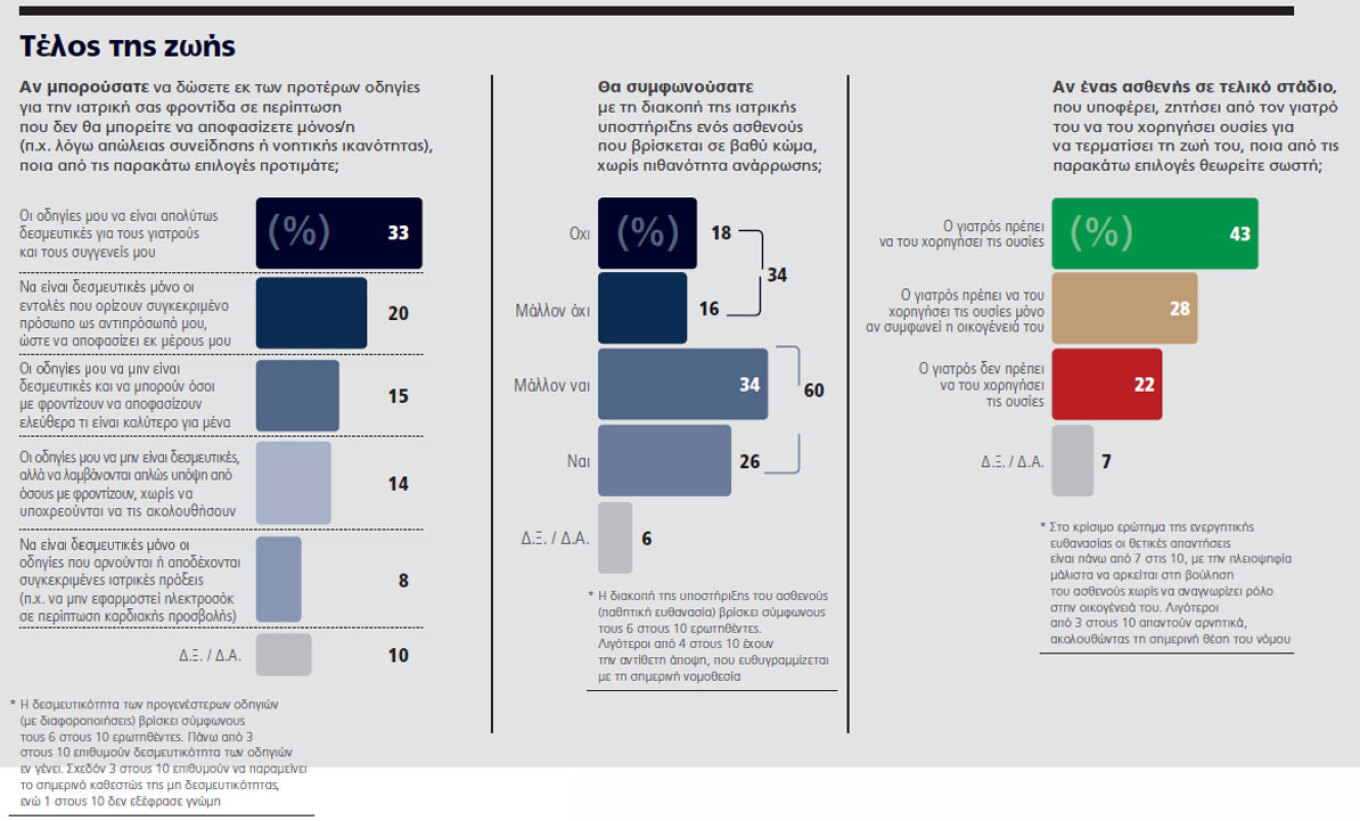
This highly significant finding emerges, among others, from the first systematic and comprehensive survey conducted by the National Commission for Bioethics and Technoethics (NCBT). One could say the timing could not be more appropriate, given the recent resurgence of public debate on the issue of euthanasia.
This was prompted by a tragic and controversial incident on May 31st in Crete, when an 87-year-old man shot and killed his wife in her hospital room at Rethymno General Hospital. Immediately after killing his lifelong partner, the elderly man turned the gun on himself.
What deepens the tragedy infinitely is the motive behind the murder-suicide: in a final note, the man explained that he intended to free his wife from her suffering. Thus, in the shadow of a violent double crime—a cold-blooded murder and a suicide—committed out of desperation and love, Greek public opinion expresses its views on euthanasia.
And as indicated by the related questions in the NCBT’s survey, the majority of Greeks do not condemn—on the contrary, they accept—the deliberate ending of a human life when, from a medical standpoint, all meaning and hope of prolongation have been lost.
The NCBT Survey and Public Opinion
The NCBT survey on current attitudes and perceptions concerning major bioethical and technoethical issues in contemporary Greece, particularly on the matter of life termination, concludes that for respondents, priority lies in relieving the patient from further pain.
More specifically, beyond the previously mentioned question (regarding passive euthanasia in cases where third parties decide to end the life of a gravely ill patient), the survey also tackles the issue of “active euthanasia.” It asks:
“If a terminally ill patient, who is suffering, requests that their doctor administer substances to end their life, which of the following options do you consider correct?”

In response to this question, as answered by 1,207 individuals, there is a clear preference in favor of euthanasia.
- 43% believe the doctor should administer the poison to the patient.
- 28% think the doctor should proceed only with the family’s consent.
- 22% believe the doctor should not comply with the patient’s request.
What’s Legal Around the World
Commenting on the survey, NCBT vice president and chair Haralambos Tsekeris notes, “The findings prompt open public discussion and seem to confirm the scientific view that our moral life: (a) often surprises us, and (b) is far richer, more diverse, and more contradictory than we imagine.”
Given how critical the issue is—choosing whether to continue or end one’s painful life—the need for a legal framework for euthanasia in Greece becomes increasingly urgent.
Internationally, just days ago, the UK joined countries where assisted suicide—or euthanasia—is legal. The legislative amendment now allows adult citizens of Britain and Wales, with terminal, incurable illnesses and a life expectancy of no more than six months, to choose euthanasia.
Similar provisions exist in countries such as the Netherlands, Belgium, Luxembourg, Spain, Switzerland, Canada, Australia, and others.
In Greece, a serious public debate—let alone legislation—has never truly taken place. Currently, euthanasia is considered a criminal act, with all the legal consequences that entails.
Roughly nine years before the 87-year-old man in Crete took the life of his wife and then his own, the case of Alexandros Velios had brought the issue of euthanasia to public attention. The well-known journalist and author ended his life in Greece in September 2016, although he had previously announced plans to travel to a Swiss assisted-suicide center.
Velios was a passionate advocate for the right to euthanasia—a view he detailed in his book Me and My Death (Roès Publications), combining his personal journey with the search for “deliverance.”
The Scientific Perspective
Triggered by both the Crete case and the NCBT survey, prominent surgery professor Dimitris Linos tells Proto Thema that, “Soon, the debate on euthanasia legalization will begin in Greece. However, even in countries where it’s permitted by law, nearly all doctors oppose active euthanasia but continue to support passive euthanasia—i.e., withholding or discontinuing treatment when no medical hope for improvement remains.”
“We doctors support palliative care, which primarily addresses pain management and other end-of-life issues, whether in hospices or at home with home care. Unfortunately, in our country, palliative care units are scarce, and state and medical association interest remains largely rhetorical. In contrast, such care is well-established in most European countries, the US, etc.
In places like India and China, support for terminally ill patients and their families is provided by the local community and municipalities. In Taiwan, medical schools even care for such patients and families until death, in exchange for body donation for anatomy classes and short-term surgical training. Afterward, the body is returned with full honors to the family for burial—attended by professors and students alike.”
The “Black Hole” of End-of-Life Care
Evangelos Filopoulos, president of the Hellenic Cancer Society, who regularly confronts the dilemmas surrounding euthanasia, explains:
“End-of-life care is the literal ‘black hole’ of Greece’s healthcare system. If any efforts to relieve pain or symptoms exist, it’s thanks to dedicated doctors volunteering at hospital pain clinics.
The decision to end one’s painful or exhausting life early is personal and must be respected. Yet while state-regulated euthanasia exists in many countries, it remains ethically, politically, and scientifically controversial. For Greece, before we discuss euthanasia, we must first establish adequately staffed structures to alleviate the suffering of the terminally ill. Only then should euthanasia be considered.
Doing things in reverse could trigger negative social and individual consequences. And even if Greece were to adopt the strictest euthanasia laws, there’s a high chance they wouldn’t be properly enforced in practice.”
God and Euthanasia
Neurosurgeon Dr. Nikos Kordolis, former head of the Neurosurgery Clinic at “Agios Savvas,” explores the medical perspective in ongoing dialogue with Christianity in his extensive study “Opinions on Certain Fields of ‘Application’ of So-Called Euthanasia.” He argues:
“Life is the supreme gift of God, and both its beginning and end lie in His hands. According to Christian teaching, the length and moment of life’s end are not matters of human rights. Today, modern medicine can fully manage pain. Since Hippocratic times, medicine’s mission has been to heal and support life—not end it.
In cases where healing is impossible, medicine must offer physical and mental support with the dignity every patient deserves until their final moments.”
Dr. Kordolis also warns of the dangers of institutionalizing euthanasia, stating:
“In today’s consumerist society, assisted suicide could become a life threat to individuals with limited social or financial means, fostering a logic of discrimination or even eugenics.”
Medicine and the Law
Professor of Bioethics at the Swiss Federal Institute of Technology in Zurich (ETH Zürich), Efi Vayena, an expert in the field, tells Proto Thema:
“An act like the one in Rethymno is not morally permissible. A life was taken.
However, it raises an essential question: What choices does a cancer patient have? Every society must face the question of what end-of-life options it considers morally acceptable—and safeguard them. Many factors come into play: whether the illness is incurable, how painful or cruel the disease is, whether the individual is mentally and emotionally sound to decide, whether they give informed consent, whether they’re assessed by an independent medical panel, whether the process is monitored.
A critical detail: the doctor’s role, who must remain faithful to the commitment to preserve life—not end it. Still, as life expectancy increases and conditions of illness worsen, either due to lack of infrastructure or the nature of diseases themselves, interest in end-of-life choices will only grow.
Ask me anything
Explore related questions




