With a Note Verbale to the UN, Libya directly challenges the median line set by Greece, upon which the licensing blocks for exploration—both west and south of Crete—have been delineated. For the first time, however, Libya formally documents its claims against Greece in an official document, based on the Turkey-Libya Memorandum.
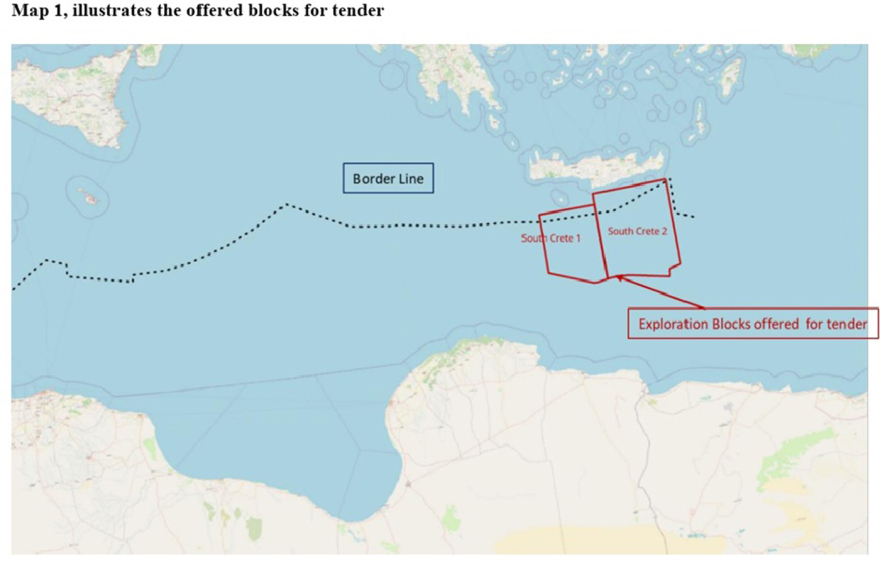
The maps attached to Tripoli’s Note Verbale show the delimitation line that Libya adopts as a continuation of the Turkey-Libya Memorandum, effectively erasing the Greek Exclusive Economic Zone (EEZ) south of Crete.
Although the Libyan Note Verbale—submitted on June 20 and published on July 3 as document A/79/860 at the UN—states that these areas are “subject to an unresolved dispute between Libya and Greece,” the same text refers to them as “Libyan maritime zones” and notes that the delineation of Greek blocks is an attempt to impose faits accomplis against Libya’s sovereign interests, which are deemed “unacceptable.”
Accusation of “Violation of International Law”
In the Note Verbale, Tripoli accuses Greece of an act that “constitutes a serious violation of international law, especially the provisions of the United Nations Convention on the Law of the Sea (UNCLOS), and undermines the principles of mutual respect and peaceful resolution of disputes.” Libya calls upon the international community, led by the United Nations, “to fulfill its responsibility to maintain peace and stability in the Mediterranean and to discourage any actions that could lead to escalation.”
Tripoli invokes international law and calls for avoidance of unilateral moves, while simultaneously asserting “sovereign rights” granted to it by the illegal and entirely contrary to the Law of the Sea Turkey-Libya Memorandum.
The attached report by Libya’s National Oil Corporation (NOC) refers to a violation of the delimitation line, which from the Libyan side is essentially the extension of the “border” defined by the Turkey-Libya Memorandum.
Consequences of Libya’s Claim
Since the 2019 signing of the Turkey-Libya Memorandum by Erdogan’s government and the Al-Sarraj government, Turkey quickly moved (by 2020) to map it and declare a Turkish EEZ based on the memorandum, marking the boundaries of the so-called “Blue Homeland”. Libya, until now, had not taken steps to declare its own EEZ. With this Note Verbale, Libya presents—for the first time on a map (with a dashed line)—its claims, which not only ignore the presence of smaller Greek islands but also drastically reduce, if not nullify, Crete’s own influence in maritime zones.
This Note Verbale contradicts earlier assessments from Athens that Libya, by delineating its own blocks, “respects” and “accepts” the Greek median line as defined under Law 4001/2011.
Still, in this same diplomatic note, Tripoli declares that the dispute must be resolved through constructive dialogue and negotiations. The formal recognition of the dispute supports Athens’ ongoing request for negotiations, which—if unproductive—should ultimately lead to referral to the International Court of Justice in The Hague, where the Court would inevitably have to rule on the legality of the Turkey-Libya Memorandum.
Greek Foreign Minister Giorgos Gerapetritis has already proposed to Eastern Libya the formation of technical working groups to initiate negotiations, with a similar proposal planned for the Tripoli government during his scheduled visit on Tuesday.
Libya’s Note Verbale to the UN and the Annex
Libya’s Note Verbale to the UN and the annex containing the NOC report is as follows:
“Note Verbale dated 20 June 2025 from the Permanent Mission of the State of Libya to the United Nations addressed to the Secretary-General”
The Permanent Mission of the State of Libya to the United Nations has the honor to express the deep concern of the Government of National Unity regarding recent developments in the Eastern Mediterranean.
The Government received with deep dissatisfaction the contents of Issue No. 3335 of the Official Journal of the European Union, dated 12 June 2025 (see Annex II), which mentions that the Hellenic Republic announced an international tender for the granting of licenses for hydrocarbon exploration and exploitation in maritime areas south of the island of Crete.
These areas fall within maritime zones that remain the subject of an unresolved dispute between Libya and Greece.
The Libyan Government considers this action to be a clear violation of its sovereign rights and a unilateral act lacking any legal basis or bilateral agreement. It constitutes a serious breach of international law, particularly the provisions of the United Nations Convention on the Law of the Sea, and undermines the principles of mutual respect and peaceful dispute resolution.
Consequently, Libya formally and categorically records its objection to this initiative and calls for strict adherence to the principles enshrined in the UN Charter and relevant international legal instruments governing the peaceful settlement of maritime disputes.
Libya reaffirms its firm commitment to constructive dialogue and negotiation and categorically rejects any attempt to impose faits accomplis in areas where no legal agreement has been reached.
The Government calls upon the international community – under the leadership of the United Nations – to fulfill its responsibility to maintain peace and stability in the Mediterranean region and to discourage any actions that could lead to escalation.
It is worth noting that this is not the first time the Government of Greece has granted exploration licenses in areas within Libya’s maritime boundaries. Previous licenses were granted to Total (France) and ExxonMobil (USA). The latter later acquired Total’s stake and proceeded with exploration activities, including 2D seismic surveys in 2022 and 3D surveys in 2024, followed by an announcement of intent to conduct exploratory drilling.
In light of the above, the Permanent Mission of the State of Libya to the UN respectfully requests the circulation of this Note Verbale and its annexes as a document of the General Assembly under item 75 of the agenda.
Annex I to the Note Verbale of 20 June 2025 from the Permanent Mission of Libya to the United Nations addressed to the Secretary-General
Report of the National Oil Corporation (NOC) regarding Greece’s offer of exploration blocks in Libya’s submerged waters
17 June 2025
- On 13 June 2025, the Greek Government announced an international tender for the granting of licenses for hydrocarbon exploration and exploitation in certain offshore areas south of the Peloponnese and the island of Crete. This marks the start of a 90-day window for submission of binding offers.
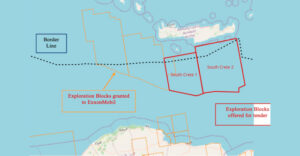
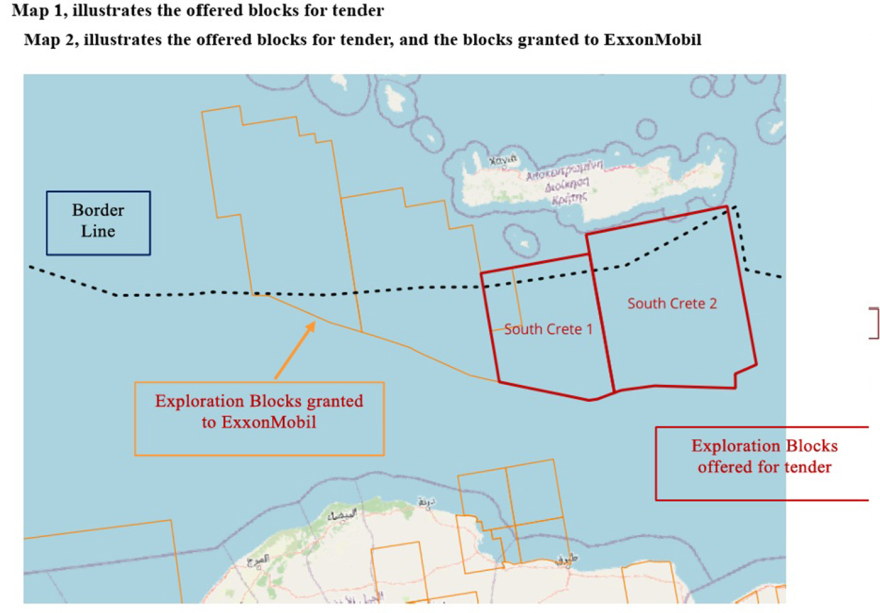
- This announcement follows an expression of interest by Chevron in March 2025 to conduct hydrocarbon exploration in offshore areas south of Crete 1 and Crete 2 (Map 1),* within the zones defined in the 2014 international tender.
- Two of the announced areas, Crete 1 and Crete 2, lie geographically within Libyan maritime zones (over which the two countries maintain conflicting claims). The total area of these two zones is 23,300 km², and more than 85% of this area lies south of the delimitation line that separates Libya from its neighbor, Greece.
- It should be noted that the Greek Government has previously granted two blocks within Libyan maritime boundaries to Total and ExxonMobil (Map 2).* ExxonMobil subsequently acquired Total’s stake and conducted exploration activities, including 2D seismic surveys in 2022 and 3D surveys in 2024, and announced its intention to carry out exploratory drilling.
Ask me anything
Explore related questions