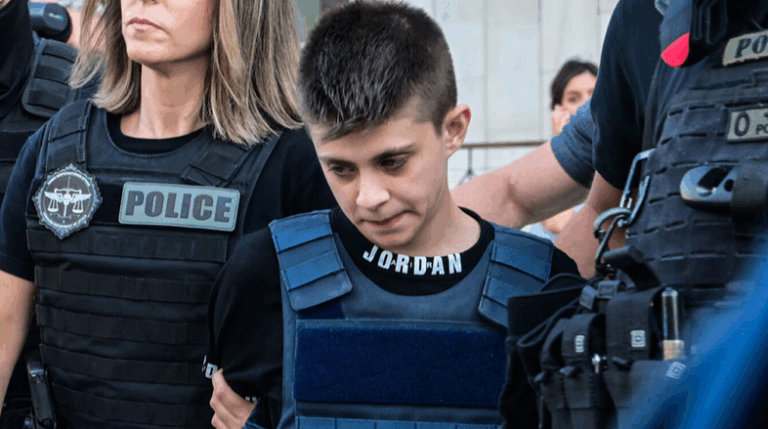
Who Eirini Mourtzoukou really is—the woman being led today to Korydallos prison following her pre-trial detention on Sunday—can perhaps only be accurately portrayed by the dead infants she left behind. The latest and final reconstruction of events by law enforcement authorities reveals far more than what she attempted to conceal—without truly concealing anything—through her devilishly intelligent yet equally brazen manner: speaking endlessly, at every opportunity, on every platform, in a frenzied publicity sprint that lasted over eight months. She persistently and carefully built the persona of a woman constantly mocking the obvious, subverting what seemed to be the self-evident thought—that Mourtzoukou wasn’t simply a modern-day Medea, but something far more peculiar: a baby-face baby killer.
In a strange way, she always gave off the impression of being a unique case—something unfathomable—beyond the performances she gave in countless TV appearances since October 2024, beyond the many and often contradictory versions she offered for each of the four or more deaths linked to her. She even managed to mislead and irreparably discredit several forensic scientists involved in the case, despite her formal education ending in the second year of junior high. Regardless, her true profile is now beginning to emerge fully, as police and prosecutorial reports fill in the details—after she confessed to the murder of four infants, with at least one more death still unexplained but closely connected to her.
The case of Ioanna-Zoi, her first child (but the third she allegedly killed—after a younger sister in 2014, when Mourtzoukou was just 14, and another infant in 2020), is emblematic of how the truth is starting to come to light. In every TV mention of Ioanna-Zoi, she would shut down the conversation before it even began, saying more or less the same thing she told authorities after her arrest: that she accidentally smothered her 19-day-old daughter in her sleep. “I woke up and realized I was sleeping on top of the baby,” she explained, adding, “Once I realized that, I tried to revive the baby with my mind. I tried to breathe life into her. I swear, I never wanted to hurt any of the children—there are people who can confirm this. They saw that I loved children.”
A Killer Mother
However, the police version, based on the synthesis of all available evidence and testimonies, debunks Mourtzoukou’s claims of an accident. At 1:40 a.m. on June 19, 2022, the already-deceased infant was rushed by ambulance to the Achaia Health Center. The EMTs attempted CPR en route, and the effort continued in vain for 20 minutes at the center. The initial autopsy report diagnosing “interstitial pneumonitis of infancy” and other conditions aligned with the mother’s story. Ioanna-Zoi’s death was largely seen as a tragic accident—a young mother losing her newborn before they even reached 40 days together. Heartbreaking, yes—but not unheard of or even suspicious.
Yet the Homicide Division began reconstructing the case starting with those close to Mourtzoukou. Ioanna-Zoi was unbaptized and her father’s identity unknown. At the time, the 22-year-old Mourtzoukou was living with a 37-year-old Bangladeshi man named Sumon, who was supporting her financially and helping care for the newborn. According to Mourtzoukou’s mother, Popi Anagnostopoulou, her daughter smoked, drank alcohol, and used drugs during her pregnancy. Even after the birth, she would spend nearly the entire day outside the house with the baby, which concerned Sumon. In reality, Mourtzoukou would leave the infant at her mother’s house in the morning and pick her up in the evening—just as she did on June 18, 2022.
The landlord of the house where Mourtzoukou lived with Sumon testified that she saw her return around 11 p.m. with the baby’s stroller fully covered by a sheet. When Sumon asked to see the baby, Mourtzoukou refused, claiming the child was asleep and shouldn’t be disturbed. This raised suspicions, as she had never before completely covered the stroller or denied him access. Mourtzoukou then went to her room, came back out minutes later to smoke in the yard without saying a word, while Sumon went to sleep in his own room. Before doing so, he knocked on her door out of concern but received no response.
Around 1 a.m., a noise startled Sumon awake. He got up and heard Mourtzoukou crying and talking on the phone. He opened her door without knocking and heard her tell her mother, “The baby is half-frozen and black.” According to Anagnostopoulou, she replied, “Again, Eirini? If you’ve done something to the baby, I’ll kill you!”
With the light on, Sumon saw Mourtzoukou holding the baby in one hand and her phone in the other. When he asked what was going on, she replied: “The baby died.” He rushed to perform mouth-to-mouth, but the baby’s lips were blue, her mouth tightly shut, and her tongue protruding.
In her first sworn statement after the death, Mourtzoukou claimed that around 1:10 a.m., while sleeping in bed with the baby, she noticed the infant having trouble breathing. It took her 10 minutes to decide to call emergency services. The ambulance arrived at 1:32. At 2:00 a.m., doctors pronounced the baby dead. However, when asked by the attending physician what had happened, Mourtzoukou didn’t say she had been sleeping next to the baby. Contradicting her later accounts, she said she had been in another room and only found the baby “half-frozen and black” when she went to feed her. Police reports also note that Sumon did not hear the baby cry at any point that night.
What the Coroner Didn’t See
In a second phase of the investigation into the baby’s death, the Hellenic Police (EL.AS.) appointed distinguished medical experts specializing in Pediatrics, Pediatric Neurology, Pediatric Infectious Diseases, and Pathological Anatomy. Firstly, they ruled out any neurological or other illness as the cause of death. According to the sworn testimony of the baby’s grandmother, the infant was completely healthy up until the moment it died. While the initial coroner had diagnosed interstitial pneumonia of infancy, the panel of experts characterized this as a “non-specific diagnosis” unrelated to sudden infant death. Their final conclusion stated there was no sign of any infection. Although interstitial pneumonia was indeed present, widespread cellular alterations were observed in the baby’s liver, which are considered proof of hypoxia.
Simply put, the child died of suffocation—as Mourtzoukou herself admitted, though likely not telling the whole truth. Her lethal method and the glaring incompetence of the responsible coroners are two common threads running through all the mysterious infant deaths in this case. In the case of her second daughter, Maria-Frederiki—whose murder Mourtzoukou confessed to directly and without hesitation—she had to act almost in plain sight: inside the Athens Children’s Hospital “Agia Sofia”, just a few meters from where medical staff were constantly moving.
“The baby is limp”
Her death was confirmed at 5:15 a.m. on October 17, 2023, one day before she would have turned two months old. About a month earlier, Anagnostopoulou had returned to the family home in Patras. When she had left, the baby and her granddaughter were perfectly fine. Upon returning, she found Irini (Mourtzoukou) dousing the baby under the kitchen faucet. The grandmother immediately grabbed the child, who was semi-conscious and bruised. When the ambulance arrived shortly after, Irini said, “the baby is limp,” even though the paramedics immediately confirmed the baby was still breathing. Maria-Frederiki was transferred from Patras to Athens, to the Children’s Hospital, where she was placed in a ward with another baby who was also under special prosecutorial observation. Mourtzoukou requested emergency help three times—on October 7, 9, and 12—claiming concern over the baby’s appearance. In none of these instances was the dedicated nurse of the other infant present in the room. Once again, she had slept next to the infant, violating the hospital’s prohibition, and once again, her baby ended up in the morgue.
The initial coroner ruled the death as a sudden pathological death of a newborn with a history of epilepsy. However, in the expert report commissioned by the police, it was found that Maria-Frederiki had no epilepsy and that her death could not have been due to natural causes. She too showed signs of interstitial pneumonia, “however,” the experts noted, “the baby’s thymus gland showed ‘starry sky’ patterns, indicative of hypoxia.” Once again, hypoxia. Mourtzoukou is believed to have attempted, consciously and deliberately, to suffocate her second child five times.
The Chain of Murders
Mourtzoukou broke down under police pressure last Tuesday night. She confessed to having killed four infants, saying:
“I want to tell you everything and get it off my chest. I snapped and committed the murders. When I argued with my mother, I wanted to do harm. I would do it, then regret it, and then do it again. I’m possessed by demons,” and so on.
She then tried to express herself in greater detail through a 33-page handwritten manuscript, which she tore up after finishing it, reconsidering her decision to confess everything—especially regarding little Panagiotis, believed to be her last victim, although she consistently denies killing him, insisting that she adored him.
Thus, she admits to killing four children—though not all of them match the cases for which she was the main suspect according to the police. Additionally, the circumstances of Panagiotis’s death in August of last year remain unresolved. As a result, it is clear that a second phase of this case will follow, focusing on exactly how many children she killed—and new twists or shocking revelations cannot be ruled out.
She specifically confessed that in February 2014, she killed her sister Zoe-Iliana, who was 2 years old, when Mourtzoukou herself was only 14. Six years later, in July 2020, she killed the 6-month-old baby of her friend and godmother, Katerina. Then, according to her confession, she killed her two own children. She insists, however, “I never laid a hand on little Panagiotis,” despite the accusations made by his mother.
According to authorities, Mourtzoukou is implicated in the murder of her two biological children, along with criminal acts against two other female infants within her close social circle. One baby, named Agapi—the daughter of her close friend Irini-Foteini—was allegedly the target of a failed killing attempt in May 2016. In contrast, she succeeded in the case of Katerina’s child. Moreover, the Homicide Division is currently investigating the deaths of both Zoe-Iliana and little Panagiotis.
Clearly, everything surrounding Mourtzoukou has always been extremely tangled—from the horrific crimes attributed to her to the shifting dynamics within her inner circle. It was a circle in constant flux, far removed from conventional notions of family—even in the broadest sense of the word.
The Child-Woman Killer
Irini Mourtzoukou’s persona is itself a mystery—and has been since she first came under public scrutiny. A child-woman, a being at odds with all conventional markers of gender, age, or even ethnic origin. A child-woman who, with her appearance and behavior, defied stereotype after stereotype. By the age of 25, she had already given birth and had watched both her infants die almost in her arms.
Now, with her confession to killing four children and being the main suspect in several more cases, she has exposed her true self. Her admission of guilt has ended the cycle of endless media speculation that had plagued coverage of her from October 2024 onward. Her public story had begun a year earlier, when the deaths of her two children initially made headlines.
Nevertheless, she did not gain publicity so much for her personal tragedy as for the possible connection to the deaths of other people’s children. Furthermore, her own unhappy experience of motherhood was overshadowed by her disastrous, traumatic relationship with her mother, as she never missed an opportunity to proclaim how much she herself had suffered as a child—consistently pointing to her mother as the culprit of her childhood drama. A mother whom she did not hesitate to symbolically execute over and over again on live television, with no trace of mercy, staging a televised symbolic matricide—an on-air lynching of her mother by her daughter, as a form of primitive, vengeful justice.
In this sense, she seems to have fulfilled to the letter her chilling promise/threat when she warned her mother: “If they take me in, I’ll take you down with me. You’ll wear black, you have no idea what you’re involved in. You don’t know what kind of child you have!” A child-enforcer, then, a young woman who, behind her immature appearance and her persona evoking the eternal childhood of Peter Pan, was also hiding a ruthless thug, a bully. It had been rumored for some time, after all, that she allegedly intimidated and terrorized those in her close circle—primarily her mother and the two mothers of the infants she eventually confessed to having killed.
The ambiguity surrounding who Irini Mourtzoukou is—and, more crucially, what she has done—was cultivated systematically, even obsessively, in the Greek public sphere for nearly two years. Thanks to a rare, almost seamless harmony between an enigmatic personality and a segment of the media that treated her as a kind of deus ex machina—the answer to the wish for the next true-crime series following the case of Roula Pispirigou. Mourtzoukou responded willingly, assuming the starring role in an imagined “season two” to fulfill the media’s desperate need to replace the Pispirigou case with a similarly serialized tragedy—ideally one even more horrific and grim.
Interrogated by TV Hosts
In the midst of this media frenzy, between her TV debut and her arrest, Irini Mourtzoukou gave multiple confessions and disclosures. She underwent countless informal interrogations by true-crime show hosts, who engaged in fierce, relentless competition over her. One journalist even encouraged her to file a lawsuit against a rival colleague, while others eagerly participated in a pathetic bidding war—offering money and VIP accommodations just to secure her appearance on their shows. And she clearly reveled in her sudden stardom—the spotlights, the cameras, the microphones that transformed her from a marginalized figure into a diva of the ultimate Greek reality show. During commercial breaks, she was often advised to watch her behavior, to respect the memory of the lost infants—instead of asking the crew to take selfies with her. In this way, she gradually grew accustomed to her role as the central protagonist in an endless reality show filled with fierce confrontations with journalists, police officers, legal experts, medical examiners, criminologists, and so on—as well as former loved ones, including parents who had lost their children because of her, as it is now apparent.
However, the most painful, twisted episodes in the Mourtzoukou saga were the vicious clashes with her mother. One of the rare moments when she seemed to give in to genuine emotion was when she cried live on air upon hearing her mother categorically accuse her of being a murderer.
The Arrogance of Guilt
If she was guilty, she hid it very well—perhaps devilishly well—for a very long time. Strangely enough, the same could be said of her potential innocence (now largely theoretical, since she has confessed). That’s why, despite the horrifying revelations of violence, abuse, and general suffering she had endured in her life, she led a parallel life—mainly on TikTok. There, for example, she celebrated the medical examiner’s favorable (and completely misguided) report on Panagiotakis’s death. On TikTok, she freely exhibited the arrogance of someone who saw herself as above the law, above the intelligence of detectives and forensic experts. She never stopped interacting, arguing, or even publicly exposing herself—apparently convinced that her perfect crime would remain forever unpunished, that human justice was too small and weak to touch her murderous genius. A behavior befitting a wannabe gangsta, someone high up in the criminal hierarchy who mocks others and issues veiled threats to those who underestimate him—someone with powerful underworld connections ready to be activated to exact revenge on anyone who wrongs him.
Similarities with Roula
It may be a global first that two women—two Medeas, Roula Pispirigou and Irini Mourtzoukou—accused of serial child killings, acted in the same place and time, and even happened to know each other, as Mourtzoukou has claimed. She followed the same strategy as Pispirigou—whether that was her plan all along, or simply because she was incapable of doing anything else. “Generally, I haven’t made mistakes. My only mistake is going on TV and contradicting myself,” is one of her most unexpected, almost outrageous quotes. At times, the show hosts—and with them, the audience—felt they weren’t hearing answers, but were eavesdropping on an internal monologue—or perhaps a dialogue between two versions of herself, with thoughts that should have stayed thoughts being spoken and reproduced.
In fact, she gave this very advice—to avoid contradictions and that “publicity isn’t good for me”—to herself, on camera, in November 2024 during a conversation with journalist Angeliki Nikolouli. When asked, “If it turns out you’re involved in the children’s deaths, how will you react?” she spontaneously replied—as far as anyone could tell—“If I had done something, I would’ve run away by now and you’d be out looking for me.”
Ask me anything
Explore related questions