Over the past 20 years, conditions such as type 2 diabetes mellitus, cardiovascular disease, hypertension, and some cancers have increased significantly. According to the Hellenic Obesity Society, more than 35% of the adult population suffers from obesity, while 55% are overweight. “Dealing with today’s problems requires a radical revision of the way the country’s nutrition policy is organised, designed and implemented,” Professor Antonis Zampelas, Chairman of the Board of Directors of EFET, stresses in his article. The full article by Antonis Zampelas* is as follows:
“Greece in the Mirror of its Diet
In a country that has been a historical beacon of food culture, cradle of the Mediterranean diet, and land of agricultural self-sufficiency, the current picture of nutritional reality is a source of intense concern. Dietary patterns have changed rapidly in recent decades, agricultural policy is not linked to the promotion of public health, and the population, although overfed, shows serious symptoms of malnutrition, nutritional deficiencies, food insecurity, and chronic diseases. Greece is currently at a critical crossroads, where the absence of a national strategy and cross-sectoral coordination on nutrition policy is costly not only in terms of health and social costs, but also in terms of food sovereignty, agricultural sustainability, and social cohesion. Addressing the current problems requires a radical overhaul of the way in which the country’s food policy is organized, designed and implemented.
1. The Current Nutritional Situation in Greece
1.1 The Shift from the Mediterranean Diet to the Western Dietary Model
The Mediterranean diet, characterized by a high consumption of vegetables, fruits, olive oil, fish, and roughly processed grains, has been recognized worldwide as one of the healthiest dietary patterns. However, in recent years, Greek society has moved away from this standard. Modern trends show increased consumption of processed foods, sugar, animal fats, meat and its products, combined with a sedentary lifestyle and reduced physical activity, and excessive exposure to screens. Studies by the National Research & Documentation Centre (2023) show that 60% of the population now follow a diet that deviates significantly from the Mediterranean diet. This change is linked to urban conditions, the economic crisis, and lifestyle changes.
1.2 Increasing chronic diseases
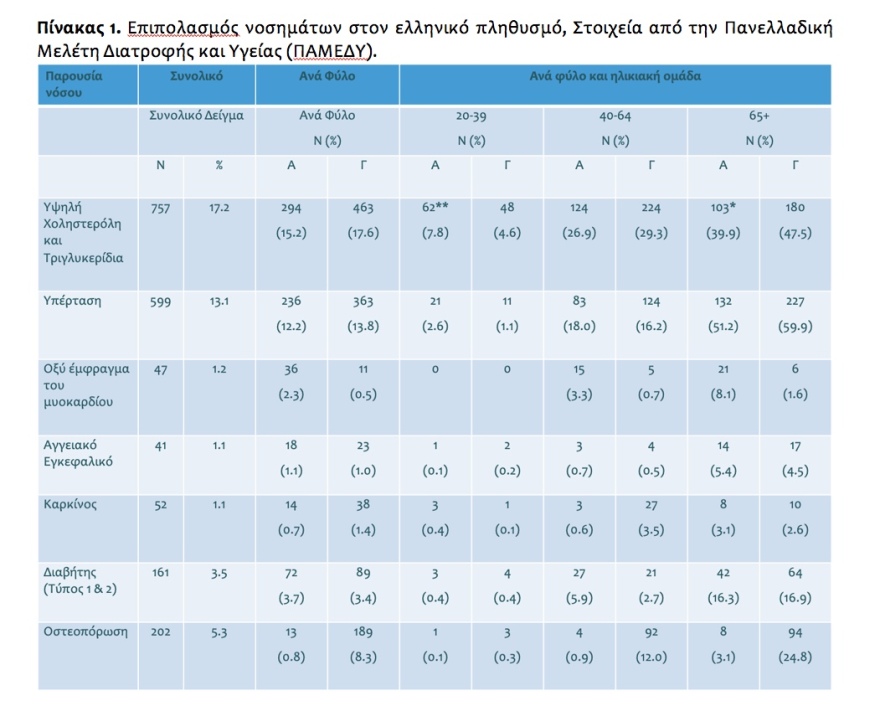
The association of nutrition with chronic diseases is undeniable. Over the past 20 years, conditions such as type 2 diabetes mellitus, cardiovascular disease, hypertension, and some cancers have increased significantly. The Hellenic Obesity Society reports that over 35% of the adult population is obese, while 55% are overweight. Table 1 shows the prevalence of chronic diseases in the Greek population from the Panhellenic Nutrition and Health Survey. It is noteworthy that at ages over 65 years, about 1 in 2 Greeks is dyslipidemic and/or hypertensive, 1 in 10 has a personal history of cardiovascular disease and type 2 diabetes mellitus, while 1 in 4 women of this age suffer from osteoporosis. At the same time, malnutrition, i.e., the lack of critical micronutrients (vitamins, minerals), is observed even in overweight people due to poor diet quality.
This dual form of nutritional imbalance burdens the health care system with increased costs for treatment and prevention. Two large nationwide studies have suggested the following:
The GRECO study (2009, ~4,800 children 10-12 years old from across the country) documented:
– Children overweight: ~29.5%, with obesity: ~11.7%
– ~11.7%
– Only 4.3 % had good adherence to the Mediterranean diet
– Obesity was associated with: thinner breakfast meals, fewer gaps between meals, fewer meals with family, less sleep, sedentary lifestyle, and electronic devices in the nursery
– Factor with the highest risk: if the parent is obese, and even more so if both parents are obese.
– In addition, dietary intake of free sugars was associated with an increased likelihood of obesity
– Microgenetic – prenatal factors: higher maternal weight at gestational age, active smoking are associated with increased childhood obesity
– Lack of sleep: Slower sleep on weekdays is associated with increased BMI.
From the Panhellenic Nutrition and Health Study – 5000 people with a representative sample recorded for the first time in such great detail the state of the nutritional profile and health of the Greek population:
– 99% of adults are deficient in vitamin D (Figure 1).
99% of the population has a high prevalence of vitamin D deficiency (Figure 1.1).
– Over 70% have low intakes of vitamins A, E, K, C, and potassium.
.
– Women over 50 years of age and men over 70 years of age have significantly lower intakes of calcium and magnesium than the Estimated Average Requirements (EAR).
– 50% of women of childbearing age have an inadequate intake of folate.
– 50-79% of the population exceeds the maximum recommended daily intake of sodium (>2,300 mg/day), which places a serious burden on the cardiovascular system.
– 50% of adults smoke, 72% consume alcohol, and 31% use dietary supplements.
– Macronutrient intakes in both adults and children and adolescents are given in Tables 2 and 3. Typically, 59% of adults consume more saturated fat than the recommendations, while 96% consume less than the beneficial polyunsaturated fat.
– Food intake compared to recommendations is given in Figures 4 (Men) and 5 (Women). Notably, both men and women consume more fast food, sweets, alcoholic beverages, and red meat compared to the recommendations, while intakes of vegetables, fish, poultry, legumes, fruit, olive oil, nuts, and roughly processed cereals are low.
2. Food Adequacy and Social Inequalities
2.1 Food Insecurity in Times of Crisis
Despite the prosperity of some segments of the population, food insecurity is a significant problem (Figure 6). Low-income families face difficulties in accessing nutritious and quality food. A Eurostat study (2024) puts food insecurity in Greece at 18%, significantly higher than the EU average (Figure 7).
Food insecurity means the inability to secure sufficient, safe, and nutritious food. Children go to school without an adequate breakfast, elderly people depend on social structures for meals, and there is increasing recourse to social groceries. This ‘new hunger’ is the result of systemic failure. Food insecurity is related not only to poverty, but also to lack of geographical access to nutritious food (food deserts), inadequate nutrition education, and food illiteracy.
The economic crisis and the impact of the COVID-19 pandemic have exacerbated the situation, especially for vulnerable groups such as children, the elderly, and single-parent families. Increased food prices and low incomes, too the increases, led some population groups to limit the variety and quality of meals.
2.2 Relationship of Socioeconomic Status to Nutrition
The quality of diet is often associated with economic status. Households with limited resources tend to choose cheaper and often less nutritious foods, such as processed products high in sugar, sodium, and fat. This creates a cycle where poor nutrition leads to increased health problems and financial burdens, both within families and the National Health System.
When Quantity Hides Quality. The modern form of malnutrition is not just about calorie deprivation, but more importantly, about nutritional poverty. Over-processed foods, rich in sugar, saturated fat, and sodium, have displaced fresh, unprocessed, and local food from the household table (Figure 8). The result is a generation that may not be hungry, but is not sufficiently nourished to maintain good health. Vulnerable groups in particular, such as the unemployed, low-income earners, and the elderly, lack access to quality, nutritious food. Rising prices of fruits, vegetables, fish, and olive oil have made the Mediterranean diet inaccessible for many households.
3. Primary Production: Critical Chain of Food Security
3.1 Reduced Agricultural Production and Import Dependence
Primary production in Greece has experienced a significant decline, mainly due to the weakening of the agricultural sector, the ageing population of producers, and the lack of adequate support. The coverage of basic nutritional needs by domestic products has declined to 50-55%, with significant dependence on imports of cereals, meat, and dairy products (Figure 9).
Greek agricultural production has become disconnected from the nutritional needs of the population. 80% of legumes, 70% of cereals, 60% of meat, and more than 50% of vegetables consumed in Greece are imported. The production of basic food products remains fragmented and vulnerable to international crises to climate change, and extreme weather events. The lack of a national plan for agricultural production based on nutritional priorities, inadequate support for small producers, and land commercialisation have led to rural desertification and weakened the country’s food self-sufficiency. Increased reliance on imports makes the country vulnerable to international market disruptions, as demonstrated by the problem created by the war in Ukraine and the disruption of grain supply, but also by energy and fuel crises, as well as geopolitical tensions, and by the effects of the climate crisis.
3.2 Lack of Strategy and Support
Agricultural policy is characterised by fragmentation, bureaucracy, and an inability to adapt to modern requirements. The absence of an integrated strategy linking primary production to public health and food sufficiency exacerbates the problem. Furthermore, technological support, training, and financing for small and medium-sized farmers is inadequate, while the promotion of sustainable agricultural practices remains limited.
4. Institutional Weaknesses and Lack of a National Plan
4.1 Fragmentation of Institutions and Lack of Coordination
.
Nutrition policy in Greece does not have a single coordinating body. There are many agencies and ministries involved with overlapping responsibilities, which makes it difficult to make decisions and implement holistic policies. This fragmentation leads to discontinuity, delays, and low effectiveness of interventions.
4.2 Lack of Focus on Prevention
Efforts at prevention through nutrition are fragmented and lack continuity. Public information campaigns are limited and mainly target the general population, without specificity for vulnerable groups. The integration of nutrition in the education of young people is weak, and information for health professionals and producers is not sufficiently covered.
5. The Importance of Education and Awareness
.
Education is a foundation for the formation of good eating habits. Nutrition education programs in schools, seminars for parents and health professionals, and awareness campaigns can help prevent chronic diseases. Social engagement and information through media and digital media are critical, but not the only tool for changing behaviours.
Letter
Food is Politics. Nutrition is not just an individual choice. It is a political choice, a collective right, and a basic precondition for health, well-being, and national sovereignty. If Greece wants to regain its title as the cradle of healthy eating, it must formulate a coherent, informed, and ambitious national plan. Nutrition is not a simple daily habit, nor is it solely an individual responsibility. It is a political act, a foundation of social justice, a driver of public health, and an indicator of national independence.
When 22% of households lack basic food sufficiency, when Greek children have among the highest rates of obesity in Europe, and when the country is dependent on imports for energy and nutrition, then the problem is deeply systemic, and the response must be equally systemic. A national nutrition policy is not a luxury, but a matter of national security, health prevention, and intergenerational responsibility. There can be no meaningful progress without institutional coordination, investment in local production, universal education, social protection,n and a radical redefinition of our relationship with food, our land, and our health.
At the Agricultural University of Athens, we are establishing an Institute of Unified Health and Nutrition Policy, which is not only a technocratic proposal but a political necessity and needs the support of the state to reorganize the whole food system in the country. A new social agreement is needed that unites farmers, health professionals, educators, scientists, municipalities, schools, consumers, and the State itself.
A coalition for food democracy that ensures universal access to healthy food, fair markets for the producer, and a sustainable environment for future generations. Greece has the human potential, the scientific knowledge, the historical legacy, and the natural potential to regain its role as a model of healthy, equitable, and self-sufficient nutrition. The question is not whether it can, but whether it wants to. If we want to. And whether we are ready, as a society and as a State, to choose the path of political will, collective action, and institutional change. Food is politics. And now is the time to exercise it.
Twelve Immediate Policy Priorities
1. Establishment of an Independent Food and Nutrition Policy Authority
The role of the Authority will be horizontal coordination and strategy development based on scientific evidence, as well as market control from primary production to the plate.
2. Establishment of an Institute for Integrated Health and Nutrition Policy.
The mission is to provide scientific evidence for policies linking agriculture, nutrition, and health. It will act as a centre for research, linkage, and standard setting, supporting and advising the Independent Authority.
3. Implementing Universal School Meals.
Distribution of daily, nutritious meals in schools, prepared from local produce and modeled on the Mediterranean diet. It contributes to equity, the fight against childhood malnutrition, and the strengthening of local agriculture.
4. Reducing VAT on fresh and basic healthy foods.
E.g., zero or reduced VAT on fruit, vegetables, pulses, olive oil, and fish.
5. Increased VAT or special tax on over-processed foods rich in sodium, saturated fat, and sugar.
6. Redesign of the RDP (Rural Development Programme) with the aim of nutritional adequacy.
Direction of support towards nutritionally important crops (pulses, whole grains, vegetables, olive trees) and support for small producers with social-ecological criteria.
7. Mapping and addressing “Food Deserts”.
Interventions in areas with insufficient access to fresh and nutritious food (e.g., isolated islands or mountainous areas), through subsidized outlets and cooperatives.
8. Introduction of nutrition education in education.
Institute an integrated compulsory course on nutrition and sustainable consumption from primary to high school, with practical workshops, school vegetable gardens, and links with local producers.
9. Mandatory Nutri-Score or Warning Labels-type nutrition labels.
With clear visual information on the nutritional profile of foods on the shelves to facilitate healthy choices, and put pressure on the industry to improve recipes.
10. Ban advertising of unhealthy foods and beverages.
11. Product reformulation.
At the initiative of food businesses and/or with the necessary legislation by the state.
Food companies.
12. Public Procurement with Health and Locality Criteria.
Institute nutritional and environmental criteria in all public institutions (schools, hospitals, military, nursing homes) to be a driver of healthy consumption and local development.
The effort for our country should be a multi-year effort that goes beyond the time of ministerial terms and should be embraced and supported by all parties so that there is continuity and the expected outcome that will make us all proud. It is not just for us. We have an obligation to our children and our grandchildren.”
* Antonis Zampelas is:
– Chairman of the Board of Directors, Single Food Control Authority (EFET),
– Member of the Board of Directors of the European Food Safety Authority (EFSA),
Anti-Food Safety Authority (EFSA).
– Professor of Human Nutrition, Laboratory of Dietetics and Quality of Life, Department of Food Science and Human Nutrition, Agricultural University of Athens,
– Honorary Professor, Division of Medicine, Faculty of Medical Sciences, University College London, UK.
Department of Medicine, Faculty of Medicine, University of Medicine, University of London, UK.
Ask me anything
Explore related questions