





The course of the hot July-August two-month period, the traffic in September, which last year reached historically high numbers with similar high expectations for this year, and the performance of the US market, to which much of the growth of Greek tourism from 2019 onwards is due, are three of the key parameters that will determine the tourism performance in 2025.
In the heart of the Greek summer, a first estimate of the industry’s performance this year suggests a 3%-5% increase in arrivals, while receipts, based on estimates so far, will be around last year’s record-breaking performance, with variations depending on how the summer ends. Last year, excluding cruises, travel around Greece reached 36 million, a figure that is likely to rise to 37-37.5 million this year, while tourism receipts reached €20.6 billion and it remains to be seen whether they will rise further, making this year the new benchmark year for Greek tourism. It should be noted that including cruises, inbound travel last year reached 40.7 million travellers, while receipts stood at 21.6 billion euros.
Destinations
Now, with July drawing to a close, a common finding among tourism operators around Greece is that 2025 is moving at multiple speeds, and travelers coming to the country, especially Europeans, appear to be spending less on retail and dining and staying fewer days.
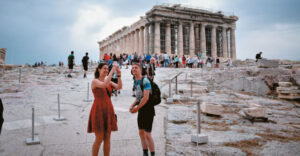
In terms of the overall picture in destinations, the two urban centres, Athens and Thessaloniki, stand out this year, recording a 9% increase in foreign visitors so far and also affecting the average length of stay, given that the majority of visitors are taking short city breaks or using Athens specifically as a stopover for the islands.
As for the major island destinations, Crete, Rhodes, Corfu, Kosos and others, also have a positive sign – greater or lesser – in arrivals, but with less spending as professionals note, given the pressure on Europeans’ pockets this year.
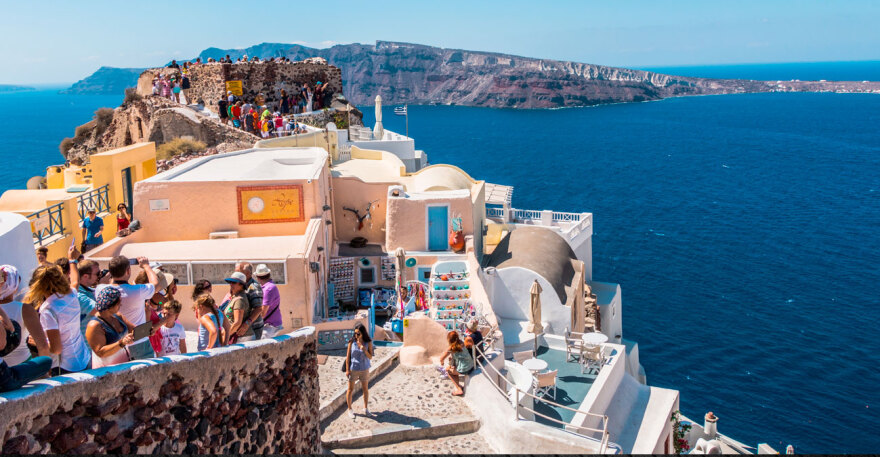
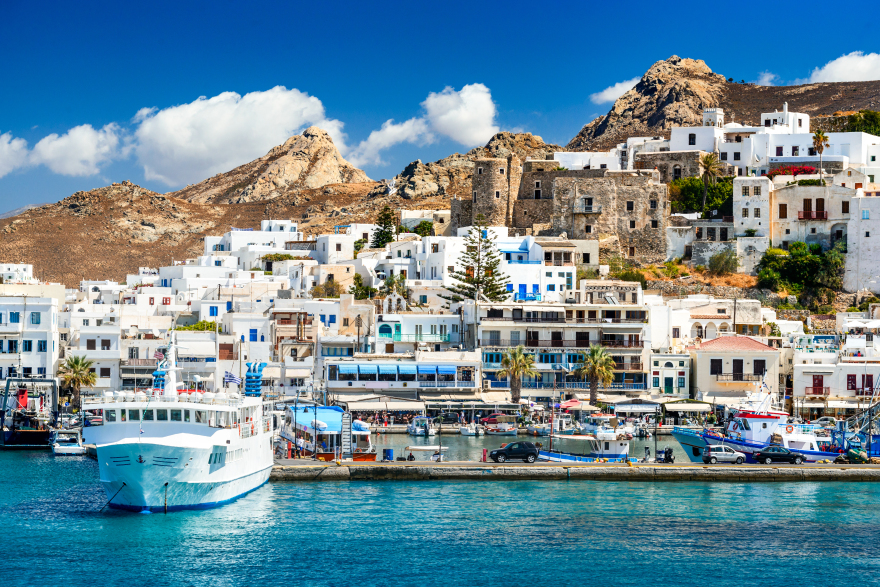
In the “champion” Cyclades, the balance is lower for the two premium destinations, Santorini -mainly due to the seismic activity of the winter, with the island, however, gradually reducing losses- and Mykonos, even though the choices this year in terms of prices are admittedly improved. On the other hand, following the general European trend of visitors to destinations beyond the beaten track, islands such as Milos, Naxos, or Syros have shown a significant increase in June both by air and by sea, even if the volumes of visitors are much lower than the two flagships of Greek tourism.
In addition, the Civil Aviation Authority has this year proceeded with operational and aesthetic upgrades, indicatively at the airports of Milos and Naxos, both for the given need to improve their image and in view of the upcoming tender process for the concession of the 22 state-owned airports.
The numbers
In Naxos, passenger arrivals at the airport in June 2025 amounted to 20.75 thousand passengers, compared to 14.3 thousand in June 2024. in Syros the increase in passenger traffic was more than double, at 3,254 passengers, even if the number is very small, and so on.
In the big picture and given that 7 out of 10 visitors arrive in Greece by air from the 39 airports across the country, 24 under the Civil Aviation Authority, 14 under Fraport Greece and Athens International Airport, the total passenger traffic (arrivals – departures, domestic – international) for the first half of the year increased by 5.2% to 32.35 million passengers.
Including visitors coming to our country by road or sea, a first estimate for arrivals this year points to a 3%-5% increase, with tourism operators, however, reiterating that the high growth rates of recent years are no longer feasible, anyway, and given the continuous record highs, while spending has been declining in recent years. They are focusing more on the need to implement a development model by strengthening infrastructure, alternative forms of tourism, promotion of alternative tourist destinations, etc.
“This year the traffic is still up, but we cannot have a 7%-10% growth every year,” Eftychis Vassilakis, president of Aegean, commented last week, as part of the presentation on the addition of two new Airbus A321neo XLR (Extra Long Range) aircraft with an even longer range, up to 10.5 hours, and the opening of the largest domestic airline to the promising Indian market from March 2026, earlier than originally planned.
A similar assessment was expressed last Thursday by Yannis Retsos, president of IOBE, at the presentation of the quarterly report on the Greek economy. He, managing director of Electra Hotels, but also a tourism institutionalist from his previous role as head of the Association of Greek Tourism Enterprises (SETE), said that “after ten years of growth, from 2014 onwards, it is logical that the industry is entering the phase of flattening out revenues”, with the target for this year being at last year’s high revenues and constituting a significant success if even greater performance is secured.
The Data
The truth of the matter is confirmed by Eurobank’s latest study of the sector: “Over the last 15 years the average annual rate of change in arrivals has been 7.1%, driving inbound travel to 40.7 million travellers in 2024 (including cruise arrivals), up from 15 million in 2010. In contrast, average traveler spending decreased to €531 in 2024, from €640 in 2010, also due to a decrease in the average length of stay of travelers in Greece to 5.9 nights in 2024, from 9.3 in 2010. The trend of reduced length of stay is also recorded this year, according to hoteliers, not only for the foreign but also for the domestic audience, with Greeks in recent years having reduced the length of stay in Greek destinations, with the prospect of a week being much less frequent.”
Mr. Retsos referred to the different speeds recorded this season in the sector and did not rule out, from his empirical assessment, the possibility that there could even be a slightly negative trend, if not this year, from 2026, given first of all the pressure on the incomes of Europeans, which is the main reservoir of Greek tourism, but also the (negative) psychology of another key market for Greece, the Americans, for travel in general in Europe due to geopolitical developments in our wider region.
The good news
And here comes positive news for our country, which so far, unlike other European markets and against the negative mood of the American public this year, as established by international surveys, is still high in the preferences of visitors from the other side of the Atlantic. Arrivals from US residents in June this year are up 26% based on data from Athens International Airport, while at the six-month level they are also up by double digits, by 10%, reaching 494 thousand in total for the period January – June 2025 from 451 thousand in the same period last year. The course of the US market, which is in the top 5 of the largest inbound tourism markets for our country, is critical as commented in”THEMA” Aris Ikkos, scientific director of the SETE Institute (INSETE), the research institute of the Association of Greek Tourism Enterprises, given that a large part (25%-30%) of the increase in receipts in the period from 2019 to date is due to this market.
Looking ahead to the more difficult times that seem to be coming from 2026, Greece, as Retsos said, will have to emphasize infrastructure to ensure the resilience of its tourism product, local added value, the interconnection of sectors – for example, tourism – primary production, tourism – culture, etc.- and ultimately the building of an integrated strategy, elements that still, despite the big rise of recent years, seem to be missing in the big picture: “Things are getting harder for the Mediterranean markets and those who benefit will be the best prepared”, said the IOBE president. Greece was indeed better prepared in the pandemic period, and that is why it stood out by delivering record results. Retsos commented that it is good to talk about better tourism, but this cannot be done without quality infrastructure. The country has not reached a ceiling in terms of the carrying capacity of its destinations, but growth without a strategy brings negative results, and some of the popular destinations are reaching their limits.
The hoteliers
Mid-summer traffic in the 2025 summer season is given to “THEMA” by hoteliers around Greece. As a general finding, for the hot two months of July-August, bookings are moving at a more moderate pace compared to last year, with the market, however, looking forward to higher rates in September. The trend has been more pronounced than last year not only in Greece, but also in other popular Mediterranean destinations, where the share of visitors increases in early autumn, a period with less heat, better prices, but less crowded, especially in the regions at the forefront of demand.
In the major destinations, in the Rhodes market, as president of the Association of Hotelier,s Yannis Papavasiliou says, demand is moving satisfactorily this year, but because there is a comparison with 2024, a record year for the island, there is no corresponding rise in numbers. “What has happened in June is that the island lost some people because of the developments with Israel, but we are now seeing that there is now a lot of demand and the Israeli market is coming back very strongly. Overall, we think the season will be at the same level as last year, with small fluctuations of 1%-2%, and it is encouraging that there is interest, as we have been told by tour operators in the UK market, until mid-November. The issue of the extension is critical for Rhodes and we believe that other markets will follow.”
In Crete, the season is generally moving upwards; however, “the people who come are saving money, there is a tightness in the pockets of Europeans as well,” comments the president of the Heraklion Hoteliers Associatio,n Nikos Chalkiadakis, adding that there are fewer tourists this year who are spending in restaurants. He also focuses on the issue of short-term rentals on the island, “which is out of control not only by Greek owners, but also by foreigners who have bought houses in Crete. We have this year arrivals up by about 5% and at the same time occupancy rates in hotels may be down even as much as 10% in some cases.” As for the immigration issue, which has been a concern for the island all the time lately, “we have no impact at the moment and we believe that there will not be an issue in the end,”
he said.
Corfu, the largest destination in the Ionian Sea, is facing a similar issue with the increase in short-term rental accommodation. In addition, the island is also moving upwards in terms of arrivals, but not in terms of spending, since, as the operators say, this year tourists are spending significantly less. For the two months of July-August, the available listings based on data from the specialist short-term rental analysis company AriDNA exceed 7,400 daily, with July being a “stronger” month compared to August, when last year – indicatively – in August the corresponding figure was just over 6,700. International arrivals in Corfu appear to have increased by 5.1% in the first half of 2025, reaching 666,500, with 6 out of 10 visitors coming from the British and German markets. The British, in fact, due to more direct flights this year, account for more than 40% of total arrivals. For June alone, the increase in international arrivals was just under 5% compared to June 2024, reaching 360 thousand, with the first British market accounting for almost 37% of traffic. The Israeli market had a 44% decrease in June. Another Ionian destination, Zakynthos, had a significant increase in the airport’s numbers, with a 6.1% increase in passenger traffic in June, mainly due to the rise of the Italian market and the addition of direct flights.
Northern Greece
In mainland Greece and starting from a very popular destination like Halkidiki, according to the president of the Hotel Owners’ Association, Quick Tasios, “the season is at 2024 levels and in some businesses there is a 5%-10% drop. The beginning of the season, through May and June, moved at lower levels, with the two months of July-August progressing better, as well as the beginning of autumn, in September, where we hope it will move better. This year, there is a very strong realisation that every tourist’s wallet is limited. The facts therefore have to do with the limited financial capacity of the travelling public, but also with the fierce competition, elements that lead to shorter holidays and the search for last-minute opportunities, especially for families. The economic data of each destination and the correct pricing of the tourist product also play an important role.
Tasios also highlights the short-term rental segment, “which has now reached the point of exceeding the number of beds in hotels with prices that can move at a rate of even more than 20% of the destination’s potential. We currently have 49,000 short-term beds, 40,000 hotel beds and 40,000 beds in rentals.” The top foreign markets for the region are Germany, Britain and Poland, while in road touris,m Romania leads the way, followed by Bulgaria and Serbia. “Given the easy access, Halkidiki is also mobile in the Greek market, but with an average demand of only 3 days, when 10 years ago the average demand was one week and five years ago it was 5 days,” says the president of the local Hotel Owners Association.
Central Greece
In Magnesia and in a popular destination such as Pelion, summer this June started sluggishly this year with a drop compared to last year, “with an improved, as is reasonable, picture in the two months of July – August, where occupancy rates are traditionally high,” says the president of the Magnesia Hoteliers Association, George Zafiris. And adds: “For the traffic from the domestic public plays an important role – and this year – the social tourism program in our region, because the beneficiaries can have up to 12 free nights, as in 2024, in continuation of the initiatives to support the destination after the floods of ‘Daniel”. For the foreign audience, road tourism is doing better – there are many Romanians, many Bulgarians, and so on. In foreign nationalities, there was a problem with Israelis, where we had close to 3,000 cancellations for the summer, which are no,w to some extent, recovering. Unfortunately, however, hotel rooms are a product with an expiry date – days lost are not made up for.”
In southern Greece and the Peloponnese, “traffic is not as expected so far,” says Dimitris Karalis, president of the Messinia Hoteliers Association, with uncertainty in the economic and geopolitical field having played a significant role. “This year’s season is evolving with moderate demand from both Greece and abroad, with the Peloponnese always having the advantage of easy road access, given that arrivals from abroad remain limited due to poor airport infrastructure. The traditional clientele of the Greek public is always present; however, it is limited to a period of 40 days.”
American tourists in numbers
26%
more arrivals in June 2025/2024
10%
increase in arrivals in the first half of 2025/2024
494,000
Travelers came from the US to Greece between January and June
Ask me anything
Explore related questions


