





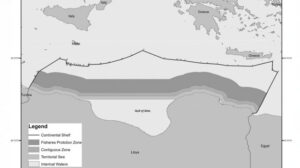
Greek diplomacy is now turning to the formulation of a comprehensive plan to prevent moves on the ground that would attempt to exploit the new facts created by the May 26th verbal declaration by Libya, with the unilateral submission to the UN of the “outer limits” of the Libyan continental shelf.
For Athens, it is extremely important to prevent moves on the ground, but also to prevent the creation of the impression that the whole area, from the Evros estuary to the Cypriot EEZ in the southeast and the tri-national point of the Greek, Italian and Libyan maritime zones in the southwest, is “disputed”.
Something that has already been initiated by a series of decisions in recent months. And it is significant that at least in this period, from 2019 to date, Greece finds a valuable helper in the other major power in the Eastern Mediterranean and North Africa, Egypt, which itself has been targeted by Libya.
With the Turkolibiko Memorandum and the unilateral filing of external coordinates by Turkey in 2020 and by Libya this year, the picture on the map also reveals Turkish intentions: To use the subservient and faltering government in Tripoli as a vehicle to exert pressure around Greece, to promote the “Blue Homeland” doctrine and the gradual suffocation of Greek maritime zones.
Thus, Turkey seeks to create the conditions not only for the usurpation of Greek maritime zones, but also for the definitive, de facto neutralization of the greatest weapon our country possesses: the right to extend Greek territorial waters.
Unauthorized actions
Libya’s reactions to Greece’s initiatives as early as 2017 with the delineation of the plots of land southwest and south of Crete have been continuous, culminating in the Turcolibus Memorandum (2019), but also the latest move of submitting to the UN the coordinates and the map with the arbitrary and unilateral delineation of the outer limits of the Libyan continental shelf.
Athens also noted during the visit of the foreign minister Giorgos Gerapetritis in Tripoli that the interim Dbeiba government is unwilling to renounce the Turkoli Memorandum and is covering itself, perhaps behind the pretext that even if it wanted to, it could not do so because it exceeds the limits of its mandate. However, Athens is assessing Libya’s attitude as a whole, as despite the existence of the Turkmen Memorandum and the May 26 verbal warning, Tripoli, as a senior source points out, has so far avoided any action on the ground towards its implementation. The Foreign Ministry believes that, despite the verbal communiqués, it is Greece, and not Libya, that has the initiative to move. As the senior source stresses: “We are the actors, not the reactors, and although the Libyan reaction was expected, it is characterized by low intensity.”
The government, however, is neither downplaying nor belittling the Libyan move, but is attempting to interpret it within the context of the situation. It is organizing and preparing the Greek letter to the UN, which will respond with legal and political arguments to Libya’s attempt to implement on paper the Turkolibian Memorandum and its decades-long maximalist aspirations.
Athens believes that this reaction of Libya is also nothing but a defensive move, since Tripoli has realized that by keeping an agreement with Greece on the delimitation of the EEZ pending, our country did not remain inactive, in a state of hostage, as perhaps the “high patrons” of the Dbeiba government hoped, by refraining from exercising its sovereign rights.
Significant accomplishments
In an unusual for Greek foreign policy chord of moves, since 2011 with Law 4001/2011, Athens, even through regressions and many vacillations, has succeeded in imposing, at least on the Libyan side, a series of important fait accompli, which not only promote the exercise of its sovereign rights, but also legally and on the ground set new standards in the process of possible future delimitations in the region.
The government, having currently hit a wall in its efforts to reach an understanding with Turkey to start the process of talks for the drafting of a compromise for the referral of the delimitation dispute to The Hague, has sought to close the remaining fronts either by agreements or, if circumstances require it, by unilateral actions based, however, on the application of the provisions of the Law of the Sea.
Significant Communications
The government’s plan includes: the partial continental shelf delimitation agreement with Egypt, which, at considerable cost, helped provide a substantial counterbalance by overshadowing the Turcolibus Memorandum; the EEZ delimitation agreement with Italy; the extension of Greek territorial waters in the Ionian Sea to 12 nautical miles, the promotion of the Marine Spatial Planning which reflects the maximum of the aspirations for the outer limits of the Greek EEZ, the expected introduction of Marine Parks, with the first of these in the Ionian Sea and the southern Cyclades (in areas that Turkey does not dispute) and the decision to launch the tender for the licensing of land south of Crete, where the Turkish-Cypriot Memorandum on the Libyan side of the illegal demarcation is directly affected.
For these reasons, as a senior source points out, the reaction of the Ankara-Tripoli interim government axis, manifested by the two verbal communiqués, was expected.
But the government insists and turns its interest to whether this theoretical construct formed by Tripoli has a reflection on the ground, which is not being ascertained at the moment.
Indeed, the plots of land that Libya has marked out and offered for exploration (four of them to the Turkish state-owned company TRAO) respectfully observe the median line that Greece unilaterally drew under Law 4001/2011 and which covers the maximum of its claims south of Crete.
The Foreign Ministry believes, in fact, that this Greek median line is shielded from the presence or interest of involvement by major US oil companies such as ExxonMobil and Chevron.
Athens is seeking to prevent in the immediate future any move that would further cloud the picture regarding maritime zones in the region.
An important point is considered to be the failure to hold – or at least significantly delay – a possible vote on the ratification of the Turkmen Memorandum in the Parliament in Tobruk. Legally, it would add nothing to its validity, but politically, it would create the impression that there is a unified stance of East and West Libya in favour of the Memorandum and that there are no problems of its legitimacy about Libya’s internal legal order.
One of the main arguments put forward in 2019 by Greece and Egypt to prove the lack of legitimacy of the memorandum was that it had been signed by a government in Tripoli which did not have the right to sign such agreements and that the process had not been completed due to its non-passage by the Parliament.
In this context, Gerapetritis’ interventions to General Khalifa Haftar and the preparation for the visit of Parliament Speaker Akila Saleh to Athens were part of this.
Tripoli is concerned by the restoration of Athens-Haftar channels, as the administration in Eastern Libya has been strengthened and indeed, unlike in Western Libya, armed groups have been brought under control and a climate of economic growth prevails, which the latest visitor to Benghazi also notes.
Talks
Tripoli – and Ankara – have also received information that the East Libyan administration would seek, under certain conditions, to start talks with Greece on the partial delimitation of maritime zones in the area under its control, thus creating a new negotiating ground and strengthening its international standing.
Tripoli’s move to unilaterally submit the outer limits of the continental shelf has exactly one more objective, to exclude this possibility and to commit the Eastern Libyan side as well, as any differentiation, and even at a time of intense political processes within the country, would expose General Haftar and Saleh as relinquishing important sovereign rights of the country for the sake of Greece.
However, Athens’ most important concern is whether Turkey will attempt to exploit the delicate balance that has been struck between the two sides in Libya to further advance the memoranda of understanding regarding cooperation and the granting of hydrocarbon exploration and exploitation rights to the Turkish company TPAO.
Libya, on its own, it is obvious that, beyond pleas and verbal declarations, it does not have the capacity to impose ultimatums on Greece. However, should it decide to do so, it will have Turkey as its willing helper.
Turkey, now having its fleet of exploratory and floating drilling vessels, is not dependent on the wishes of the large specialized oil or research companies and thus at any time can, in cooperation with Libya, attempt to create a fait accompli to implement the Turkish-Libyan Memorandum against Greece.
The delimitation of the continental shelf, which Libya effectively declared on 26 May, is unilateral and has no legal effect. Just as in the case of the Memorandum of Understanding with Turkey, which is also invalid for Greece and has no legal basis, it is a question of the correlation of forces whether unilateral moves will be attempted on the ground.
Turkey, unlike Libya, which does not have the relevant capacity, has occasionally attempted to secure fait accompli by mobilizing its military power: initially with the “Oruc Reis” mission and, more recently, by blocking the laying of the Crete-Cyprus electricity interconnection cable.
The fact of the presence of a soon-to-be second major American company on Greek land is highly significant.
However, it is not the proclamations of licenses on marine plots that give a state under the form of “usufruct,” internationally recognized and secured maritime zones, but agreements with other coastal states, and this remains Greece’s goal if and when the issue of negotiations with the Libyan side arises.
Libya and Turkey will hesitate to obstruct or harass an ExxonMobil or Chevron exploration vessel, much more so when the new occupant of the White House is Donald Trump, but it is important that the companies are not only theoretically present but also active on the ground.
Test Drilling
Thus, another gamble for Greece is that ExxonMobil decides to start test drilling which has already been postponed several times and Chevron soon proves that it is seriously interested in developing the two plots south of Crete by claiming the licence in the tender and starting exploration in the area. Then indeed a serious fait accompli will have been created that will put its stamp on a future delimitation agreement.
Libya’s 26 May verbal declaration adopts the whole framework of the Turkish argument on maritime zones. Like the appeal filed in 2009 by then opposition leader and current Prime Minister Edi Rama against the delimitation agreement signed between Athens and Tirana, it seems to have been almost written by a “Turkish hand.”
Libya’s verbal warning stresses that the demarcation and the definition of the median line must be made between the continental coasts of the two coastal states, ignoring the islands, which, it says, are not automatically recognized as having maritime zones beyond their territorial waters (6 nautical miles in the case of the Aegean and the Eastern Mediterranean).
Turkey, among other things, is attempting to strengthen its negotiating position vis-à-vis Greece by claiming that the Aegean and Eastern Mediterranean is a “special area” that requires special arrangements and that this view is shared with other countries to form a critical diplomatic acquis. The filing of the Libyan verbal note to the UN and the pointing out that in any discussion on maritime zones, the zones (fishing and border) declared by internal legal procedures in Libya must be accepted, as well as the invocation of the Turkolibian Memorandum, puts a very big obstacle in Athens’ effort, after almost 15 years, to start a structured dialogue with Libya, at least in the current political situation.
Baseline
In its maritime zones, Libya has calculated the closure of the mouth of the Gulf of Sirte as its baseline, while attributing zero impact on several islands, from Strophades to Gavdos and Chrysi, and a shrinking impact even on Crete itself. This is a framework that Greece does not accept, and there is even disagreement about the closure of the bay, even from the European Union itself. The most difficult part for Greece is the one concerning the Libyan side’s commitment to the Turcolibian Memorandum, which it is a given that Athens cannot even accept as a matter of discussion, much less as an exception in the context of some future compromise that the two sides might reach.
Beyond deterrent moves, however, it is now the time for Greece to seriously consider the prospect of extending its territorial waters to 12 nautical miles south of Crete, as well as the possibility of declaring an EEZ in the same area, up to its farthest outer limits, under Law 4001/2011. In this way, there will be a legally equivalent counterbalance to Libya’s unilateral actions.
At the same time, it is crucial to strengthen relations with Eastern Libya, promoting the advantages of a good relationship with Greece and promoting an agreed solution on maritime zones, and of course, to continue pursuing a new understanding with President Abdel Fattah Al-Sisi to formulate the appropriate framework for the completion of the delimitation of maritime zones between the two countries and east of the 28th meridian.
Ask me anything
Explore related questions




