

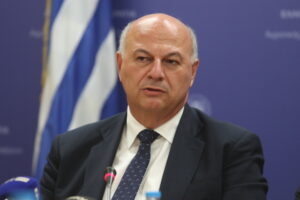
Minister of Rural Development and Food, Kostas Tsiaras, sent a clear message of accountability and reform in an interview with Real FM regarding the OPEKEPE scandal, revealing the shocking scale of fraud within the agricultural payment system.
He described the current situation as “a chronic dysfunction rooted in the past,” and stressed that, in light of ongoing inspections, “we will soon have the first results—and they will be quite resounding.”
Specifically, Mr. Tsiaras disclosed that inspections following payments to organic farming schemes uncovered staggering irregularities. “We discovered that around 30,000 producers held more than 49,000 fake certificates. Whether this was the fault of the producers themselves or involved the Certification and Control Bodies (KYD) is still under investigation,” the minister stated. He added that there is already a mass exodus from organic subsidy programs, with over 2,000 exits from organic livestock and beekeeping and another 2,000 from organic farming—where an eligibility list had already been published.
Even more worrying, he noted, are instances of beneficiaries disappearing before scheduled inspections. “Some appointments were made between inspectors and recipients of organic subsidies, and by the next day, those individuals had vanished, not even answering their phones,” Tsiaras reported.
In any case, the minister emphasized the government’s commitment to addressing the root of the issue: “This dysfunction is longstanding, with deep roots, and the responsibility is shared by many successive governments.”
Regarding the opposition parties’ conduct during the parliamentary debate on the OPEKEPE case, Tsiaras criticized them for walking out of the vote on their own proposal to establish a Preliminary Investigative Committee. “The same parties that had been pushing hard for a preliminary inquiry were the ones who eventually walked out, undermining the institutional process they had demanded,” he explained.
Tsiaras also clarified that there was no issue of constitutional legitimacy in the vote, as a quorum was present before it began, and New Democracy never left the procedure. He also noted that opposition MPs had submitted their votes by mail.
The minister stressed that the political system has a “pedagogical obligation” to send a unified message to society, rather than exploiting the issue for party politics. “The reality is this: at such a critical time, we must send a clear, educational message to society—that this systemic dysfunction must be addressed collectively,” he said.
In conclusion, Tsiaras also responded to comments made by PASOK leader Nikos Androulakis, saying: “We cannot educate society by saying, ‘there’s no issue if a farmer slightly overreports something; the real problem is when it’s done in an organized way by a criminal group.’ That’s the wrong political message, and we must state that clearly.”
Ask me anything
Explore related questions