Athens has strongly condemned Turkey’s announcement of new marine parks in the Aegean and Eastern Mediterranean, calling it an “unacceptable, unilateral and illegal action” that has no legal effect on Greece’s sovereign rights, according to a statement from the Greek Ministry of Foreign Affairs.
Turkey’s Provocation and the Blue Homeland Doctrine
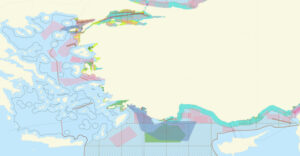
Turkey recently submitted a revised Maritime Spatial Planning map to UNESCO, reinforcing its “Blue Homeland” doctrine, as a direct counter to Greece’s establishment of the Southeast Cyclades Marine Park, once again disputing Greek sovereignty.
In its updated map, Turkey presented its proposed marine parks without including explicit “grey zones,” likely to avoid overt provocations that could escalate regional tensions. The areas involved are:
- The Northern Aegean, between Lemnos and Samothraki, and
- The region surrounding Kastellorizo, stretching up to Rhodes.
Greek MFA: “Unilateral Move Without Legal Standing”
The Greek Ministry of Foreign Affairs firmly rejected Turkey’s move:
“This is an unacceptable, unilateral and illegal action that produces no legal effect with regard to Greece’s sovereign rights,”
the ministry stated, stressing that the marine parks are being announced in undelimited areas beyond Turkey’s territorial waters.
Greece emphasized that Turkey’s move demonstrates a complete lack of respect for the international law of the sea.
“The Greek government consistently and responsibly protects our national rights and the sustainability of our seas. Reflexive and hollow actions risk undermining good neighborly relations,”
the ministry concluded.
Legal Overreach Beyond Turkish Waters
An analysis of the two maritime maps reveals that Turkey, in violation of international principles governing marine protection zones, is attempting to establish parks beyond its territorial waters, in areas it claims under its unilaterally interpreted Exclusive Economic Zone (EEZ)—at Greece’s expense.
In the Northern Aegean, Turkey uses its own version of the median line between the two countries’ mainland coasts, ignoring the existence and effect of Greek islands on maritime zones.
The outlined marine parks clearly follow Turkey’s longstanding claim over Greece’s continental shelf, dating back to the 1970s and the issuance of exploration licenses to its state oil company TPAO.
Kastellorizo Strategically Excluded
Regarding Kastellorizo, Turkey deliberately excludes the island from its marine park plans, limiting it to its 6-nautical-mile territorial waters. The aim is to portray it as isolated and lacking influence in maritime delimitation—just as Turkey has done in the past, including in 2012 with illegal exploration licenses granted to TPAO.
Turkey is once again attempting to establish on-the-ground facts that Kastellorizo should not affect future maritime delimitation—thus denying Greece an EEZ in the Eastern Mediterranean.
This approach aligns with Turkey’s demand to limit Greece’s EEZ to only 6 nautical miles off the coasts of Rhodes, Karpathos, and other islands, and follows the Turkey–Libya Maritime Agreement, whose EEZ boundaries were unilaterally submitted to the UN in 2020.
Notably, on the Turkish map, Kastellorizo appears without any maritime boundaries—not even the standard 6 nautical miles—while the waters of nearby Greek islands are also left undefined, suggesting Ankara’s belief that no sea borders exist between Greece and Turkey in the Aegean.
Future Expansions & Ankara’s Messaging
Sources cited by Turkey’s Anadolu agency stated that the number of Turkish-designated marine areas will expand in all seas, emphasizing that these zones won’t interfere with economic activity.
They further argued that international maritime law promotes cooperation among coastal states in semi-enclosed seas—like the Aegean—and reiterated that Turkey will not accept Greece’s unilateral actions or any attempt to create “faits accomplis” in the region.
Ask me anything
Explore related questions