





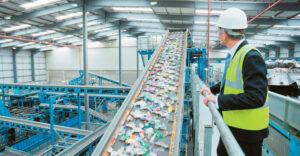
The picture is familiar in every corner of the country: garbage bags piling up on sidewalks, landfills at breaking point, and the slow—almost invisible—progress of recycling.
Greece, despite steps taken in the last decade, still buries the majority of its municipal waste in landfills, often violating European targets and paying hefty fines.
What the average citizen may not know is that, even if recycling were to skyrocket tomorrow, there would always be residual waste that cannot be recycled or composted.
These, known as Refuse-Derived Energy Raw Materials, currently end up almost exclusively in landfills. By 2030, this amount is expected to reach 1.45 million tons per year. These are wastes that have undergone special treatment and are turned into a type of pellet—small, compact fuels resembling wood or peat (fossil coal) but derived from waste.

These raw materials are divided into two main categories: Solid Recovered Fuel (SRF), a higher-quality fuel also called “class 3,” and Refuse Derived Fuel (RDF), a lower-quality fuel with more limited uses.
All new waste treatment plants produce these fuels, which are currently used by cement factories as fuel. In fact, they are paid to take them, since this saves oil and reduces their carbon footprint.
The government, realizing that recycling targets are failing and that without new infrastructure the 10% landfill limit is a pipe dream, is promoting a plan that changes the game in waste treatment: the creation of the first integrated network of six waste-to-energy plants, spatially distributed across the country from north to south, Attica, and the islands (Crete).
These six “plants” will burn non-recyclable waste as well as untreated municipal waste from the green bin (mixed refuse such as food scraps, soiled paper, plastics, etc.) and will generate electricity and heat, in line with European standards.
Overall, the energy produced from the new plants is estimated at 1,033 GWh per year, about 2% of national electricity consumption in 2030.
Currently, mixed waste is sent to Waste Treatment Plants (WTPs), where it is mechanically separated into recyclables, solid fuel RDF, and biodegradable material. What cannot be recovered goes to landfill, since no energy recovery exists.
Waste management: How we arrived at the solution of six waste incineration plants – Where they will be built, how much they will cost
Why incineration?
The word “incineration” is highly charged—and not without reason. For decades in Greece it was associated with pollution and environmental scandals. However, technology has changed radically since then. Across Europe, waste-to-energy plants operate in city centers like Vienna, Paris, and Copenhagen, without being sources of stench or toxic emissions.
The Strategic Environmental Impact Assessment (SEIA) of the Ministry of Environment and Energy, recently put up for consultation, explains that modern incineration takes place at temperatures above 850°C, on special moving grates that ensure complete combustion and neutralization of pathogens, achieving high efficiency.
The flue gases pass through multi-stage filtering systems that remove particles, heavy metals, and oxides. Emissions thus comply with strict EU Directive 2010/75 on industrial emissions.
The geography of the plan: six plants, four zones
The SEIA divides the country into four major Waste Management Zones to reduce long-distance waste transport, which would otherwise increase cost and CO₂ emissions.
Two plants in Northern Greece
- One in Kozani, the largest, with a capacity of 288,000 tons/year, located at PPC’s Ptolemaida 5 facilities. It will serve Central Macedonia, Western Macedonia, Epirus, Thessaly, and part of the Ionian Islands.
- Another, smaller one (62,000 tons/year) in Rodopi or Xanthi, covering Eastern Macedonia–Thrace.
One plant in Western Greece–Peloponnese
- In Arcadia, Achaia, or Ilia, with capacity 154,000 tons/year, serving Western Greece, Peloponnese, and part of the Ionian Islands.
Two plants in Central Greece & Attica
- One in Boeotia, serving Central Greece and part of Attica.
- Another in Attica, serving the rest of Attica, the North Aegean, and part of the South Aegean. Total capacity: 321,000–401,000 tons.
One plant in Crete
- In Heraklion, with capacity 140,000 tons/year, serving all of Crete and part of the South Aegean.
Will local communities say “yes”?
No waste-to-energy project can proceed without preparation, information, and dialogue. Local opposition has historically delayed or canceled waste projects, especially in Attica. The solution proposed: early public consultation, transparency, and proof of local benefits.
The economic basis of the plan
- High operational cost: gate fee €100–138/ton for municipalities.
- Revenues from electricity (€80/MWh) and scrap metals (€50/ton) not enough to offset costs.
- Burning seen as the only viable way to achieve <10% landfill target, but new financial mechanisms are needed for viability.
Additional revenues may come from:
- Classifying 57% of produced energy as renewable (RES).
- Using surplus heat in district heating (e.g., Western Macedonia).
Investors positioning themselves
- PPC (Public Power Corporation) leading with a 38 MW plant in Western Macedonia.
- Metlen considering Boeotia.
- Motor Oil targeting Crete.
- GEK TERNA and Mesogeios also exploring options.
Official tenders expected first half of 2026 (possibly delayed to 2027).
Challenges for investors
- Supply guarantees: steady waste feed for 25 years.
- Transport cost & fair gate fee distribution.
- Lack of flexibility in plant number/location.
- Transitional fuels in Athens raise doubts.
The scale of the challenge
- Cost: over €1 billion total, estimated €1 million per ton of waste capacity.
- Without stable rules for waste quantities, pricing, and revenue-sharing, investor interest remains cautious.
The ultimate challenge: Can Greece turn the waste problem into an opportunity for clean energy and economic growth, through a mix of institutional, technological, and social solutions that prove the future is sustainable and profitable?
PHOTO: Shutterstock
Ask me anything
Explore related questions




