





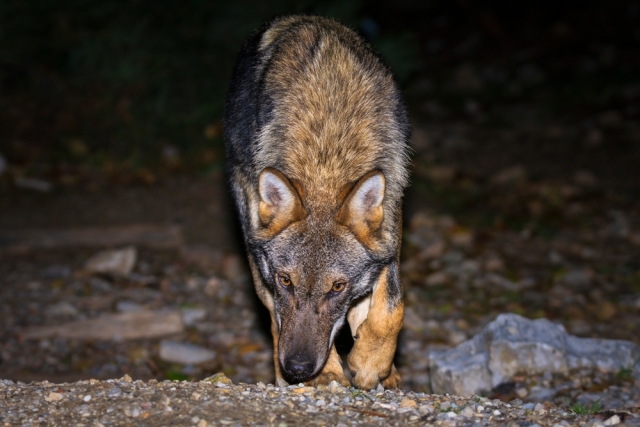
The growing presence of wolves in populated areas, public parks and tourist beaches in Greece has raised concerns over public safety, with a wildlife expert warning that authorities must intervene before potentially dangerous encounters result in injuries.
At least six incidents involving reported wolf attacks on children and adults have been recorded in Greece during 2026, highlighting the challenges posed by animals that have become accustomed to human presence.
Professor Periklis Birtsas, director of the Wildlife Management Laboratory at the University of Thessaly’s Department of Forestry, Wood Sciences and Design, told the Athens-Macedonian News Agency (AMNA) that protecting wolves must go hand in hand with safeguarding human life.
“The protection of an emblematic species of Greek wildlife must be combined with the protection of human life and the timely management of dangerous incidents,” he said.
Birtsas stressed that the grey wolf (Canis lupus) is an integral part of Greece’s biodiversity, playing an important ecological role as an apex predator and contributing to the balance of natural ecosystems.
However, he warned that conserving the species should not mean unconditionally accepting its presence in residential neighbourhoods, urban and suburban parks, crowded beaches or tourist resorts.
“This distinction does not call into question the ecological value of the species. Rather, it concerns the limits of coexistence between a large carnivore and humans, particularly in places where human activity is intense and constant,” he explained.
“Wolf conservation is an environmental obligation. Protecting human life and physical safety is an equally fundamental responsibility of the state. These two obligations should not be treated as competing priorities.”
Wolves are wild carnivores, not urban animals
According to Birtsas, wolves are highly adaptable animals capable of travelling considerable distances and occupying extensive territories.
In Greece, they primarily inhabit forests, mountainous and semi-mountainous areas, and mixed agricultural and woodland landscapes, where they can find food, shelter and suitable breeding sites.
Their adaptability means they may occasionally pass through areas close to human settlements. However, this does not make densely populated cities, residential neighbourhoods, organised beaches or busy recreational spaces suitable habitats for their permanent presence.
These are places where children play, residents walk or exercise, families spend time outdoors and pet owners take their animals.
Birtsas argued that it is neither appropriate nor environmentally sound to regard wolves establishing themselves in such settings as a normal development, particularly when their presence is associated with human-provided food or repeated approaches towards people.
While wolves should be protected in their natural habitats, their gradual adaptation to living among humans and relying on food sources associated with human activity must be prevented.
Becoming accustomed to humans changes wolf behaviour
Under normal circumstances, wolves generally avoid contact with humans.
However, Birtsas explained that repeated exposure to human activity without experiencing any perceived threat can gradually reduce the distance wolves maintain from people.
Of particular concern is the association between humans and easily accessible food.
Household rubbish, discarded food, improperly disposed of animal by-products and the deliberate feeding of wild animals can encourage wolves to return repeatedly to populated areas.
Becoming accustomed to humans does not necessarily make a wolf aggressive. Nevertheless, when this behaviour is combined with the expectation of food and repeated approaches towards people, it creates circumstances requiring specialist assessment and immediate management.
“We must not wait for a person to be injured before recognising that there is a problem requiring intervention,” Birtsas warned.
Public safety cannot depend on the assumption that an attack will not happen
The professor emphasised that assessing the risks associated with wolves entering urban, suburban and coastal areas must take into account the potential severity of an incident, not simply the likelihood of an attack.
“On an organised beach, for example, there may be hundreds of bathers, young children playing, visitors unfamiliar with wild animal behaviour and people who might attempt to approach or photograph the animals,” he said.
Such circumstances increase the likelihood of unwanted encounters while limiting the options available for managing an incident safely.
Birtsas argued that residents and visitors should not be expected to alter their normal, lawful activities or remain constantly vigilant because a wolf accustomed to humans is regularly present in residential or recreational areas.
“Public safety cannot be guaranteed through general reassurances that wolves do not usually attack humans,” he stressed. “It is ensured through scientific risk assessment, prevention, specific protocols and the ability to intervene promptly.”
At least six reported attacks in Greece in 2026
According to Birtsas, the issue is no longer merely theoretical.
During 2026, at least six incidents involving reported wolf attacks on children and adults were recorded in Greece, drawing attention to the difficulties of managing wolves that have become increasingly accustomed to human contact.
He cautioned against interpreting these incidents as evidence that every wolf in the wild poses a threat.
Nevertheless, he said the presence of wolves in urban, suburban and coastal tourist areas has generated considerable concern among residents and visitors.
The incidents also demonstrate the importance of establishing effective management mechanisms before potentially dangerous situations develop into more serious emergencies.
Prevention, Birtsas added, must address not only the behaviour of the animals themselves but also human practices that alter their natural instincts and encourage them to approach populated areas.
Coexistence between humans and wolves has limits
Coexistence between humans and wildlife is a central principle of modern biodiversity management, but Birtsas argued that it should not be interpreted as an obligation to tolerate every species in every location, regardless of the circumstances.
The conditions for coexistence in a mountainous forest are fundamentally different from those in agricultural areas used by livestock farmers or densely populated tourist resorts during the summer.
Unconditionally accepting the presence of wild animals without assessing potential risks is not necessarily an environmentally responsible approach, he said.
On the contrary, it can lead to more frequent conflicts, increase fear among local communities and ultimately undermine public acceptance of wolves and efforts to protect the species.
Calls for a clear national protocol and immediate intervention
Birtsas called for a unified, practical response protocol rather than measures introduced only after incidents attract media attention or public pressure.
Such a framework should clearly define the responsibilities of forestry services, the Natural Environment and Climate Change Agency (OFYPEKA), local authorities, public safety services and other relevant bodies.
It should include systematic reporting and assessment of incidents, identification of the species and individual animals involved, removal of food sources linked to human activity, public information campaigns and appropriate methods to deter wolves from approaching populated areas.
Given the increase in wolf populations in Greece and across Europe, the professor said the authorities should be equipped to intervene immediately whenever wolves are detected in urban, suburban or coastal tourist areas.
These interventions should be carried out by appropriately trained personnel before unpredictable behaviour or dangerous encounters occur.
Protecting wolves and safeguarding people are not opposing goals
Birtsas concluded by calling for a national policy that combines the conservation of viable wolf populations in suitable natural habitats with practical measures to protect residents, visitors and their activities.
He also emphasised the importance of compensating people for verified damage caused by wolves.
“Wolves have their place in the Greek natural environment. However, their presence in cities, places where children play and crowded tourist beaches should not be regarded as normal or desirable,” he said.
“The aim is not to choose between humans and wolves, but to establish a scientifically grounded management system that protects both.”
Effective wildlife conservation, he concluded, depends on public acceptance, clearly defined boundaries, responsible intervention and, above all, respect for human life.
Ask me anything
Explore related questions




