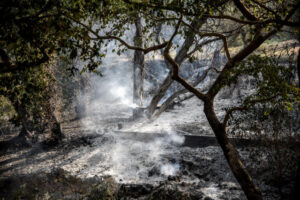
“The large wildfire that broke out in the Sychaina area of Patras on August 12, along with the planning required to restore the damages and the natural environment, and the need to raise citizen awareness, make it imperative to plan for adaptation and mitigation of climate change impacts in the city,” he told the Athens–Macedonian News Agency (ANA-MPA).
He added:
“Things will not be the same from now on, because the fire in Sychaina changed the vegetation in the area and therefore the microclimate will change too. For this reason, the future of Patras’ climate adaptation must be designed.”
Unique meteorological conditions
As Kazantzidis explained, Patras has very particular atmospheric characteristics:
- The city lies between a large mountain and an arc-shaped coastal expansion.
- Winds can blow from opposite directions simultaneously: during the Sychaina fire, a northeasterly wind affected one part of the city, while a southwesterly wind blew in another.
This results in distinct microclimates within different parts of the city, both at low and high altitudes. He noted that such phenomena can cause large variations in air pollution depending on place and time.
For example, during the wildfires in Western Achaia and later Sychaina:
- A mild westerly–southwesterly wind in Western Achaia helped control the fire.
- In contrast, a strong northeasterly wind (≈ 5 Beaufort) in Sychaina worsened the situation.
The “Aitheras” network
Referring to pollution caused by particulate matter in Patras due to the Sychaina fire, Kazantzidis said that the Laboratory of Atmospheric Physics carried out measurements through the “Aitheras” network, which has been operating for research purposes for about nine years.
- The network tracks suspended particles, particularly fine particulate matter, across the city.
- Data showed that smoke from the Western Achaia fire did not affect Patras, as winds carried it westward over the Ionian Sea.
- But the Sychaina fire polluted the entire city, from the Rio–Antirrio bridge southwards.
Pollution levels
He noted that at certain times, triple-digit particle concentrations (µg/m³) were recorded—far above the 25 µg/m³ threshold, after which air quality is already considered poor.
Significantly, the monitoring stations are not located inside burned areas but oriented toward the urban zone, highlighting how severely conditions deteriorated.
The worst moment came at dawn on Wednesday, August 13, when late on the 12th the Sychaina fire erupted. Stations in Synora and Kritiká, closer to the fire, recorded high pollution levels, though by Thursday, August 14, conditions had improved somewhat.
Looking ahead
“Now things have changed,” Kazantzidis stressed, adding that researchers are working to expand the Aitheras network:
“For us, a new phenomenon is unfolding. Of course, we do not aim to replace any official body that could carry out measurements, but rather to provide information whenever requested.”
Ask me anything
Explore related questions