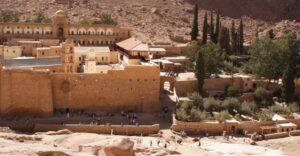
The situation at the Monastery of Sinai has reached a critical point, as the monks who were expelled yesterday after their failed coup remain outside the gate and are attempting to force their way back inside.
Archbishop Damianos of Sinai has appealed to the Egyptian authorities to take action for their removal, denouncing threats against his life as well as moves to initiate legal proceedings against him. According to his close associates, the Archbishop remains inside the Monastery, while the insurgent monks are continuously summoning supporters and trying through shouting and pressure to re-enter the compound. The same sources note that although Egyptian police are present nearby, they have so far refrained from intervening to disperse them.
On the contrary, witnesses report that officials in contact with the authorities have allegedly advised the Archbishop and the brotherhood to allow the rebels back into the Monastery—something that has sparked deep concern for both the safety of the community and the smooth functioning of the monastic complex.
The crisis at the Sinai Monastery is developing into an issue with serious religious, institutional, and diplomatic implications, given the historic importance of the site and the necessity of safeguarding its uninterrupted operation.
The “Neutral Stance” of the Patriarchate of Jerusalem Fuels the Crisis
Meanwhile, the already tense situation at St. Catherine’s Monastery in Sinai has been further inflamed by a carefully worded statement from the Patriarchate of Jerusalem, following a visit by its delegation to the Monastery.
The communiqué, issued from Jerusalem, appears primarily aimed at reaffirming the Patriarchate’s canonical jurisdiction over the Monastery. By maintaining a stance of “equal distance,” however, it effectively stopped short of condemning the coup attempt against the Monastery’s abbot, Archbishop Damianos.
The content of the statement reveals Patriarch Theophilos’ intention to assert greater control over the Monastery—even though traditionally the Patriarchate’s role was limited to the ordination of each new Abbot. In cases of refusal, ordination was carried out by the Ecumenical Patriarch instead. The announcement was accompanied by a photo of the delegation with the monks of the Monastery, while notably omitting the photo of their meeting with Archbishop Damianos, the Abbot.
Ask me anything
Explore related questions