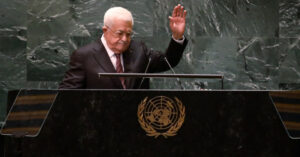
The president of the Palestinian Authority, Mahmoud Abbas, will not be able to attend the UN General Assembly in New York next month, as the United States canceled his visa along with those of about 80 other Palestinian officials. The decision was confirmed by the U.S. State Department, with Secretary of State Marco Rubio stating that the Palestinian leadership “undermined peace efforts” and is seeking “unilateral recognition of a hypothetical Palestinian state.”
The move is considered unusual, as the U.S., as host country of the UN, is obliged under the UN Headquarters Agreement to facilitate access for all officials participating in meetings, regardless of their bilateral relations with Washington. The fact that the ban comes at a time when France and other countries—including the UK, Canada and Australia—have announced they will proceed with recognition of a Palestinian state, adds greater political weight to the decision.
The Palestinian side reacted strongly to the decision. Abbas’ office described the visa revocation as a “flagrant violation of international law,” stressing that the State of Palestine has been a UN observer member since 2012. The Palestinian ambassador to the UN, Riyad Mansour, had already announced that Abbas would lead the delegation to the General Assembly, something that is now no longer possible.
In contrast, Israel welcomed the American stance. Foreign Minister Gideon Sa’ar declared that “the State Department’s decision is justified,” while Prime Minister Benjamin Netanyahu reiterated his longstanding position that recognition of a Palestinian state would amount to “rewarding Hamas terrorism.”
Along the same lines, Rubio accused the Palestinian Authority and the Palestine Liberation Organization (PLO) of being “unable to be considered peace partners” as long as they do not renounce terrorist attacks such as the massacre of October 7, do not end “incitement to terrorism in education,” and continue to appeal to international courts against Israel.
At the UN, spokesperson Stéphane Dujarric emphasized that there will be communication with Washington, stressing that “it is important that all member states and permanent observers are represented at the General Assembly.” This is particularly relevant, he noted, ahead of the special session on the two-state solution, to be co-organized by France and Saudi Arabia.
The U.S. decision raises questions regarding compliance with its international obligations, while the political balance around the Palestinian issue appears to be entering a new phase, with recognition of statehood by more Western countries now looming.
Ask me anything
Explore related questions