





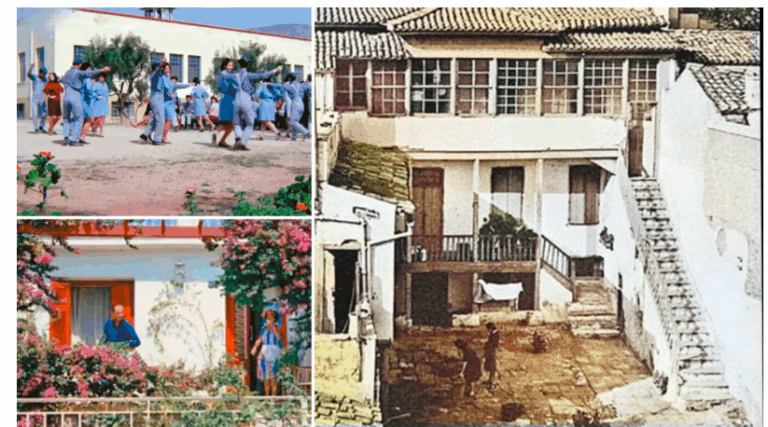
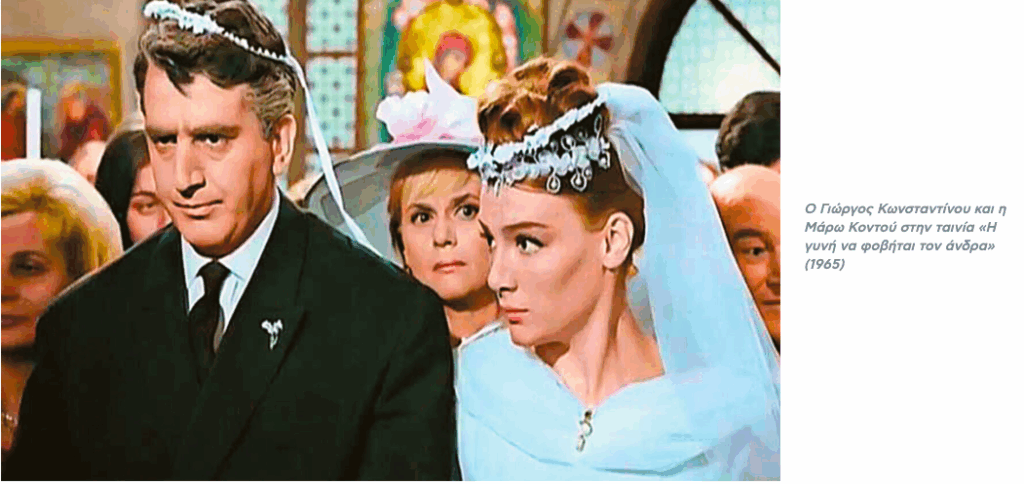
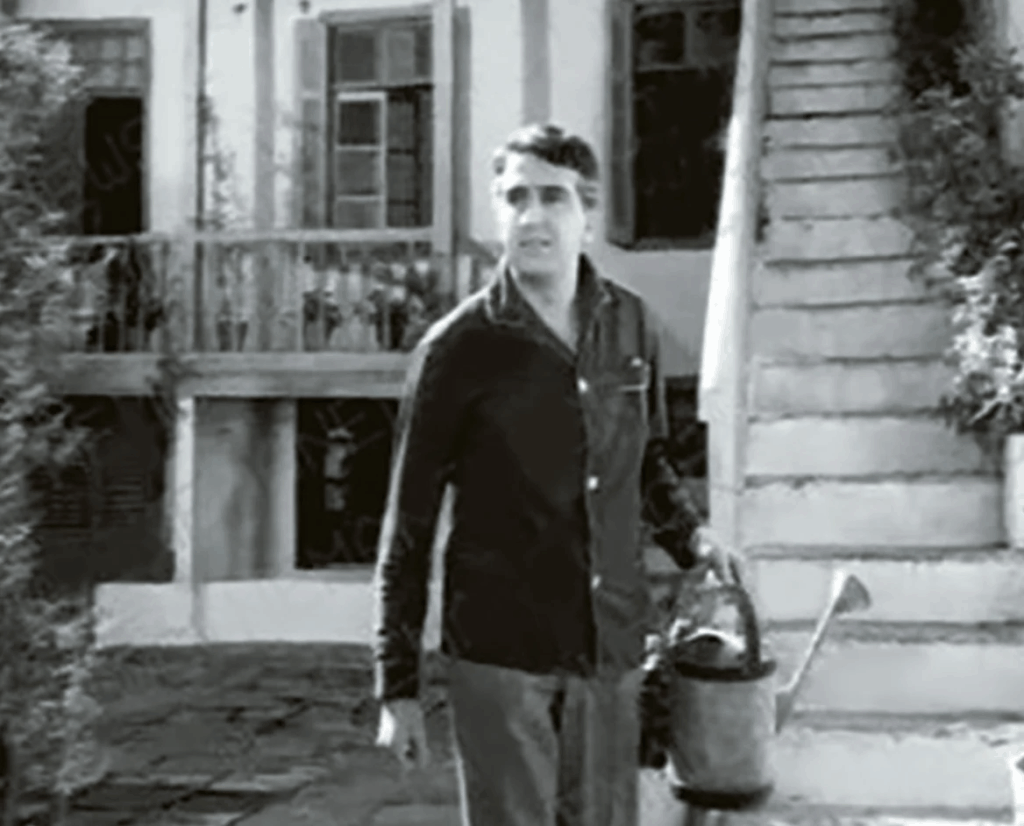
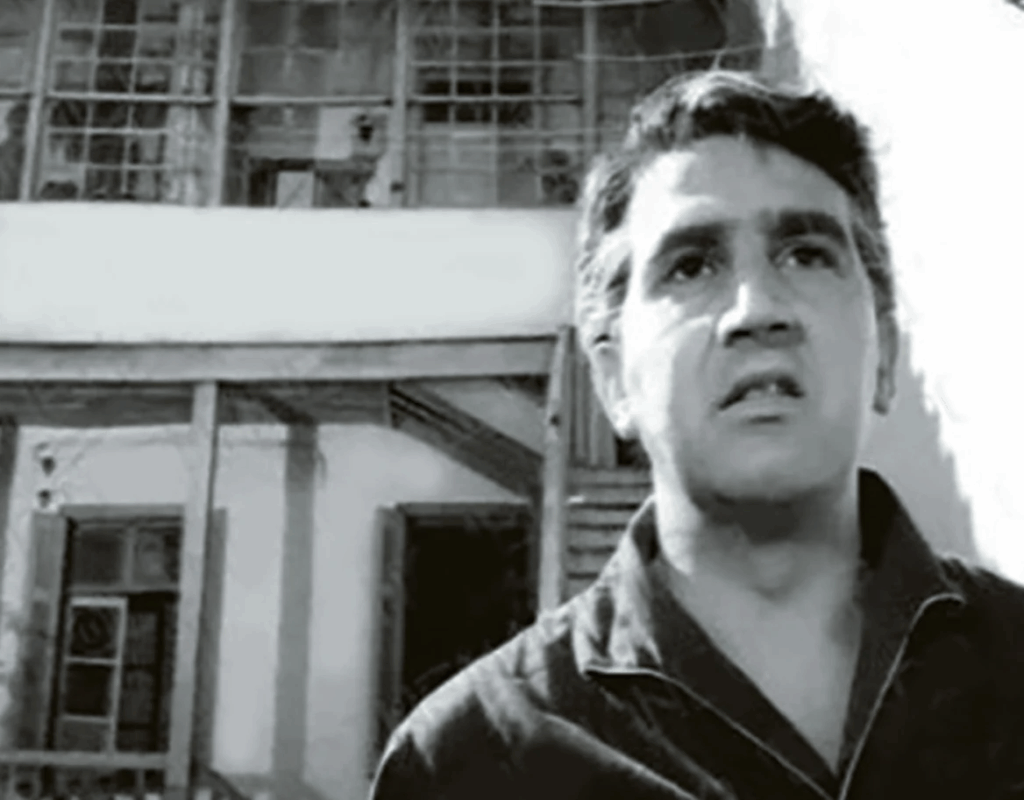
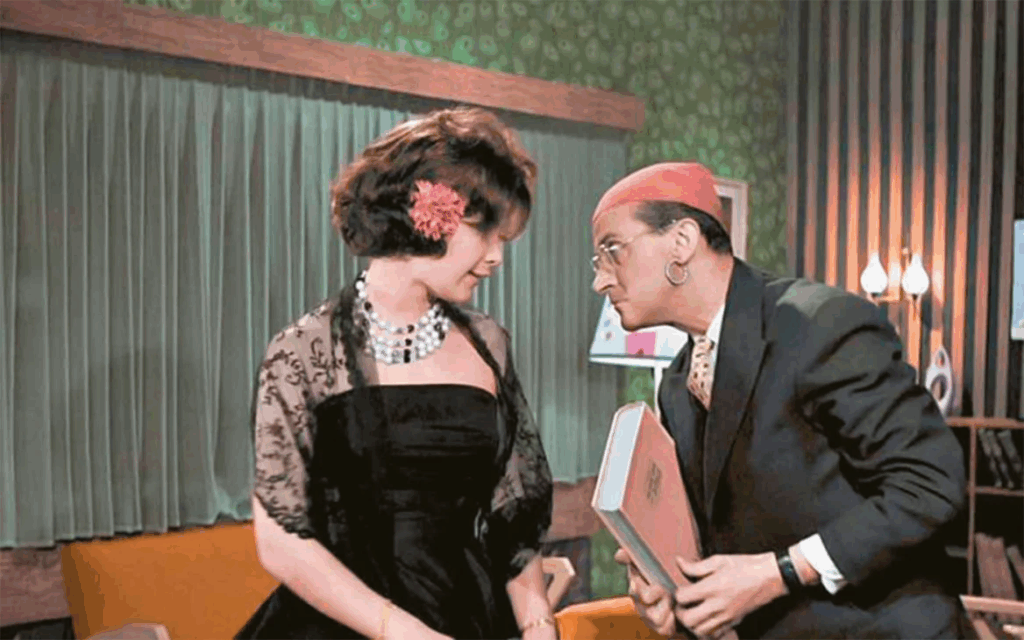
Giorgos Konstantinos and Maro Kondou, two living legends of Greek cinema and theater since the 1960s, starred in the significant romantic comedy “The Woman to Fear the Man” by Giorgos Tzavellas. Most of the film was shot in a house at 32 Tripodon Street in Plaka—a three-story old building, now in ruins, which once embodied the birthplace of modern Athens and still retains the character of the old city.
Affordable Entertainment
This is the essence of Greek cinema of those decades—from the War period until television pushed it aside. It was the cheapest, most accessible form of mass entertainment, captivating audiences watching the white screen. During Greece’s golden cinematic era, hundreds of films were produced, including dramas, comedies, musicals, crime thrillers, adventures, and war movies—some true masterpieces, others more hastily made. These films drew millions of viewers.
Between 1959-1967, 704 films were produced. From 1959-1963, ticket sales reached 8,292,955, and during the 1963-1964 season, an unprecedented 12,471,089 tickets were sold.
One might agree or disagree with the ideals portrayed: the good versus evil, the honest but poor worker, the arrogant and overbearing rich, the clever con artist, the conspirator, the hero, the petty criminal, and the obligatory happy ending (one in three films ending at church steps). The list of morals and characters is endless. While social distances were artificially minimized or even erased in these films, they still depicted stories from real life.
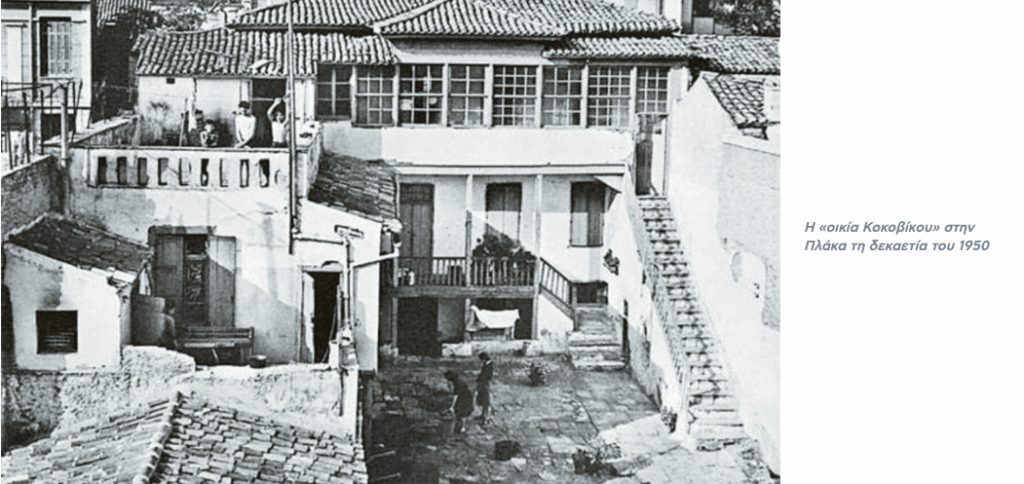
And everyone agrees that through these movies, we glimpse our past—Athens and its neighborhoods from 60 or 70 years ago—the streets and houses, how they looked then and how they look today. Some of these, like the “Kokovikos House” and others seen in films, have become landmarks of an era and symbols of the social fabric of that time. Among them, Levidis Villa in Pallini, and characteristic single-family homes in Kifisia, Filothei, and other areas.
Today, these films are passionately watched by new generations. For those curious, the poet long ago offered an answer: “They feel an immense nostalgia for all that they have not experienced.”
The Ministry of Culture’s decision to restore the “Kokovikos House,” now completely abandoned, to turn it into a cinema museum dedicated to Greek films, brings joy to cinema and architectural heritage enthusiasts. Since 1995, it has been designated a historic preserved monument.
The “Kokoviko House” in Plaka during the 1950s
The house was built around 1800. Its first occupant was the cadet Haji Khalil (or Haji Khalil Efendi). He lived there when the Revolution in Athens erupted on April 25, 1821. The Ottoman Porte summoned him to Constantinople.
There, he refused to issue orders for massacres against Orthodox Greeks and others in the territory he controlled. He paid with his life—executed after inhumane torture, almost paralyzed, in Afyonkarahisar, under Sultan’s orders. Later, the house changed owners multiple times and even hosted a private school for a period.
It was expropriated in 1979 for archaeological purposes. In the early 2000s, excavations in the courtyard and interior revealed finds from Classical and Byzantine periods. In September 2014, it was auctioned by TAIPEΔ with a starting price of €900,000—an extremely high amount for the 411.37 sq.m. plot and 266 sq.m. building. After public protests, no bids were submitted.
Legends of Levidis Villa
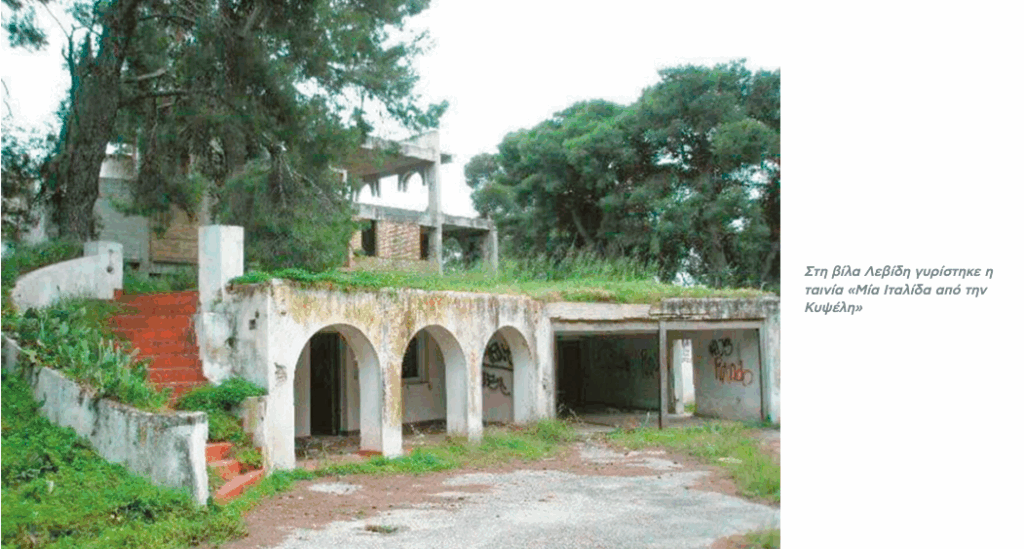
At Levidis Villa, also known as the “Tower with 70 Rooms,” many films have been shot. It is an imposing building located on the hill of Pallini that bears its name. It enjoyed great fame during the golden age of Finos Films. On its steps, one can imagine Dimitris Papamichail searching desperately for Aliki Vougiouklaki in the film “The Queen and the Tramp.”
Today, it is in complete ruin, with only its skeleton remaining. Levidis Villa is surrounded by urban legends and conspiracy theories. It was built in 1935, entirely of Pentelic marble, on an expansive 80-acre estate, by architect Konstantinos Sakellarios.
A distinctive feature is the tower at the entrance, considered one of the architectural gems of the era. In 1955, King Pavlos transferred the property to the courtier of the Tatoi royal estate, Dimitris Levidis. He lived there with his family until 1963, when he died. Subsequently, his widow, Toula Botsi—former star of Greece—due to financial pressure, decided to exploit the villa’s beauty and rented it out to film production companies.
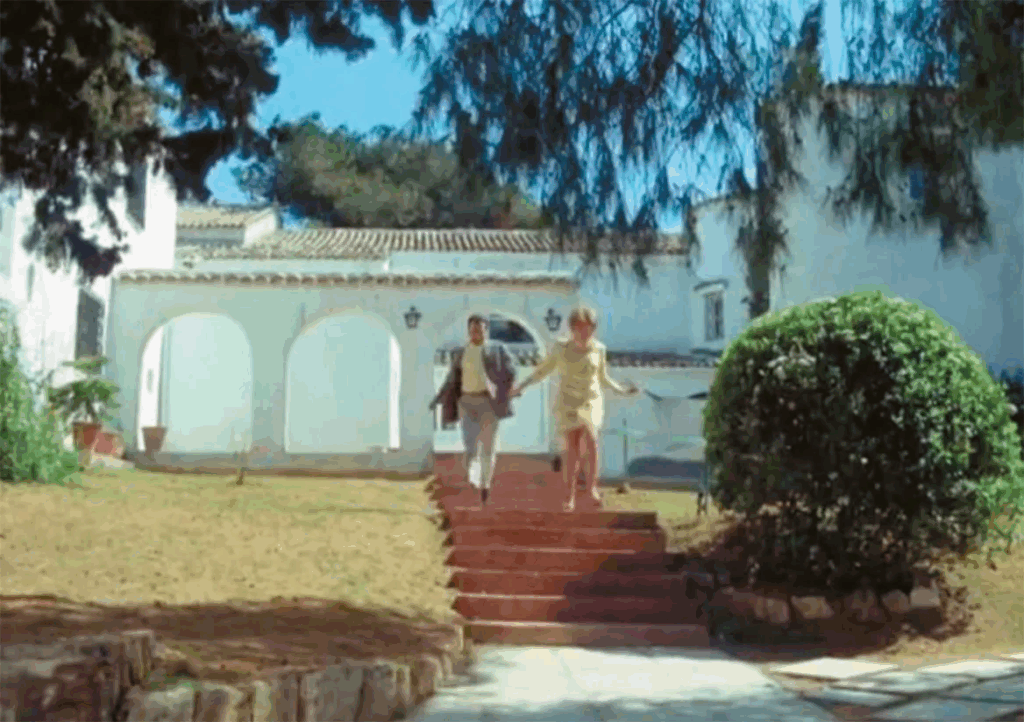
Some of the movies featuring Levidis Villa include “A Girl from Kypseli” (1967), “The Lady and the Tramp” (1968), “The Brave Little Boy” (1969), “Beautiful Days” (1970), “The Man with the Tricycle” (1972), “The Diktator Calls Thanasis” (1973), “Lovers of the Dream” (1974), “The Terrorist” (1975), and “Cunning Female, Deceitful Woman” (1980).
Many scenes from “A Girl from Kypseli” (1967) were shot at Levidis Villa.
It was also used as a studio in the 1980s, such as for films like “I Play Like a Man” (1983), “Lalakis the Imported” (1984), “Tall, Skinny, and Liar” (1985), “A Pilot for Disposal” (1987), and many others.
After Toula Botsi’s death in 1990, her son sold the villa to Greek entrepreneurs, whose identities remained unknown. However, just hours before signing the transfer contracts, the villa was completely destroyed by fire.
The burned villa was inevitably vandalized. Over the years, various people, believing they would find hidden treasures, dug into walls and floors, even removing cables to sell them. In 2007, the villa was transferred to Cypriot entrepreneurs, but the area was designated forest land, and the new owners could not make use of it.
Decades later, another theory emerged. The complete abandonment of the villa gave rise to rumors that it was used as a nighttime refuge. It is also rumored that even Satanic groups used it for their rituals. Many findings on the walls suggest a connection between the villa and Satanic organizations, though no concrete evidence exists.
The Single-Family House in Kifisia
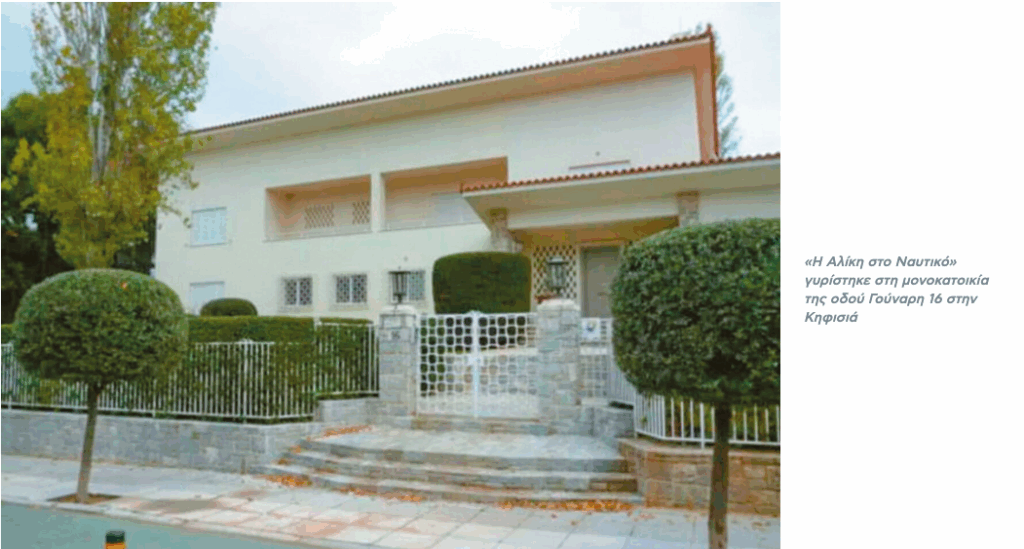
Another iconic house in Greek cinema is the one located at 16 Gounari Street in Kifisia. It was usually used by directors to vividly depict the social distance between the wealthy upper class and the poorer strata.
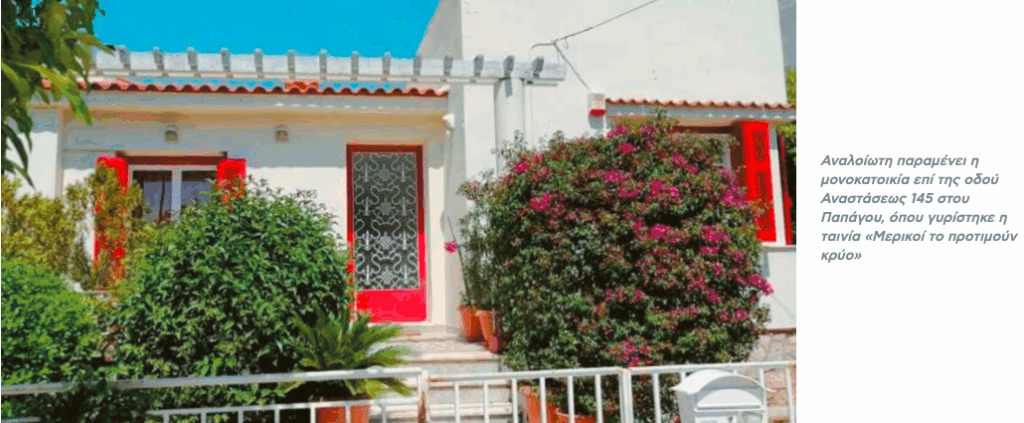
Many memorable films of Greek cinema were shot there, including collaborations between Vougiouklaki and Papamichail, many directed by Alekos Sakellarios and produced by Finos Films. Among these, “Alice in Naval” and “Knocking on the Desk” were filmed in the same house. It was also the residence of Liza Papastavrou, played by our national star in the 1959 film “The Wood Came Out of Paradise,” as well as Sakellarios’s.
Today, it looks as if time has stood still. Externally, it remains unchanged—such as the garden where the spoiled student used to have her lavish breakfast with her mother, or the entrance where the sailor driver of her father (Lambros Konstantaras) waited to carry her luggage for her next educational trip by ship.
The “Papatrehas” in Pagrati
In another beloved film, “Papatrehas” (1966), directed by Henryk Thalassinos, Thanasis Vengos stars as a doorman of an apartment building. He struggles to manage the tenants to marry off his six sisters before he himself can climb the church stairs with his beloved.
The film was shot in a building at 151-153 Ymittou Street and Arrivou Street in Pagrati. One of the most remembered scenes is Vengos smashing the entrance glass like it wasn’t there, turning it into shards—without getting hurt, of course.
This scene was shot without a stunt double, with Vengos risking a dangerous injury. Another famous scene features him carrying the overweight Mrs. Kalliakouda (Rena Paschalidou) on his back, having previously placed a “broken” sign on the elevator to earn twenty dollars.
Looking at the current appearance of the building, it appears almost identical. However, the entire area has changed dramatically due to extensive development over the subsequent years.
Unaltered and Ruined
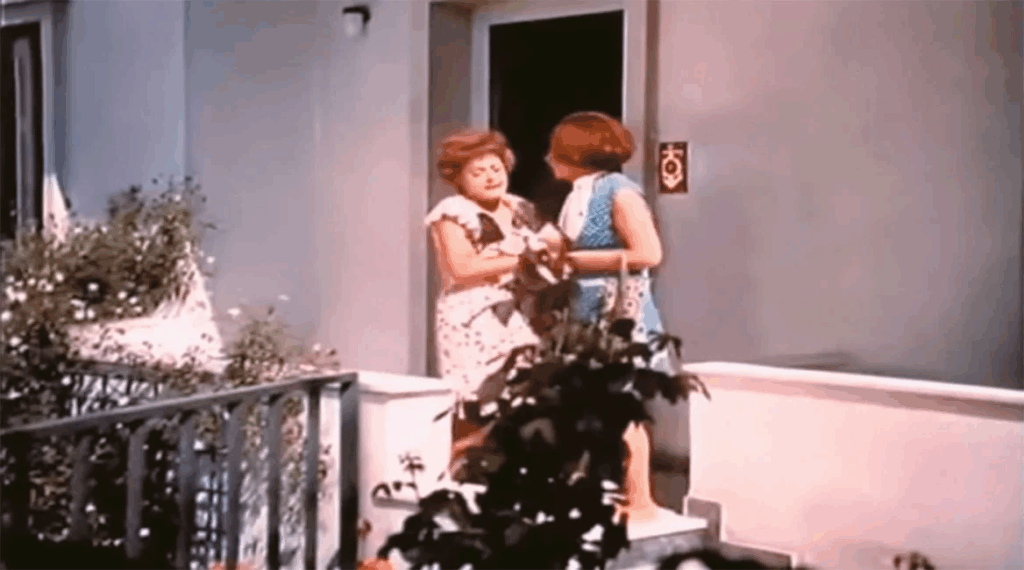
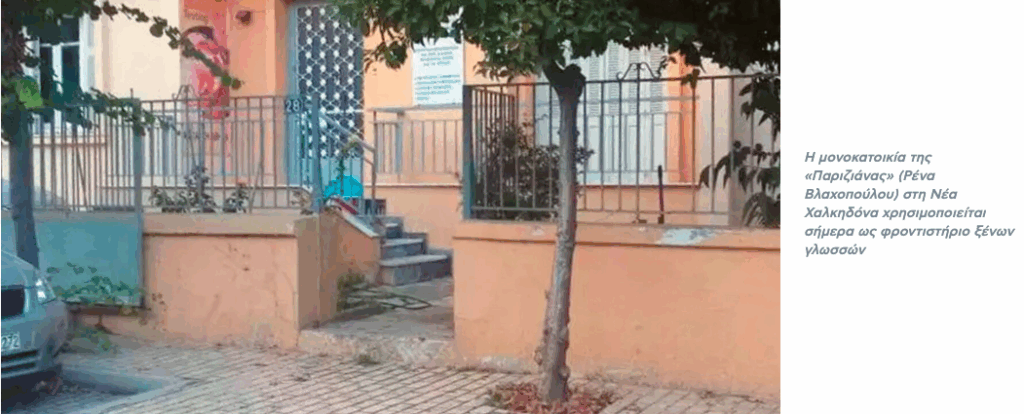
The single-family house where the hit film “The Parisian” (1969), starring Rena Vlachopoulou as Pelagia—who becomes Pelazi—was shot, looks untouched by time. Located at 28 Crete Street in Nea Chalkidona, it retains its small entrance stairs and iron fence, just as it was when the iconic line “Souzi, do you eat? And lie, and eat!” echoed inside. On the terrace, Vangelis Seilenos used to dance. Its use has only changed; it now functions as a language school.
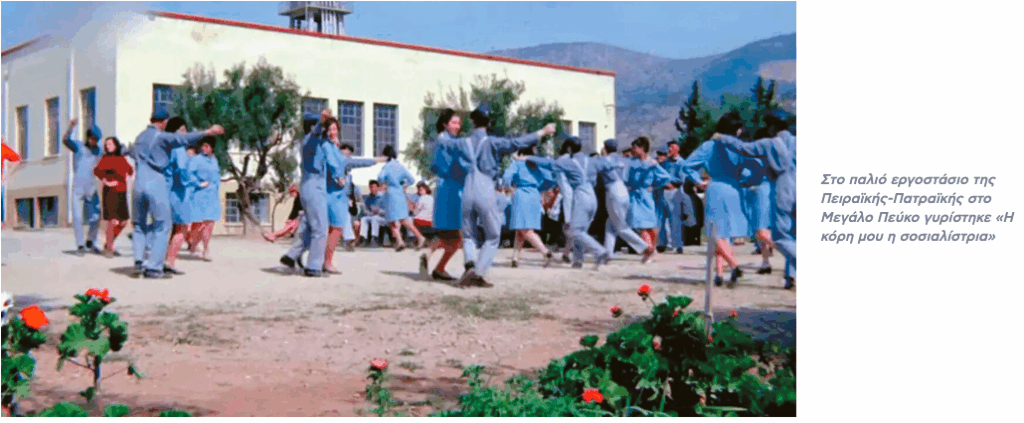
Another notable building is the former factory of Piraiki-Patraiki in Megalo Pefko, which was used in Alekos Sakellarios’s 1966 film “My Daughter the Socialist.” The factory, once Greece’s largest textile industry operating until 1996, was built in 1950.

Many scenes were shot in the yard of the factory, from choreographies to stone fights. Today, only ruins remain.
The Benaki Megaron
Many Greek films feature scenes set in business offices, ministers’, or other government officials’ offices. One building in downtown Athens is particularly associated with numerous films: the Megaron of Bodosakis, at the corner of Amalias Avenue 20 and Sourou 5, where the office of the late businessman’s group was located. Since January 1, 2024, it has been leased to the Parliament for official use.
This symmetrical, six-story corner building was constructed between 1949-1958 based on designs by architect Andreas Ploumis. Professor Eleni Fessa-Emmanouil describes it as “classic-modernist” or an example of “how a new building can essentially be old or academically styled.”
For the film “The Little Friend of the Lady” by Giannis Dalianidis, the offices of a steelworks led by Dionysis Papagianopoulos and with an employee played by Dinos Iliopoulos, who ultimately marries his boss’s daughter (Jenny Karezi), were set up inside. The same building also served as the headquarters of a steel company in Kosta Andritsos’s “Out, Thieves!” where, overnight, the managing director Dionysis Papagianopoulos is demoted from CEO by the new owner Orestis Makris to doorman, in uniform.
The former Megaron of Bodosakis became the set of “The Little Friend of the Lady.”
Furthermore, the building was transformed into the offices of a construction company in the film “Miss Director” by Dinos Dimopoulos, where Jenny Karezi, the new director-engineer, meets and falls in love with the sub-engineer Alexis Alexandrakis.
In the same film, a house in Filothei at 17 Kodrou Street is used as the residence of the family of factory owner Apostolos Lambirikos (Dionysis Papagianopoulos) in the film “For Whom the Bell Tolls” by Orestis Laskos. This house remains in excellent condition to this day.
The Filmos Film Building
The building housing the offices of Filmos Films at 53 Chios Street, opposite the Church of St. Paul, has been used repeatedly in film scenes. In 1954, Filopimin Finos moved his company’s offices there, leaving the old three-story building at 27 Stournari Street. The Chios Street premises housed Greece’s finest film laboratories until then, including a projection hall, sound editing studio, technical processing room, and editing studio.
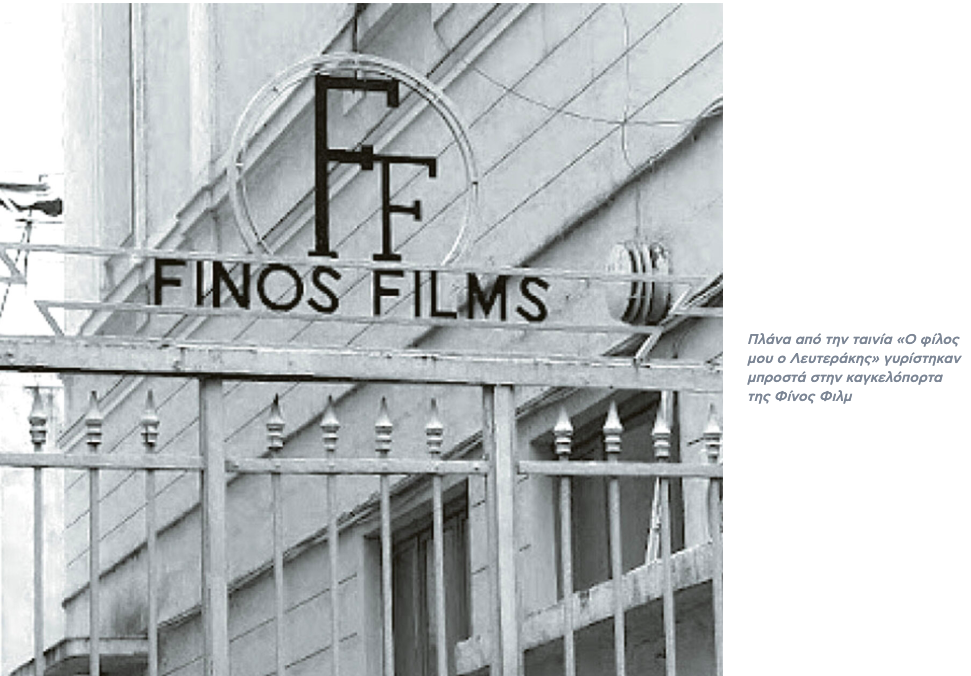
It’s no coincidence that it was called “the Hollywood of Athens” at the time. To save costs, the building was also used as a set in various films—both exterior, with its characteristic wrought-iron gate, and interior. Observant viewers will notice that the Finos Films emblem on the gate was replaced twice with names of clinics for the needs of two different films.
First, in 1963, in Alekos Sakellarios’s comedy “My Friend, Lefterakis,” Dinos Iliopoulos is taken from the Neurology Clinic “V. Karatzamoulis,” accompanied by his wife (Maro Kondou) and Lefterakis (Kostas Voutsas), to be seen by the doctor-professor (Christos Tsaganéas), who helps him recover from delirium.
Scenes from “My Friend, Lefterakis” were filmed in front of the Finos Films gate.
A year later, the same building in “The Card Player” by Giannis Dalianidis is transformed into the “Saint Panteleimon” Clinic, where the family’s daughter (Chloe Lianou) is hospitalized.
In Dalianidis’s “Barefoot Prince” (1966), the building becomes a police station, where Voutsas ends up with his pirate boat. In Nikos Foskolos’s “Locus of Hatred” (1968), the gate and courtyard are used as the entrance to the Forensic Laboratory, where Kostas Kazakos visits at night.
In Nicos Foskolos’s “Zero Visibility” (1970), the building is converted into the offices of shipowner Horst Richter’s shipping company (Manos Katrakis). Furious relatives of the shipwrecked on “Christina” storm the premises and eventually break through the gate to storm the yard. The iconic character is the only survivor, sailor Angelos Kreouzis (Nikos Kourkoulos), with scenes shot inside the building for the first time.
Ask me anything
Explore related questions




