





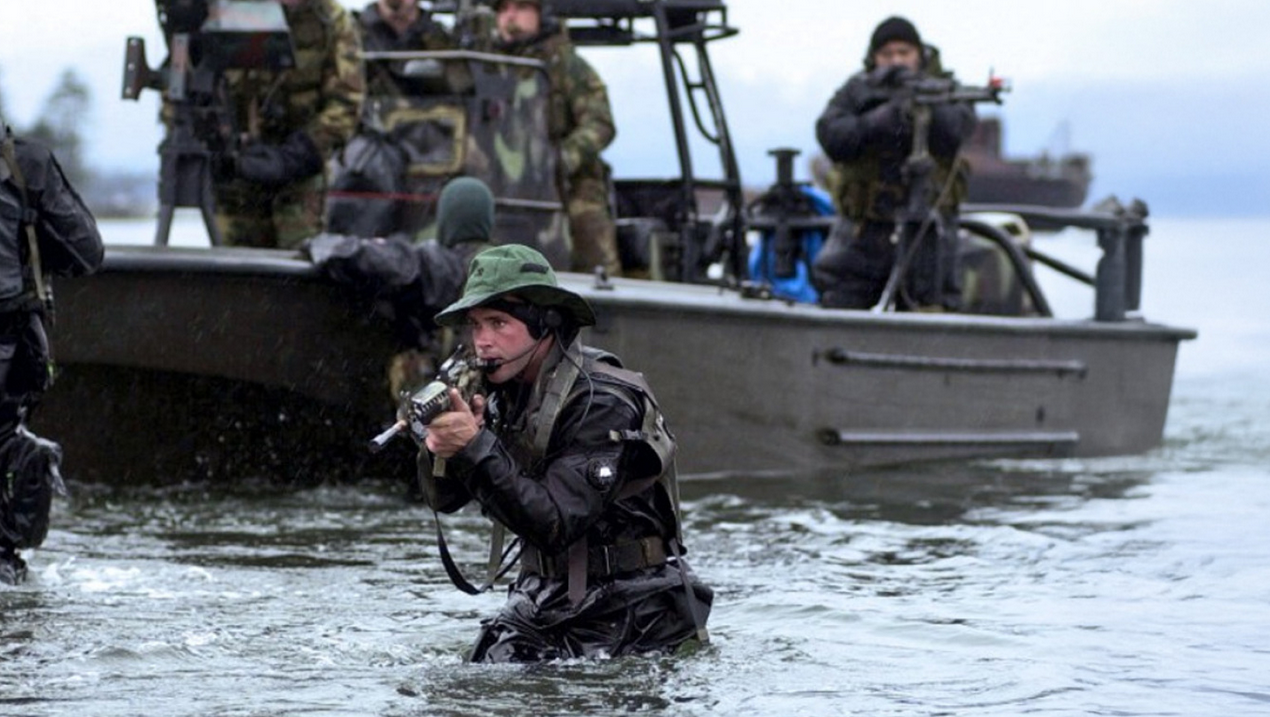
A team from the “cream of the crop” of U.S. special forces, the famed Navy SEALs, emerged from the dark ocean on a winter night in early 2019 and approached a rocky shore in North Korea. The elite American commandos were on a secret mission, so complex and important that everything had to go exactly right.
Their mission was to install an electronic device that would allow the United States to monitor the communications of North Korea’s isolated leader, Kim Jong Un, amid high-level talks that were at that time taking place with U.S. President Donald Trump—during his first term.
The operation had the potential to provide the U.S. with a stream of valuable intelligence. But if the American commandos were detected on North Korean soil, not only would the talks collapse immediately, but even worse, it could trigger a hostage crisis or an escalation of conflict with a nuclear-armed adversary.
It was so risky that it required the president’s direct approval, according to the exclusive—and revealing—report by The New York Times.
For the mission, the military selected the Red Squadron of SEAL Team 6—the same group that eliminated Osama bin Laden. The SEALs prepared for months, knowing that every move had to be flawless. But when they arrived at what they believed was a deserted coastline that night, wearing black diving suits and night-vision goggles, the mission quickly began to unravel.
A North Korean boat appeared from the darkness. Searchlights from its bow swept across the water. Fearing they had been detected, the SEALs opened fire. Within seconds, everyone on the North Korean vessel was dead. The SEALs retreated into the sea without ever placing the surveillance device.
The U.S. and North Korea act as if it never happened
The 2019 operation has never been publicly acknowledged. The U.S. and North Korea act as if it never happened. The details remain classified and are being revealed for the first time through testimonies from those directly involved and others with knowledge of the matter, who spoke anonymously to the NY Times.
The Trump administration did not inform key members of Congress who oversee military operations, either before or after the mission—acting illegally, most likely. The White House declined to comment.
It remains unclear how much North Korea managed to discover about the mission. But the SEAL operation is another chapter in the decades-long effort by U.S. administrations to infiltrate North Korea and curb its nuclear programs. Almost nothing the U.S. has tried—neither promises of closer relations nor the pressure of sanctions—has worked.
The top-secret plan and the mission…blindfolded
The plan called for the Navy to send a nuclear submarine, nearly the length of two football fields, into waters near North Korea, and then deploy a small team of SEALs in two mini-submarines, each about the size of a whale, that would silently approach the shore. The SEALs would ride submerged in 40-degree water for about two hours to reach the coast, using self-contained diving equipment and heated suits to survive. Near the beach, the mini-subs would release a team of about eight SEALs, who would swim to the target, plant the device, and then return to the sea. But the team faced a serious limitation: they would have to operate almost completely blind.
Normally, Special Operations forces rely on drones above the mission, streaming high-definition video of the target, which SEALs on the ground and their senior commanders in distant operations centers can use to guide the operation in real time. Often, they can even monitor enemy communications.
But in North Korea, any drone would be detected. The mission had to rely instead on satellites in orbit and spy planes flying in international airspace, which could provide only relatively low-resolution still images, officials said. These images would arrive not in real time but with a delay of several minutes—at best. Even then, they could not be transmitted to the mini-subs, because a single encrypted transmission could expose the mission. Everything had to be done under almost total communications blackout. If something awaited the SEALs on the shore, they might not learn about it until it was already too late…
The President’s green light and a series of…unfortunate events
SEAL Team 6 trained for months in U.S. waters and continued preparations into the early weeks of 2019. That February, Trump announced that he would meet Kim in Vietnam at the end of the month. For the mission, SEAL Team 6 partnered with the Navy’s premier underwater unit, SEAL Delivery Vehicle Team 1, which had been conducting mini-submarine reconnaissance for years. The SEALs boarded the nuclear submarine and headed toward North Korea. When the submarine was in the open ocean and ready to cut all communications, Trump gave final approval.
The submarine approached the North Korean coast and launched two mini-subs, which moved toward a point about 100 meters from the shore, in shallow water. The mission planners had tried to compensate for the lack of live aerial imagery by monitoring human activity in the area for months. They studied fishing patterns and picked a time when boat traffic would be minimal. Intelligence suggested that if the SEALs arrived quietly at the right spot in the middle of a winter night, it was unlikely they would encounter anyone. The night was calm, and the sea was still. As the mini-subs closed in on the target, their sensors indicated the intel was correct. The shoreline looked empty.
The mini-subs reached their designated parking spot on the seabed. There, the team made perhaps the first of three small mistakes that seemed minor at the time but may have doomed the mission. In the darkness, the first mini-sub settled on the seabed as planned, but the second overshot and had to turn around, officials said.
The plan called for the mini-subs to park facing the same direction, but after the second sub’s turnaround, they ended up pointing opposite ways. Time was short, so the team decided to deploy the commandos to shore and fix the problem later.
The hatches opened, and the heavily armed SEALs swam silently underwater toward the shore, carrying the surveillance device with them. Every few meters, they surfaced slightly to check their surroundings. Everything seemed clear.
That may have been the second mistake. In the darkness, a small boat carrying a group of North Koreans drifted nearby. They were difficult to detect because the SEALs’ night-vision goggles relied partly on heat sensors, and the North Koreans’ wetsuits were chilled by the icy seawater.
The SEALs reached the shore, believing they were alone, and began removing their diving gear. The target was just a few hundred meters away. Behind them, the operators tried to reposition the misaligned mini-sub. With the hatches open for visibility and communication, one of the pilots engaged the electric motor to move it into place.
That may have been the third mistake. Some SEALs later argued that the motor noise could have drawn the attention of the North Korean boat. And if the crew heard the hum and turned to look, they might have spotted light from the open hatches glowing in the dark water. The boat began moving toward the mini-subs. The North Koreans swept flashlights across the water and spoke as if they had noticed something.
Some of the mini-sub pilots later told officials that from their position, looking through the clear water, the boat still seemed at a safe distance, and they doubted the subs had been spotted. But the SEALs on the beach saw it differently. In the dark sea, the boat appeared almost on top of the mini-subs.
With communications blocked, there was no way for the team ashore to coordinate with the subs. Beams from the boat cut across the water. The SEALs didn’t know if they were seeing a security patrol hunting them or just a group of fishermen, unaware of the high-risk mission unfolding around them. A man from the North Korean boat jumped into the sea.
If the team onshore ran into trouble, the nuclear submarine carried a backup SEAL team with inflatable speedboats. Farther out at sea, stealth helicopters were staged on U.S. Navy ships with even more Special Forces soldiers, ready to intervene if necessary.
The execution of civilians
The SEALs faced a critical decision, but there was no way to discuss their next move. The mission commander was miles away. Without drones and under a communications blackout, many of the technological advantages the SEALs usually relied on were stripped away, leaving a handful of men in the middle of nowhere, unsure of what to do. As the team onshore watched the North Korean in the water, the senior SEAL on the beach chose to act. Without a word, he aimed his rifle and fired. The other SEALs instinctively did the same.
If they weren’t sure their mission had been exposed before opening fire, they had no doubt immediately afterward. The plan required the SEALs to abort immediately if they encountered anyone. North Korean security forces might soon be closing in. There was no time to place the device.
The team onshore swam to the boat to confirm that all the North Koreans were dead. They found no weapons or uniforms. The evidence indicated that the crew—reported by mission officials to be two or three people—were civilians diving for shellfish. All were dead, including the man in the water. The SEALs dragged the bodies back into the sea to hide them from North Korean authorities. One source added that the SEALs stabbed the lifeless bodies with knives to ensure they would sink.
The SEALs swam back to the mini-subs and sent a distress signal. Believing they were in immediate danger, the large nuclear submarine executed a risky maneuver in shallow waters near the coast to recover them, then sped back into the open ocean. All the American soldiers escaped unharmed.
Shortly afterward, U.S. spy satellites detected increased North Korean military activity in the area. Pyongyang never made any public statements about the deaths, and U.S. officials said it was unclear whether the North Koreans ever figured out what had happened or who was responsible.
The Vietnam summit went ahead as planned at the end of February 2019, but the talks quickly collapsed without an agreement. By May, North Korea had resumed missile testing.
Trump and Kim met once more in June in the Demilitarized Zone between North and South Korea. The meeting was carefully choreographed for television, with Trump even stepping into North Korean territory. But the brief encounter produced little beyond a handshake.
In the months that followed, North Korea launched more missiles than in any previous year, including some capable of reaching the United States. Since then, according to U.S. estimates, North Korea has amassed 50 nuclear warheads and material for about 40 more.
As for the failed SEAL mission, the killing of the civilians was deemed justified under the rules of engagement, and the mission itself was written off as canceled due to a series of unfortunate events that could not have been foreseen or avoided. The Pentagon’s findings remain classified.
The Trump administration never informed the leaders of key congressional committees overseeing military and intelligence activities about the operation or its findings, government officials said. In doing so, it may have violated federal law, according to Matthew Waxman, a law professor at Columbia University who served in national security positions during George W. Bush’s presidency. Waxman said the law contains “gray areas” that give presidents some leeway in how they brief Congress. But for major missions such as this one on the North Korean coast, the obligation is to provide notification.
Many of those involved in the mission were later promoted. But the episode worried some senior military officials because the SEALs have a checkered history that, for decades, has been shielded by secrecy. Elite Special Operations units are often assigned some of the toughest and riskiest missions. Over the years, the SEALs have scored major successes—including strikes on terrorist leaders, high-profile hostage rescues, and the killing of Osama bin Laden—events that skyrocketed their reputation and gave their image an almost mythical aura.
The troubled past of the Navy SEALs
Yet, for those in the know, behind the façade lay a series of failed missions. The Team 6’s first mission, as part of the U.S. invasion of Grenada in 1983, is a prime example. The plan was to parachute into the sea, reach the shore by speedboat, and place beacons to guide assault forces to the island’s airport. But the SEALs’ plane took off late, they jumped at night into a storm with heavy equipment, four SEALs drowned, and the survivors sank their boats.
The airport was later seized by Army Rangers, who parachuted directly onto it. Since then, the SEALs have undertaken other complex and daring missions that failed, in places like Panama, Afghanistan, Yemen, and Somalia. During a 2010 hostage rescue in Afghanistan, Team 6 SEALs accidentally killed a hostage with a grenade and then misled their superiors about how she had died.
It was partly because of this track record that President Barack Obama restricted Special Operations missions toward the end of his second term, authorizing them only in exceptional circumstances, such as hostage rescues.
The first Trump administration rolled back many of those restrictions. Just days after taking office in 2017, the then-president bypassed established procedures to approve a Team 6 raid on a Yemeni village. That mission left 30 villagers and one SEAL dead and destroyed a $75 million stealth aircraft.
When Joe Biden succeeded Trump, the gravity of the North Korea mission prompted an independent investigation into the SEALs’ actions, carried out by the lieutenant general who headed the Army inspector general’s office. In 2021, the Biden administration briefed key members of Congress on the findings.
The findings remain classified.
Ask me anything
Explore related questions




