





The article highlights worries about the potential erosion of the site’s cultural and religious heritage, the opposition of the local Bedouin community, and Greece’s involvement due to the presence of the Monastery of Saint Catherine.
Mount Sinai at the Center of Controversy
Mount Sinai, revered by Jews, Christians, and Muslims, is believed to be the location where Moses received the Ten Commandments. According to both the Bible and the Quran, it is also where God spoke to the prophet through the burning bush. Known locally as Jabal Musa, the mountain is now the focus of intense debate over plans to convert it into a new mega-tourism project.
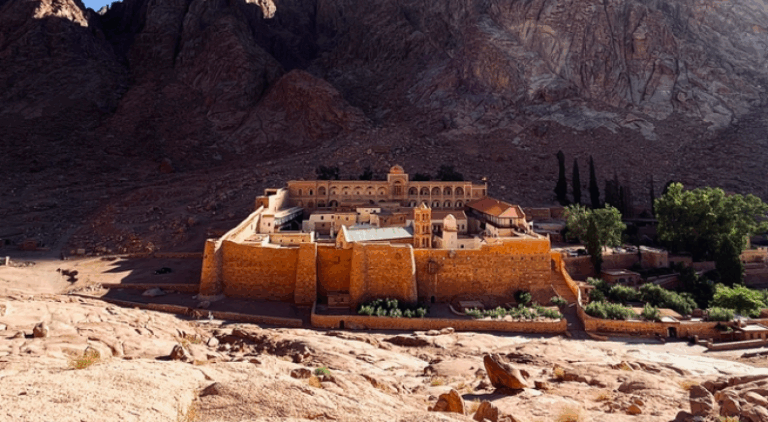
The area also hosts the 6th-century Monastery of Saint Catherine, which falls under the jurisdiction of the Greek Orthodox Church. Following pressure from Greece, Egyptian authorities have confirmed that the monks will remain and that the monastery will not be closed.
However, concerns persist over how this isolated desert landscape – a UNESCO World Heritage Site that includes the monastery, surrounding settlements, and the mountain itself – will soon be transformed. Luxury hotels, villas, and shopping centers are reportedly already under construction.
Impacts on the Bedouin Community
The region is home to the Jebeliya Bedouins, also known as the “Guardians of Saint Catherine.” Members of the community have seen their homes and eco-tourism lodges demolished with little or no compensation. In some cases, they were forced to relocate graves from the local cemetery to make room for new parking areas.
Although the government presents the project as a step toward sustainable tourism, it was imposed on the Bedouins without their consent. British travel writer Ben Hofler, who has worked closely with Sinai’s tribes, told the BBC: “This is not development the Jebeliya requested; it is something imposed by powerful interests to serve foreign agendas at the expense of the local community. A new urban world is being built around a nomadic Bedouin tribe that never agreed to it, and it will permanently alter their place in their homeland.”
Greece’s Response
The local population, around 4,000 people, tends to avoid openly speaking out about the changes. Greece, however, has been the most vocal foreign country due to its connection to the monastery.
Tensions escalated in May when an Egyptian court ruled that the Monastery of Saint Catherine – the world’s oldest continuously operating Christian monastery – sits on state-owned land. The court declared that the monastery only has “usage rights” over the land and surrounding archaeological and religious sites.
Archbishop Ieronymos II, head of the Church of Greece, condemned the ruling: “The monastery’s property is being seized, and this spiritual beacon of Orthodoxy and Hellenism faces a real threat to its survival.”
In a rare interview, the monastery’s Archbishop Damianos called the court’s decision “a heavy blow and a disgrace.” Disputes among the monks over the ruling eventually led him to resign. The Greek Orthodox Patriarchate of Jerusalem emphasized that the sacred site – under its ecclesiastical jurisdiction – had historically been protected, including by a decree from Muhammad himself. The monastery, which also hosts a small Fatimid-era mosque, is considered a symbol of peace between Christians and Muslims.
After a series of diplomatic discussions, Greece and Egypt issued a joint statement ensuring the protection of Saint Catherine’s Greek Orthodox identity and cultural heritage.
A “Gift to the World” or Destructive Intervention?
Egypt launched the state-funded Sinai Megaproject in 2021, aiming to boost tourism with luxury hotels, eco-lodges, a large visitor center, airport expansion, and a cable car to Mount Sinai. Officials present the development as “Egypt’s gift to the world and all religions”, promising tourism amenities, local development, and preservation of the natural and cultural character of the area.
While some construction has paused due to funding issues, the El-Raha Plateau overlooking Saint Catherine’s Monastery has already changed dramatically. Roads are being built, and critics warn that the mountain’s unique natural features are being damaged.
UNESCO has repeatedly emphasized the site’s exceptional universal value, noting that “the rugged mountain landscape provides the perfect setting for the monastery” and that the monastery’s placement reflects a deliberate effort to link spiritual devotion with the surrounding natural isolation. UNESCO called on Egypt to halt interventions and prepare a protection plan, but so far, this has not happened.
In July, World Heritage Watch urged UNESCO to list the Saint Catherine area as “World Heritage in Danger.” Appeals for protection also reached King Charles, honorary patron of the Saint Catherine Foundation, which preserves and studies the monastery’s collection of rare Christian manuscripts. The King described the site as “a great spiritual treasure that must be preserved for future generations.”
Bedouins Excluded from the Project
This is not the first Egyptian tourism project criticized for ignoring local communities. Yet successive governments see these ambitious plans as key to reviving Egypt’s fragile economy. The once-thriving tourism sector was recovering from COVID-19 when it was hit by the Gaza conflict and new regional instability. The government aims to attract 30 million visitors by 2028.
The Sinai Peninsula, occupied by Israel during the 1967 Middle East war and returned to Egypt after the 1979 peace treaty, has long been a point of contention for the Bedouins, who feel treated as second-class citizens.
Like the Red Sea resorts built in the 1980s, the Saint Catherine project is expected to rely on workers from other parts of Egypt rather than the local Bedouins. While the government claims it is “upgrading” Bedouin settlements, the community risks being excluded from the economic benefits.
A Site of Faith and Tradition Under Transformation
Saint Catherine’s Monastery has weathered centuries of change, from its earliest hermit monks to modern-day pilgrims. Large crowds visit the site to see the supposed remains of the burning bush or view pages from the Sinai Codex, the oldest nearly complete manuscript of the New Testament.
Even if the monastery and the mountain’s deep spiritual significance remain intact, the surrounding environment and Bedouin way of life face irreversible change, the BBC concludes.
Ask me anything
Explore related questions




