





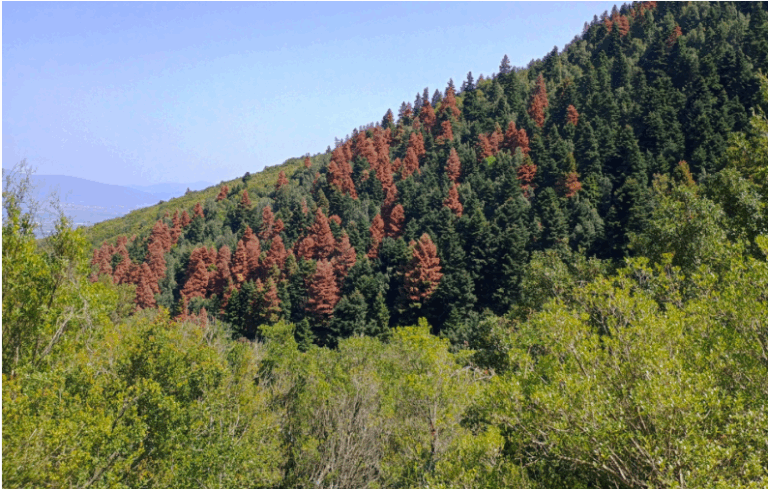
Bark beetles act like “sharks smelling blood in the water” in Greek forests: they detect weakened trees and launch their attack. This vivid description of the phenomenon, mainly affecting firs in the Peloponnese and Epirus, comes from Dimitris Avtzis, Senior Researcher in Forest Entomology at the Institute of Forest Research of ELGO-DIMITRA.
Speaking to the Greek Press Agency (ΑΠΕ-ΜΠΕ), Avtzis emphasizes that Greece is currently experiencing an environmental crisis, manifested by the widespread death of firs and other woody forest species. This results from the systematic weakening of forest ecosystems due to climate change, combined with population surges of bark beetles, which attack once a tree is too weak to defend itself.
Fir Trees in Decline – When the Problem Began
The visible signs of this issue date back two years, with increasing infestations particularly affecting firs. Avtzis notes:
“Bark beetles operate silently for a long time. By the time the first dead trees appear, the damage has already occurred.”
This year, the phenomenon is particularly intense in the Peloponnese and Epirus, though it is not confined there. In recent years, pine forests have also been affected, and this year, through his network with forestry agencies nationwide, Avtzis has observed losses even in broadleaf species such as kermes oaks and holm oaks.
The Common Thread: Tree Weakening
Each case has its specifics, but the common factor is tree weakening, directly linked to climate change: prolonged droughts, extreme temperatures, reduced snowfall, and severe weather events all create cumulative stress in forest ecosystems.
Profile of the Enemy
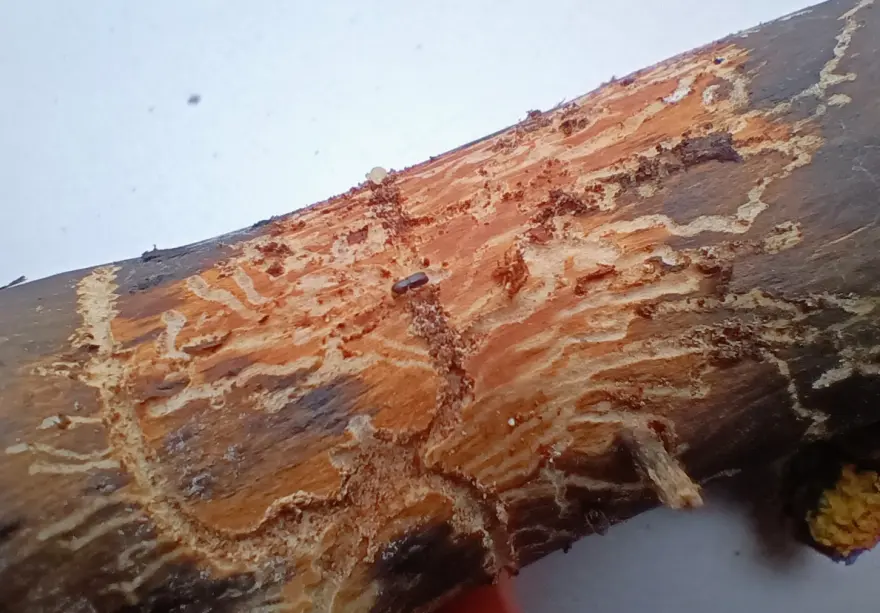
Bark beetles, beetles of the subfamily Scolytinae, operate almost “militarily.” They detect weakened trees guided by chemical cues and start the infestation.
“Once a tree is infested, they move to neighboring trees, spreading the destruction,” Avtzis explains.
Pityokteines curvidens, one of the most numerous beetles attacking firs in Greece, is not new. Similar problems occurred in the 1980s. What has changed today is the frequency and intensity of population outbreaks.
“In the past, these outbreaks were rare. Now they are increasingly frequent and usually more severe,” Avtzis notes.
When the Tree “Cries for Help”
Bark beetles do not initially attack healthy trees. They target already weakened trees. However, when beetle populations surpass a certain threshold, even slightly weakened trees can die.
“The old distinction between ‘primary’ and ‘secondary’ insects loses meaning. When populations are low, insects target the most vulnerable trees. When populations are high, they can attack the rest. The tree simply cannot respond in time.”
Fir Trees: Fragile and Demanding
Greek firs are less resilient than other species, like pines. They thrive in deep, cool, nutrient-rich soils, unlike pines, which survive in poor, dry soils.
“When environmental conditions change, firs are highly vulnerable,” Avtzis explains.
He also notes that the lack of winter snow, increasingly common, deprives ecosystems of crucial moisture.
“Even heavy rains can worsen the problem by washing away fertile soil, weakening root systems further.”
A Global Problem
This issue is not exclusive to Greece. Avtzis points out that similar situations are reported in Italy, Spain, and Turkey, especially in the warmer southern regions.
“This is not a local phenomenon. It is global and increasing. We must adapt our response to these new realities.”
What Must Be Done – and What Is Already Being Done
Forest management must be redesigned according to new data, Avtzis says:
“It is no longer enough to intervene when a problem is visible. Prevention and monitoring must become central tools.”
When Avtzis learned about the Peloponnese fir issue last April, he went on-site, documented the situation, and immediately recommended measures to the Ministry of Environment. Funding for initial interventions was then sought.
Optimism Through Planning
Despite the crisis, Avtzis remains optimistic:
“We have the scientific knowledge and data. Now we need coordinated action and adaptation. The management model of past decades is insufficient. It must change.”
Key steps include:
- Removing dead biomass to prevent the spread of beetles
- Thinning dense forest stands to improve tree vitality
- Systematic insect population monitoring in collaboration with forest services
- Rapid response to new infestations
“The problem may not be visible immediately, but once it is, the challenge is to act in time. I see the glass half full. To prevent it from emptying, we need planning, science, and composure. We can still achieve this. The natural landscape is not lost, as long as we act promptly and in an organized manner.”
Ask me anything
Explore related questions




