The ingenuity and brilliance of architects are concentrated in the new stages designed by renowned international firms. From the translucent football stadium in Hangzhou, China, to the all-wood Eco Park Stadium in the UK, the new sports facilities combine high-level design, cutting-edge technology, and sustainability.
Jacksonville Jaguars – NFL Stadium of the Future, Jacksonville, USA
The $1.8 billion redevelopment of the NFL team Jacksonville Jaguars’ EverBank Stadium was undertaken by international architecture and engineering firm HOK. The existing stadium will be transformed with an undulating, reflective cladding covered by a transparent membrane. The surrounding area is inspired by Florida’s natural richness: its beaches, wetlands, marshes and lush green landscapes. Fans will enter through a subtropical park, leading to the elevated main foyer with panoramic views of the city and river.
Eco Park Stadium – Zaha Hadid Architects, Stroud, England
Zaha Hadid Architects was commissioned to design the stadium for the Forest Green Rovers football club. Made entirely of wood, the Eco Park Stadium will be located in the town of Stroud – “the best place to live in Britain”, according to the Sunday Times – and aspires to become the “greenest football stadium in the world”. The stadium will be the centrepiece of the Eco Park, a £100 million development that will include, in addition to sports facilities, a science sports centre and a ‘green’ technology park. Behind the project is UK-based Ecotricity, a green energy pioneer company based in Stroud.
Hangzhou International Sports Centre – Zaha Hadid Architects, Hangzhou, China
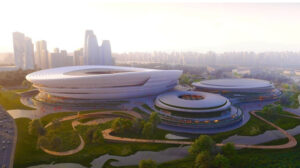
Another colossal project signed by the studio of the legendary architect, remembered for her futuristic, fluid designs. It is a state-of-the-art sports complex that includes a 60,000-seat football stadium, a 19,000-seat indoor arena for basketball and concerts, and a wet track and field centre with two 50-metre swimming pools. The architects were inspired by the staggered tea plantations of the Hangzhou region and designed an iconic stadium, with the stands forming undulations on the façade, which will be lined with blinds, giving the stadium translucency and shading.
Stade Hassan II-Populous, Casablanca, Morocco
The football stadium being designed by Populous in collaboration with Paris-based architecture firm Oualalou + Choi in Casablanca is expected to be the largest in the world, with a capacity of 115,000 seats. The inspiration came from the “moussem”, the traditional Moroccan festival that combines worship, music, dance and market. The majestic aluminium lattice roof, which dominates the forest landscape, is reminiscent of traditional tents in the desert and rests on a ring of 32 staircase gates. Botanical gardens have been landscaped on raised platforms and around the stage, creating a unique spatial experience.
Prince Mohammed bin Salman Stadium – Populous, Qidhiya, Saudi Arabia
International architecture firm Populous, with offices in Kansas City, London, and Brisbane, specializes in stadium and sports venue design. Its new project in Qidhiya is named after the country’s prime minister and is reminiscent of a science fiction movie set: perched on a 200-metre hill, it upends the traditional stadium experience with unparalleled technological innovations. It features a retractable roof, a sliding pitch, and an equally retractable giant LED wall for live broadcasts, films, and laser shows. The stadium, which can be transformed from a football pitch to a theatre in a matter of hours, will host matches for the 2034 World Cup. It will operate year-round thanks to its air-conditioned facilities; a cooling pond beneath the stadium will harness rainwater to pre-cool the air conditioning system, drastically reducing energy consumption.
Ask me anything
Explore related questions