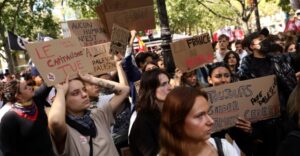
France remains in political turmoil, preparing for one of the biggest strikes in years. Unions have joined forces, a rare occurrence, to pressure the new prime minister, Sebastien Le Corneille, to reconsider budget cuts and take action on wages, pensions and public services.
Police estimate that some 800,000 people will take part in marches across the country, while schools, rail and air transport will be affected. In total, up to 80,000 police officers will be deployed.
Infrastructure and school closures
Already, bus depots in Paris and northern France are on lockdown since this morning, as are schools in the French capital and Amiens. There are problems with rail transport across the country.
Nationwide, 250 marches have been planned. Today is expected to be the biggest day of protests since 2023, when citizens took to the streets to protest Emanuel Macron‘s use of executive powers to pass an increase in the retirement age to 64 without a vote.
Political crisis
The protests come at a time of intense political crisis. Last week, Emanuel Macron appointed his close ally Sebastien Le Corneille as his third prime minister in a year. Already, François Bayrou and Michel Barnier have been ousted from parliament over fierce disagreements over the budget.
The situation is not easy for Lecorni, who served as defense minister in the two previous governments. His tenure started with very low approval ratings and he is finding it hard to convince the parties that he is offering something new, despite his public promises of a “deep break” with the past.
Lecorni has announced that he will withdraw his predecessor’s proposal, François Bayrou, to abolish two public holidays. But the slight retreat is not enough for the unions, who have expressed fears that other elements of Bayrou’s €44 billion cuts plan, such as a freeze on social benefits, may be retained.
The clock is ticking down for Lecorni, who has only a few weeks to present a new budget and form a minority government. Doing so means he will have to convince opposition parties not to table a new no-confidence motion.
He asks for a “non-aggression pact”
Yesterday, Lecorni met with opposition parties for consultation. Coming from the right, the 39-year-old then joined Macron’s centrists. He is expected to maintain cooperation with the right-wing Les Républicains party and Macron’s pro-business economic policy.
At the same time, he is trying to avoid another no-confidence vote and is under pressure to attract the Socialists, with a minimum goal of a “non-aggression pact”. However, the Socialist Party has called for an end to harsh cuts and fair contributions from the richest.
Meanwhile, Marine Le Pen of the National Rally has warned that if Le Corneille continues with the same policies, he will fall.
At the same time, France is under pressure to reduce both its deficit and its debt, which stands at 114% of GDP, and last week, credit rating agency Fitch Ratings downgraded the French economy, citing concerns about political instability.
Ask me anything
Explore related questions