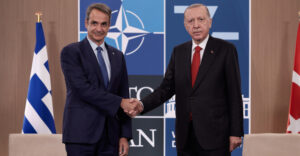
For their most difficult meeting since December 2023, when the Athens Declaration was signed, the leaders of Greece and Turkey, Kyriakos Mitsotakis and Recep Tayyip Erdogan, are preparing for next Tuesday on the sidelines of the 80th UN General Assembly.
After a period when, although problems were not resolved, a relatively mild climate had been restored—helping maintain the “calm waters” in the Aegean—the atmosphere has soured again in recent months, as differences have once more “unfolded,” this time in the field.
Their meeting is scheduled for Tuesday noon, New York time, on an extremely “crowded” day, as U.S. President Donald Trump will be speaking at the opening of the General Assembly and later hosting the traditional Transatlantic Alliance reception. Coordination was already an issue, since the Turkish President will be in New York from September 21 to 24, while Kyriakos Mitsotakis will be there from September 23 to 26, when he is also scheduled to address the General Assembly. The fact that the meeting was finally arranged under these circumstances shows, of course, that—perhaps for different reasons—both leaders wanted it to take place.
The positions of Greece and Turkey
The Greek side insists that it is useful to talk and to keep communication channels open, even if disagreements are obvious. In any case, both Athens and Ankara want to send the message that the rapprochement process is alive, something that helps maintain the “calm waters” but also serves Turkey’s efforts to approach both the EU and the U.S.
The meeting takes place in an extremely heavy international environment, as the war in Ukraine and the war in Gaza have left a profound impact.
At this General Assembly, Erdogan wants to establish himself not only as the leader expressing the Muslim world but also as the voice of global public opinion—someone unafraid to openly support the Palestinians and emerge as Israel’s fiercest critic. At the same time, he makes no secret of his ambition to transform Turkey, despite being a NATO member, into a regional power capable of straddling both West and East.
With this spirit of arrogance, the Turkish President also approaches Greek-Turkish relations, though he recognizes that both ties with Greece and the Cyprus issue affect these ambitions.
In Greek-Turkish affairs, the situation has worsened, as the rapprochement process has not produced results in resolving the dispute over delimitation of the EEZ/continental shelf or other issues arising on the ground.
Athens, however, as the Prime Minister himself has repeatedly emphasized recently, without illusions, is proceeding with an unprecedented armament program for our country, to strengthen its deterrent capability—something that simultaneously enhances its negotiating power.
The differences
The confrontation between the two countries over Maritime Spatial Planning maps and Marine Parks has revealed the full framework of disputes in the Aegean and Eastern Mediterranean. It confirmed Turkey’s approaches regarding delimitation, which leave no room for optimism about even minor progress in this area. And while this confrontation remains at the level of maps and statements, the same cannot be said about the case of the survey for the Crete–Cyprus electricity interconnection cable (GSI).
This case, having already developed in the field, represents an open wound in Greek-Turkish relations, as it is not merely about a cable but directly concerns Greece’s ability and determination to exercise its lawful sovereign rights—not in a “disputed area,” but within its delimited EEZ.
Greece’s decision to license the blocks south of Crete with the “vehicle” of U.S. company Chevron’s entry—thus challenging the Libyan side of the Turkey–Libya Memorandum—has brought the two countries into an underground competition. Athens has so far persuaded Benghazi not to ratify the Memorandum and Tripoli to enter talks on EEZ delimitation, while Mr. Erdogan, even publicly this week, essentially called on General Haftar to ratify the Memorandum. Turkish diplomacy is now focusing its weight in that direction.
The new “thorn” of the SAFE program
In recent weeks, another serious thorn has been added to bilateral relations, perhaps the most irritating one for Recep Tayyip Erdogan: Athens’ explicit commitment, voiced personally by the Prime Minister, that Greece will not allow into the €150 billion SAFE program for Europe’s rearmament a country that threatens EU member states with war. Moreover, he has stated that he will raise the issue of lifting the casus belli with the Turkish president.
Turkey and Erdogan, who boast about the achievements of the Turkish defense industry, have also invested politically in Turkey’s entry into this program, essentially seeking to impose a “special relationship” with Europe, where Turkey would enjoy rights and benefits without obligations. It is obvious that Athens’ and Nicosia’s veto will significantly burden relations.
This comes at a time when Turkey has launched a campaign against the measures Cyprus is taking for its defense (with Israeli BARAK missiles), while pro-government media and analysts fuel the climate, claiming that Israel and its “allies” are orchestrating Turkey’s encirclement.
Athens has also noted that Ankara chose the timing, just before the planned meeting of the two leaders, to issue a NAVTEX for the Piri Reis scientific surveys, disputing the area of Greek competence to issue NAVTEX and indirectly Greece’s potential continental shelf. The Piri Reis was still docked in the port of Izmir, but the NAVTEX remains valid until September 25…
And of course, an extremely difficult moment will come when the discussion turns to Gaza, as Greece has maintained a balanced stance—reflected in its positions at the General Assembly and the UN Security Council—whereas Erdogan is uncontrollable when he lashes out against Israel, considering those who do not follow his line as “accomplices in genocide.”
The Greek Prime Minister’s meeting with the Turkish President will be a difficult one, reminiscent of older times, testing the resilience of relations so that such a meeting can be a place where truths are spoken without leading to ruptures and tensions.
Ask me anything
Explore related questions