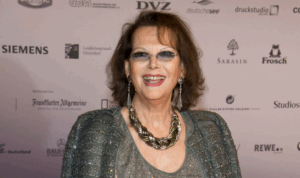
The beloved actress of Visconti and Fellini, who stood next to the greatest actors of the 20th century—from Burt Lancaster and Alain Delon to Henry Fonda, Jean-Paul Belmondo, and Marcello Mastroianni—passed away tonight at the age of 87 in Paris, according to the French Press Agency.
Who could disagree with Jason Robards’ line as the legendary Cheyenne in Sergio Leone’s Once Upon a Time in the West? Addressing the dazzling Claudia Cardinale, just before dying from a bullet wound to the stomach, the charming outlaw tells her: “You can’t imagine how much happiness a man can feel just by looking at a woman like you. Just looking… And if someone dares pinch your behind, pretend it’s nothing—he’ll be happy.”
And happy were all those who got lost in her deep dark eyes, perhaps the most sensual in the history of cinema. In 1968, Cardinale appeared in the film as a sex symbol. Wearing a small hat that barely held back her curls from a rich bun, and a long lace dress fluttering in the wind, while Ennio Morricone’s cellos soared. She brought civilization. She was its goddess.
At 87, the brunette who has just left this life was anything but unnoticed. Even alongside the legendary blonde Brigitte Bardot in the western satire Les Pétroleuses (1971), she held her ground.
That production was Franco-Italian—just like her. A perfect Mediterranean woman, nicknamed in her youth “the Berber girl.” Very quickly she became “the fiancée of Italy.” With Sicilian grandparents, Claude Joséphine Rose Cardinale was born on April 15, 1938, in Tunis, then still under French protectorate. Her father worked as a railway engineer. As the eldest of four children, she lived carefree in the sun, wild and untamed like a tomboy, having everything that could make her happy. But her life began with trauma, only to culminate in triumph.
In 1957 she was raped. From that deeply traumatic experience her son Patrick was born—something she kept secret so it wouldn’t obstruct the brilliant career that was just beginning. After winning the title of “Most Beautiful Italian Girl in Tunis” in a contest organized by the Italian film office, she traveled as a tourist to the Venice Film Festival. All eyes turned to her. “Claudia! Claudia!” photographers cried at the sight of the fresh-faced girl in a bikini sewn by her mother. The name stuck.
Her first appearance on camera came thanks to Mario Monicelli, with a small role in Big Deal on Madonna Street, alongside Vittorio Gassman, Marcello Mastroianni, and Totò. Still, she returned to her studies, aiming to become a teacher in southern Tunisia.
From 1961 onward, her presence in films with Jean-Paul Belmondo, Jacques Perrin, and Gian Maria Volonté established her. Despite language difficulties, her brilliance was undeniable. Guided and controlled by producer and husband (1966–1975) Franco Cristaldi, she starred in works such as Abel Gance’s Austerlitz and Visconti’s Rocco and His Brothers.
Triumphs followed: The Leopard (1963), Fellini’s 8½, and Blake Edwards’ The Pink Panther. That same year, David Niven paid her an unforgettable compliment: “Claudia, along with pasta, you are the best invention of the Italians.”
In the years that followed, she starred in dozens of international productions alongside John Wayne, Rita Hayworth, Lee Marvin, and Robert Ryan. In 1972, she reunited with Belmondo in Scoumoune, with fiery red hair. Her personal life was marked by director Pasquale Squitieri, with whom she lived from 1974 to 2011 and had her daughter, Claudia.
In the 1980s, she acted with Klaus Kinski in Werner Herzog’s Fitzcarraldo. Her career spanned over 150 films, and she was honored with awards such as the Golden Lion at the Venice Film Festival (1993) and the Golden Bear in Berlin (2002).
Beyond acting, she was also an activist. She worked with UNESCO, fought against muscular dystrophy and AIDS, stood by Rock Hudson shortly before his death, and supported Amnesty International. She fought for women’s rights, the protection of nature, and against the excesses of plastic surgery.
In 2023, the Claudia Cardinale Foundation was created to support young artists. With her dazzling smile and distinctively husky voice, Cardinale remained until the end the eternal symbol of Mediterranean beauty and cinematic brilliance.
Ask me anything
Explore related questions