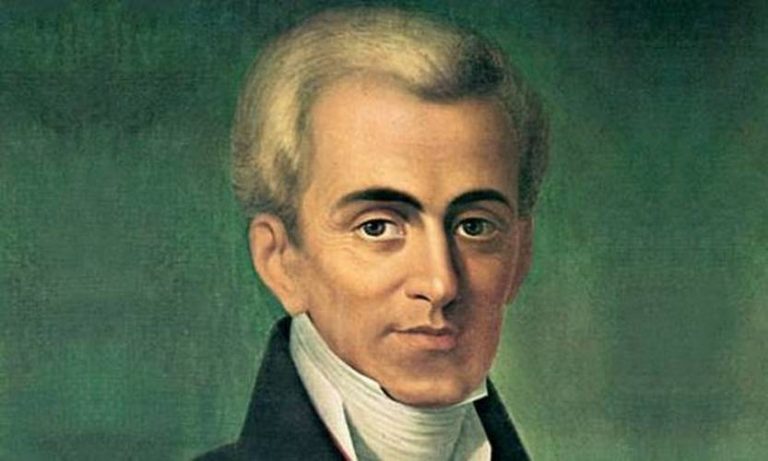
On September 27, 1831, Ioannis Kapodistrias, the first Governor of Greece after the Ottoman occupation, was assassinated in Nafplio. His killing robbed the country from the chance to become a modern state sooner.
Born on Corfu on February 11, 1776, when the island was under Venetian rule. Coming from a noble family, Kapodistrias studied philosophy and law and became a sought-after diplomat who later became Minister of Foreign Affairs of Russia (1816-1822). When he became the first governor of the independent Greek state, he built it from scratch and funded it with his personal wealth.
In 1822 he settled in Geneva, Switzerland, where he contributed to the creation of the Swiss Federation, receiving the title of honorary citizen. He remained there until 1827, simultaneously helping the Greek Revolution.
On March 30, 1827 the National Assembly of Trizina elected him Governor of the newly established Greek state. After arduous consultations in European capitals to ensure the necessary support for the Greek state, he arrived in Nafplio on January 7, 1828 and was welcomed with enthusiasm and celebrations.
His first period as a governor was daunting, as the rivalry that arose between the factions during the revolution had not abated, while the country was bankrupt.
Kapodistrias was asked to rule on the basis of the Republican Constitution of Trizina, but as a believer in enlightened despotism, he thought that a constitution and parliamentary bodies were too premature for a state that was not built yet.
On January 18, 1828 he managed to convince parliament to suspend the Constitution. So, he achieved absolute power, aided by the Panellinion, an advisory body consisting of 27 members.
The new Governor set out to put an end to civil conflicts and served immediately to the task of state creation from scratch, demonstrating enviable activity. He founded the National Bank with the help of a Swiss friend who was a banker. He adjusted the monetary system, as foreign and Turkish currencies were still circulating in Greece. On July 28, 1828 Kapodistrias established the Phoenix as the national currency and founded the National Mint. On September 24 of that year, he established the first postal service.
Knowing that the administration of justice is the foundation for the creation of a well-governed state, he took a personal interest in the establishment of courts staffed with the appropriate personnel. He organized the state administration and founded the Statistical Service, which conducted the first census.
Kapodistrias reorganized the armed forces under a single command, managing at the same time to fight the establishment of chieftains and to prevent the Ottoman advance, as shown in the Battle of Petra. The Greek army appeared disciplined and structured in the last battle of the independence war. The new navy eliminated piracy in Greek waters.
Kapodistrias applied quarantine procedures in communities that were affected by epidemics of typhus, malaria and other contagious diseases. He tried to rebuild the damaged educational system of Greece, founding many schools and the Orphanage of Aegina.
The first governor took decisive steps in boosting agriculture, seeing it as the cornerstone of the Greek economy. He introduced the cultivation of potatoes, in a way that showed his deep knowledge of the psyche of the Greeks of that era. He ordered to have a load of potatoes in Nafplio harbor and urged everyone to get as many as they wanted. Greeks viewed the new vegetable with icy indifference. Then he placed guards around the potatoes and Nafplio residents started circulating the rumor that the army was guarding a valuable cargo at the port. People gathered at the port and began slowly to steal the potatoes from under the noses of the guards until all potatoes were gone. They didn’t know though that Kapodistrias had instructed the guards to turn a blind eye. With this clever move, the potato became part of the daily diet of Greeks.
Kapodistrias’ policies, though, caused resentment, both of the constitutional regime supporters, and the elders and sailors. The glory that surrounded him began to dissolve. Failure to satisfy all, combined with the delay of the elections, created a strong opposition against the Governor. Kapodistrias was even accused of ignoring Greek traditions and wanting to import foreign institutions and more.
The first rebellious move came from Hydra in 1829, when the navy tried to overthrow the government. Kapodistrias managed to suppress the coup with the help of the Russian navy. Yet, discontent was rising. The big farmland owners of Mani — led by the Mavromichalis family — refused to pay taxes to the central government and revolted.
The rivalry between Kapodistrias and the Mavromichalis family escalated. The governor ordered the arrest and confinement in prison of elder Petrobey Mavromichalis.
The dominant theory until now has been linking this rivalry with Kapodistria’s assassination. According to this theory, Petrobey’s brother Constantinos and his son Georgios decided to take revenge. On the morning of September 27, 1831 they slaughtered Kapodistrias outside the church of St Spyridon where he was going to attend mass. The governor was accompanied only by his one-armed bodyguard.
However, the facts as they come from recent research do not support this belief. For example, both Constantinos and Georgios Mavromichalis crossed roads with the Governor as he was on his way to the church early in that morning and while the street was empty. Although it was an ideal moment to assassinate him, they said “good morning” and went on their way. This incident is not disputed by anyone. Also, the wounds inflicted on Kapodistrias’ body do not correlate with where Constantinos and Georgios were standing according to the official reports. The only eyewitness with the best view of the crime scene, Mrs. Paraskevoula, did not identify Constantinos and Georgios as the Governor’s murderers. These are just a few of the many inconsistencies in the dominant theory.
Nonetheless, Constantinos Mavromichalis was lynched on the spot by Nafplio residents. The only thing he managed to shout before he died was “I didn’t do it”. Georgios Mavromichalis took shelter in the French Embassy, where he sought asylum. The angry mob threatened to burn down the embassy, forcing the French to let him go. Mavromichalis was tried with disputed procedures and sentenced to death by court-martial. He was executed by firing squad on the morning of October 10, 1831. He asked from his relatives not to revenge his death and ordered himself the firing squad to shoot him.
Suspicion for the Governor’s assassination goes to the British and French as Kapodistrias was not willing to make Greece a puppet state for anyone’s interests.
One of the very few files Great Britain refuses to declassify to this day is the one referring to the death of Kapodistrias…
After Kapodistrias’ murder, Greece plunged into chaos. Anarchy prevailed and a few months later England, France and Russia convened in London and decided on May 8, 1832 to appoint the 17-year-old German Prince Otto, King of Greece. On February 6, 1833 Otto arrived in Nafplio and had a welcome similar to that of Kapodistrias.
Swiss philhellene I.G. Eynard wrote at the time: “He who murdered Kapodistrias, murdered his homeland. His death is a disaster for Greece and a misfortune for Europe.”
For many historians, Kapodistrias would have been the man to make Greece a modern state much sooner, the way he had helped build Switzerland. It is doubtful that Greece would have taken the same course with a foreign king, like the one appointed by the superpowers of the time. If Kapodistrias had lived and was allowed to materialize his vision, Greece would have been a totally different country through today.
Sources: greekreporter, D. Kokkinakis
Ask me anything
Explore related questions