×
GreekEnglish

×
  • Politics
  • Diaspora
  • World
  • Lifestyle
  • Travel
  • Culture
  • Sports
  • Cooking
Sunday
18
Jan 2026
weather symbol
Athens 7°C
  • Home
  • Politics
  • Economy
  • World
  • Diaspora
  • Lifestyle
  • Travel
  • Culture
  • Sports
  • Mediterranean Cooking
  • Weather
Contact follow Protothema:
Powered by Cloudevo
> World

ESA’s Gaia space telescope detects stellar wave in the Milky Way

A giant wave of stars rippling outward from the center of our galaxy has been detected by the European Space Agency’s (ESA) Gaia space telescope

Newsroom October 1 06:43

We already know that the stars of the Milky Way orbit its center, and Gaia has measured their speeds and movements with unprecedented accuracy. The telescope also discovered that the Galactic disk wobbles over time, much like a spinning top. Overall, Gaia — which ceased operations last March — has given us the largest and most precise multidimensional map of our galaxy.

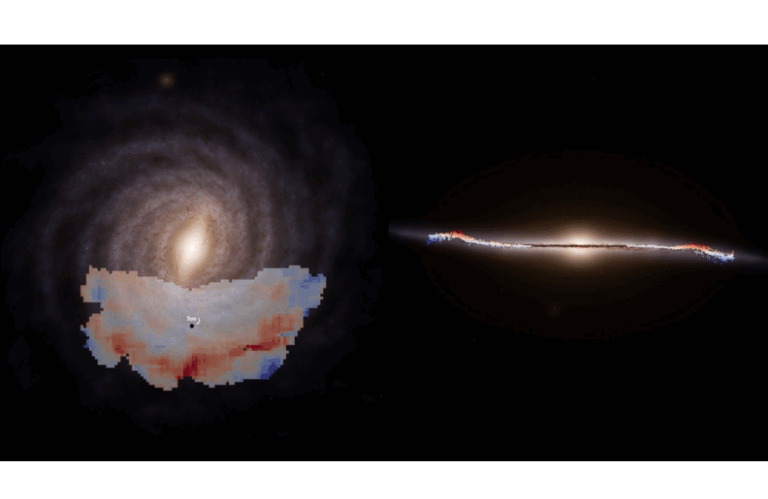
Now, a new analysis of Gaia’s data provides fresh insight: a massive wave is shifting stars tens of thousands of light-years from the Sun. According to ESA’s announcement, this galactic wave resembles the ripples spreading outward when a stone is thrown into a lake.

The maps created with Gaia’s data show the wave stretching across a vast region of the Galactic disk, influencing stars located between 30,000 and 65,000 light-years from the Galactic center.

Researchers identified this motion by studying the precise positions and movements of young giant stars and Cepheids — a type of variable star used as key markers for measuring galactic and extragalactic distances. As these stars move with the wave, scientists believe that gas in the Galactic disk may also be caught in this ripple-like flow.

>Related articles

The Milky Way may escape collision with Andromeda, according to new research

Possibly habitable “Super Earth” discovered in our own Milky Way Galaxy

The Black Hole at the center of the Milky Way is spinning so fast, it’s squishing space-time down like a football

The origins of these galactic oscillations remain unknown. One possible explanation could be an ancient collision with a dwarf galaxy, though this requires further investigation. The massive wave might also be linked to a smaller-scale ripple observed about 500 light-years from the Sun, in a different part of the Galactic disk, known as the Radcliffe Wave.

The findings were published in the journal Astronomy and Astrophysics.

Ask me anything

Explore related questions
#ESA’s Gaia#Milky Way
> More World

Follow en.protothema.gr on Google News and be the first to know all the news

See all the latest News from Greece and the World, the moment they happen, at en.protothema.gr

> Latest Stories

Politico: Europe for the first time considers tough response to Trump on Greenland tariffs, what is the Anti-Brexit Act

January 18, 2026

The backstory behind Trump’s decision not to attack Iran: The camps in the White House, the SMS from Tehran, and the calls from Arab allies

January 18, 2026

Mitsotakis: Greece will not be challenged by anyone with the Belharra frigates – Our goal is to support farmers with transparent subsidies

January 18, 2026

Akylas receives rave reviews for his Eurovision 2026 Greek final entry: “We might actually win with this little gem,” Fans write

January 18, 2026

What Trump is seeking with the extra tariffs on eight European countries for Greenland, the trade deal with the EU is in the air

January 18, 2026

The global era of Messinia: How the film Odyssey and the lists of major media praise it for 2026

January 18, 2026

Greek exports broke records with a record 37 billion euros

January 18, 2026

Sakkari delivers the ‘point of the year’ as she advances at the Australian Open

January 18, 2026
All News

> Greece

Akylas receives rave reviews for his Eurovision 2026 Greek final entry: “We might actually win with this little gem,” Fans write

Akylas has been met with enthusiastic praise following the presentation of his song “Ferto,” with which he is competing for a place in the Greek national final of Eurovision 2026.

January 18, 2026

The global era of Messinia: How the film Odyssey and the lists of major media praise it for 2026

January 18, 2026

Weather: Why the new cold wave brings little snow until Tuesday – Stronger weather deterioration expected from Wednesday

January 18, 2026

Weather: A return to winter in the coming days – Cold and strong northerly winds – Kolydas’ post

January 17, 2026

A view of Nikolaos Stasinopoulos of Viohalco – The “enduring imprint” of Greece’s greatest industrialist

January 17, 2026
Homepage
PERSONAL DATA PROTECTION POLICY COOKIES POLICY TERM OF USE
Powered by Cloudevo
Copyright © 2026 Πρώτο Θέμα