





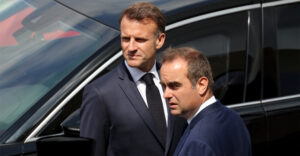
The sudden – for some, expected by others – resignation of Prime Minister Sebastian Le Corneille yesterday sealed the shortest tenure of a head of government in modern French history and plunged Paris even deeper into a crisis of legitimacy and governance with no end in sight. Lecorni left just 27 days after his appointment, in an environment where the opposition was preparing for yet another vote of no confidence and markets were showing obvious nervousness this time over the budget and debt of the “Hexagon”. Emanuel Macron accepted the resignation and has triggered a new wave of uncertainty, with the president having to choose between appointing a new prime minister or going to the polls, while the credit risk is more than evident, and the credit rating agencies are not missing an opportunity to publicly and clearly highlight it.
The essence of the crisis is deeper than it seems. From the 2024 early elections onwards, France operates with a quadrupolar parliament, lacking a clear majority. Left, far-left, far-right, and presidential centre cancel each other out. The promise of “political renewal” proved difficult when Le Corneille’s government shape looked more like continuity than rupture, undermining his ability to negotiate in parliament from the start. The result was a pre-emptive “handbrake” before the 2026 budget clash – a clash that threatens to veer off course and turn into institutional paralysis.
For Macron, the options are few – long, clear, but all “expensive” politically. The first is the appointment of another prime minister – probably of a technocratic profile – with a mandate to seek minimal, thematic majorities (budget, defence, and industrial policy are highly pressing and polarising issues). The risk here is obviou,s as without numerical certainty, any critical bill will semi-automatically turn into a home of tactics. The second option is to dissolve the National Assembly and hold new elections, but with the National Coalition of Jordan Bardela and Marine Le Pen on an upward trajectory and the left divided, the possibility of further instability is not diminished; instead, it seems to be escalating to levels unprecedented for the Fifth French Republic. The third – theoretically extreme – option would be a limited-horizon “government contract” with bipartisan commitments on specific policy chapters, but it requires levels of trust that are currently dwindling, as are funds from French public coffers.
Communicatively, Macron needs to regain the initiative with a narrative that goes beyond the technical language of deficits. French society is demanding visible evidence of effectiveness in the cost of living, security, education, and health. Without tangible results, the fatigue of “governments-in-waiting” will reinforce antisystemicism. At the same time, the European dimension – from fiscal rules to industrial policy and defence – requires Paris to remain functional, otherwise France risks turning from an “engine” into a “plumb line” for the EU, and it is a given that this has ceased to be a “taboo” for the institutions after the Greek crisis despite the huge size difference.
Financial stress is the second half of the equation. With a deficit well above 3% and debt close to 115% of GDP, the agencies warn that political paralysis is making fiscal adjustments more difficult. Each new change of prime minister without a solid plan intensifies borrowing costs and sways investor confidence. In other words, the political crisis fuels economic uncertainty, which in turn closes the room for manoeuvre of any next government.
In less than two years, France has seen three governments collapse or leave in less than two years: Michelle Barnier (December 2024), which fell in a vote of no confidence – the first successful one since 1962; François Bayrou (September 2025), which was disapproved by the National Assembly; and now Sebastian Le Corneille (October 2025), who resigned before being tested in the parliamentary ballot boxes. To appreciate the novelty of the circumstance: in the Fifth French Republic (since 1958), there has been only one successful vote of no confidence before 2024 – against Georges Pompidou’s government in 1962 – and governmental changes, while not rare, have not usually occurred at such a dense pace nor under such parliamentary fragmentation. The ‘triptych’ Dec. 2024-Oct. 202,5 therefore, constitutes a historical exception in terms of intensity and frequency of destabilisation for the Fifth Republic.
What’s next? In the short term, Macron will attempt to appoint a successor to Matignon who possesses two minimum skills: sewing thematic majorities and buying time in the markets. Without these two conditions, France will slip into a vicious circle: more political instability, more expensive funding, and less ability to conduct policy. In the medium term, Paris needs a sincere compromise on three pillars: a realistic fiscal path, reforms that reach the average citizen and a functioning parliament that does not become hostage to polarisation. Without these, the “Le Corneille crisis” will remain only as the latest symptom of a deeper institutional fatigue – not as a starting point for an exit from it.
Ask me anything
Explore related questions




