





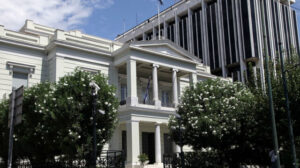
The Turkish invasion of Cyprus in 1974 remains an open wound for Hellenism and constitutes a blatant violation of international law, with consequences that continue to burden the international community, Greek diplomatic sources stressed in response to the spokeswoman of the Russian Ministry of Foreign Affairs, Maria Zakharova.
At the same time, Athens reminds that the July 15, 1974 coup has been unequivocally condemned by all democratically elected governments of Greece, while highlighting the long-standing international recognition of the Cyprus issue as one of invasion and occupation.
In light of these facts, Greece’s response to the Kremlin underscores the importance of the peaceful resolution of disputes — as demonstrated in the case of North Macedonia — and highlights the historical significance of the 1975 Helsinki Final Act, which established the principles of peaceful coexistence and cooperation between states.
Full Greek response:
Diplomatic sources on today’s statements by the Spokesperson of the Ministry of Foreign Affairs of the Russian Federation (08.10.2025):
It should be made clear that the Turkish military invasion of Cyprus in 1974 constitutes a flagrant violation of the sovereignty and territorial integrity of the Republic of Cyprus. It led to the illegal occupation of approximately 37% of Cyprus’s territory, a humanitarian tragedy involving the displacement of Greek Cypriots from their homes, as well as the issues of the enclaved and the missing persons.
It is worth noting that the Helsinki Final Act was signed in August 1975. As for the unfortunate reference to the coup of July 15, 1974 — which occurred a year before the signing of the Final Act — we emphasize that all democratically elected Greek governments since 1974, as well as all political forces in Greece, have categorically condemned it.
We also refer the international community to its repeated declarations on the Cyprus issue as an international matter of invasion and occupation — in direct violation of the UN Charter and relevant UN Security Council Resolutions.
Furthermore, we point to public statements by the Minister of Foreign Affairs of the Russian Federation, which explicitly refer to these relevant UN Resolutions.
Regarding references to Greece’s relations with North Macedonia, we recall that our dispute with North Macedonia was resolved peacefully under UN auspices.
We should all reflect on the fact that there were once conferences that left an indelible mark on the history of international relations. In Helsinki in 1975, a historic leap was made with the institutionalization of peaceful coexistence among states and the definition of the principles that would govern their relations.
Ask me anything
Explore related questions




