





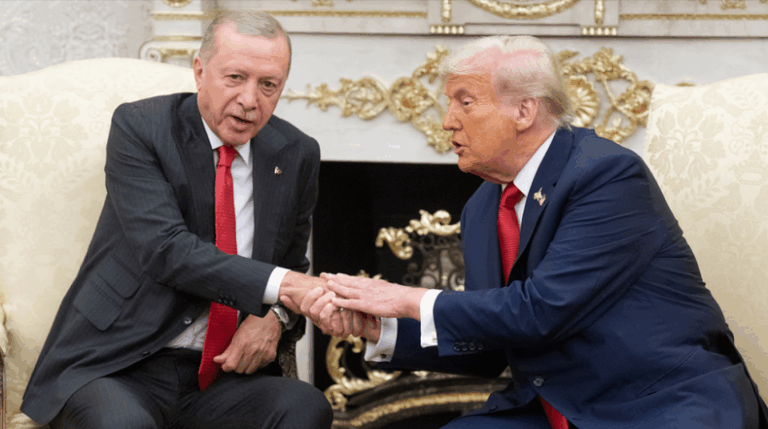
Behind the scenes of U.S.–Turkey relations, a high-stakes game is unfolding. According to an exclusive Reuters report, Turkish officials proposed to Donald Trump a $100 million out-of-court settlement for the Halkbank case during their recent meeting at the White House.
Ankara’s proposal also included additional terms, the most important being that the bank would not admit guilt — a non-negotiable condition for Recep Tayyip Erdoğan. Reuters cites two sources with direct knowledge of the talks, confirming that the issue was at the center of the meeting.
Halkbank, Turkey’s fourth-largest bank, is accused in the United States of fraud, money laundering, and conspiracy, allegedly helping Iran evade U.S. sanctions on its nuclear program. Ankara rejects the charges as politically motivated and sees behind them a form of “judicial pressure” from Washington.
From S-400s to F-35s and now Halkbank
The Halkbank case is not an isolated episode but part of a decade-long path of escalating tensions. In 2019, Turkey purchased the Russian S-400 missile system, provoking Washington’s anger. The U.S. response was swift: cancellation of the F-35 fighter jet sale, Ankara’s expulsion from the co-production program, and sanctions on Turkey’s defense procurement agency.
That same year, criminal proceedings against Halkbank began. Today, as relations appear to be warming thanks to the personal ties between Trump and Erdoğan, the bank’s case has become a testing ground for rapprochement. The Turkish side avoids making public statements, while the White House has not responded on whether the proposal remains on the table.
The judiciary’s stance and market signals
The U.S. Supreme Court recently rejected Halkbank’s latest appeal, allowing criminal proceedings in New York to continue. The bank’s shares plunged 10%, while management announced that “initiatives to find a legal understanding with the United States” are ongoing.
Erdoğan, who sat next to Trump during his first visit to the White House in six years, said that Halkbank would be a key topic on the agenda — in the mere 45 seconds he spoke on camera upon his arrival. Since then, he has repeatedly stated that the charges are “illegal and unfair.” In Ankara’s diplomatic microcosm, the case is viewed as a political tool, not a legal issue.
The essence of the case and the crisis background
U.S. prosecutors accuse Halkbank of helping Iran bypass sanctions by using intermediaries and shell companies in Iran, Turkey, and the UAE to illegally transfer about $20 billion. Revenues from Iranian oil were allegedly converted into gold and cash through fake food shipments.
The bank argued that, as a state entity, it enjoyed immunity from prosecution abroad. U.S. courts rejected this claim, setting a precedent for how state-owned banks involved in international sanctions violations can be treated.
Analysts believe the settlement amount could exceed $100 million, as similar cases have cost much more. French bank BNP Paribas alone paid nearly $9 billion for violating sanctions on Iran, Cuba, and Sudan.
The political message behind the proposal
The $100 million offer is more political than legal. For Ankara, it symbolizes a willingness to “close pending issues” with Washington, provided there is mutual understanding. Erdoğan knows that a potential Trump return to the White House would open a new round of negotiations, away from Biden’s sanctions-driven approach.
For Turkey, the Halkbank case represents the epitome of U.S. legal coercion through geopolitical power. For the U.S., it is a test of consistency in applying the very rules it enforces internationally. The outcome will reveal who needs the other more.
The numbers behind the relationship
U.S.–Turkey trade grew from $28.3 billion in 2021 to $32.1 billion in 2023. U.S. exports to Turkey reached $15.8 billion, mainly in energy, machinery, and defense materials, while Turkish exports to the U.S. totaled $16.3 billion, focusing on industrial goods and metals.
More than 2,000 U.S. companies operate in Turkey, with total investments exceeding $14 billion. However, the freezing of the F-35 program and sanctions over the S-400 have slowed the flow of new capital. Despite the rebound in trade, political risk remains high.
Erdogan’s next move
If Trump rejects the proposal, Erdoğan is likely to follow two parallel strategies. He will present the case as proof of U.S. bias against Turkey and strengthen ties with Moscow and Beijing to show he has alternatives.
In practice, Ankara will keep channels open with Washington, sticking to its rhetoric of “equal partnership.” Halkbank has ceased to be merely a banking issue. It has become a symbol of Turkey’s narrative of sovereignty and independence. And in that narrative, Erdoğan is not prepared to back down — no matter the cost.
Ask me anything
Explore related questions




