The significant meeting in Sharm el-Sheikh yesterday unfolded as a one-man show, where leaders from more than twenty countries, along with the UN Secretary-General, expressed their support for the Gaza ceasefire agreement and for Trump’s plan for peace and the shaping of a New Middle East.
It was expected that Donald Trump would seize the opportunity not only to highlight his undeniable success in achieving the ceasefire and the exchange of Israeli hostages for Palestinian prisoners, but also to lay the foundations — with the support of all attendees — for a process that he considers the only path to lasting peace in the Middle East.
The American president wanted to enjoy a day he believed was rightfully his. Through a barrage of three major public addresses — in the Knesset, at the opening, and at the closing of the Sharm el-Sheikh Summit — he thanked those who contributed to the agreement, confidently predicted the support of all participants for his Middle East plan, and warned those who might oppose him.
.@POTUS participates in a bilateral meeting with Egyptian President Abdel-Fattah el-Sisi: "We're having an amazing period of time like I think nobody's seen before. We had a tremendous stop in Israel, and now, we're in a country where a friend of mine is a very powerful leader." pic.twitter.com/3ko5jNhgHw
— Rapid Response 47 (@RapidResponse47) October 13, 2025
With his trademark personal style, Trump put several foreign leaders in awkward positions as they listened to his often unconventional remarks — even by U.S. presidential standards.
For example, he told Italian Prime Minister Giorgia Meloni that he would call her “beautiful, though if someone said that in America, they might get in trouble for it.”
He also turned to Emmanuel Macron, who had chosen a seat far from the cameras, and remarked, “You must be avoiding the spotlight.”
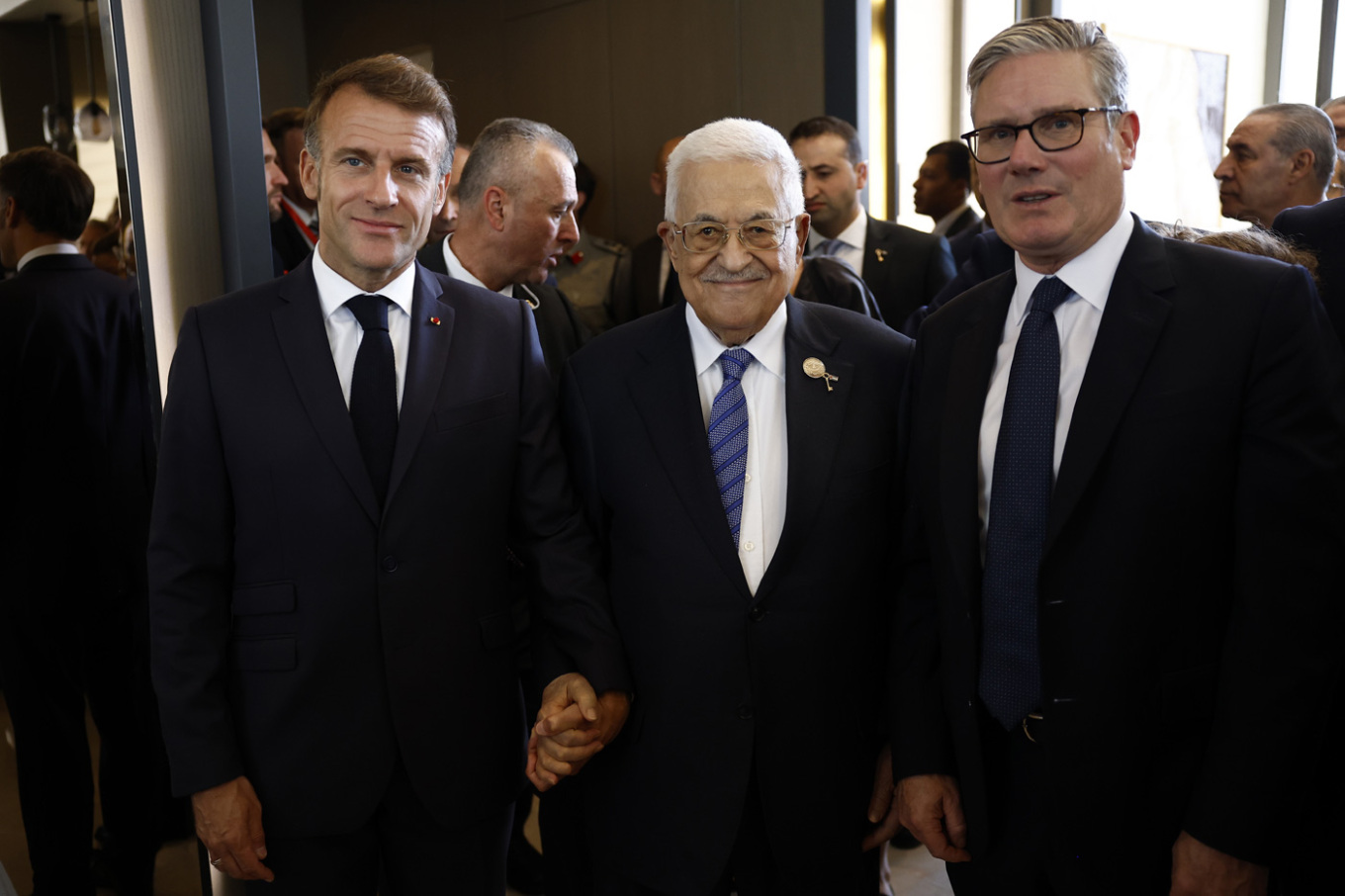
French President Emmanuel Macron, Palestinian Authority President Mahmoud Abbas, and British Prime Minister Keir Starmer
In his speech, Trump also stated that he thanked everyone who attended the summit, “but there are some I don’t particularly like — they may not know it yet, but they’ll find out.”
By contrast, he was exceptionally warm toward Egyptian President Abdel Fattah el-Sisi and Hungarian Prime Minister Viktor Orbán — whom he said he would support again in the next elections — and he once again praised Recep Tayyip Erdoğan, showing that his relationship with the Turkish leader remains strong.
As for the Arab leaders, Trump made no effort to hide his “intentions,” as he turned at least twice toward the representatives of the UAE, Qatar, and Saudi Arabia, saying: “These guys have a lot of money,” clearly indicating whom he expects to fund Gaza’s reconstruction efforts.
In a somewhat grotesque scene, Trump addressed each leader individually as the Gaza Summit concluded, with Trump and the leaders of Egypt, Qatar, and Turkey signing the Sharm el-Sheikh Declaration — a document outlining a broad and somewhat vague framework for “the day after,” not only for Gaza but for the entire region
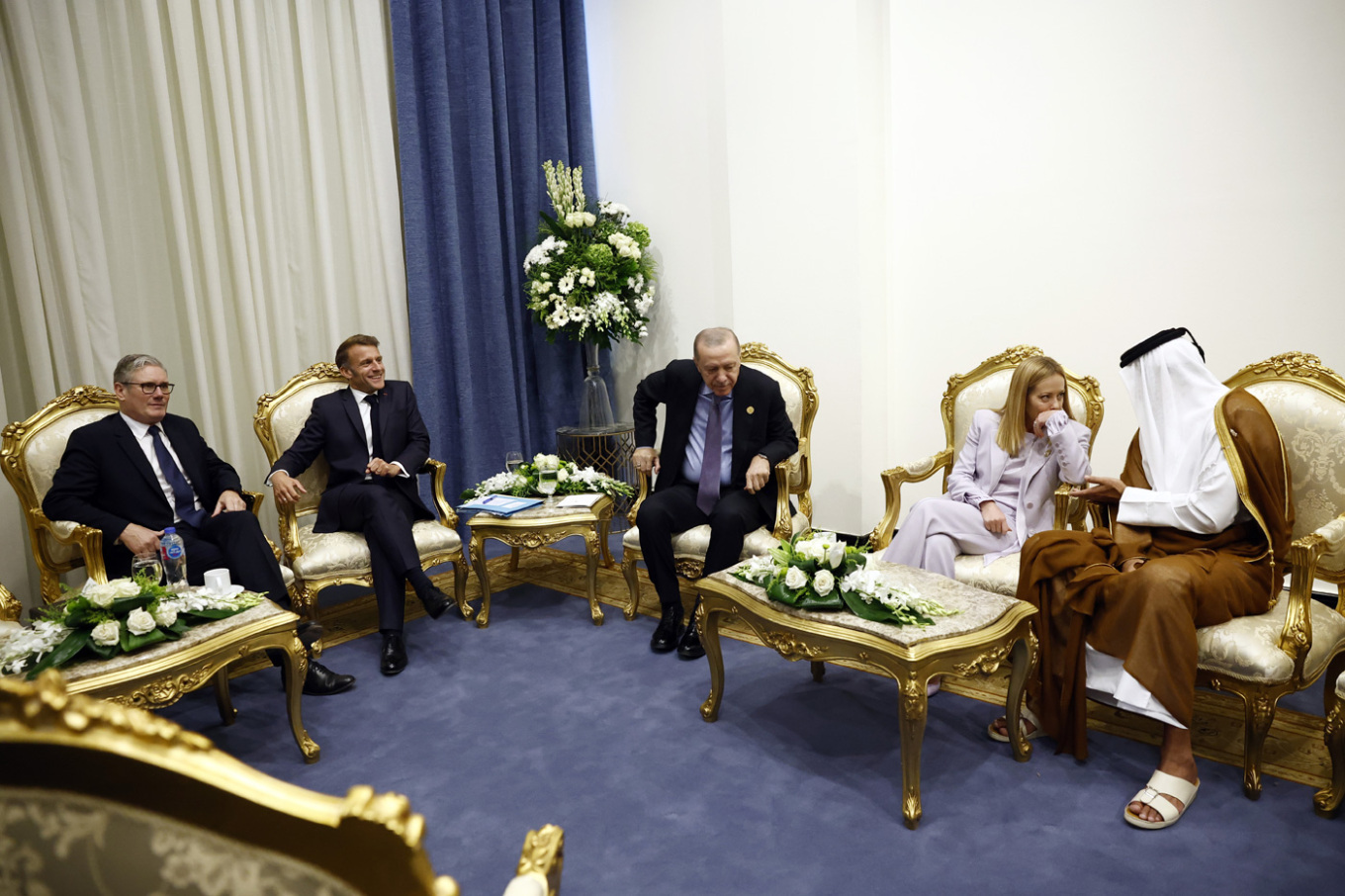
From left: British Prime Minister Keir Starmer, French President Emmanuel Macron, Turkish President Recep Tayyip Erdoğan, and Italian Prime Minister Giorgia Meloni
The Trump Declaration for Lasting Peace and Prosperity promotes a consensual rhetoric of peace, emphasizing cooperation, economic reconstruction, and regional stability, setting the stage for a new phase of political balance in the Middle East.
HISTORIC MOMENT.
— The White House (@WhiteHouse) October 13, 2025
President Donald J. Trump, alongside the leaders of Qatar, Egypt, and Turkey, signs the Gaza Peace Plan for peace in the Middle East. pic.twitter.com/depaxQO8g2
The text includes a clear reference to the need to eliminate extremism and radicalism. Special emphasis is placed on the religious and cultural significance of the region and the protection of holy sites.
It prioritizes diplomacy as the means to resolve conflicts and presents a vision for the prosperity of the peoples of the region — implicitly recommending the expansion of the Abraham Accords. The declaration acknowledges equal rights for Israelis and Palestinians, though without explicit mention of a two-state solution. Notably, the document was not signed by either of the two primary parties — Israel or the Palestinian Authority.
The American president declared: “We achieved the hardest part — now comes the easy part,” reflecting a completely unconventional approach and understanding of the Middle East.
If intense diplomatic pressure on Netanyahu and military pressure on Hamas led to the ceasefire, the road to permanent peace and the remaking of the New Middle East remains long and difficult.
Following the Sharm el-Sheikh Summit, the next challenging phase begins: the disarmament of Hamas, the start of Gaza’s reconstruction, the withdrawal of Israeli forces, the creation of a Palestinian security force, the formation of an international stabilization mission, and, crucially, the establishment of a Peace Council to oversee Gaza’s governance.
Turkey emerges strengthened from the Gaza developments. It secured a leading role in brokering the ceasefire and gained influence in the peace process — actively involved while maintaining its hostile stance toward Israel.
Indeed, the Turkish presidency’s propaganda apparatus spread the news yesterday afternoon that Benjamin Netanyahu’s canceled trip to Sharm el-Sheikh — while Mahmoud Abbas attended — was due to a “veto” reportedly imposed by Recep Tayyip Erdoğan.
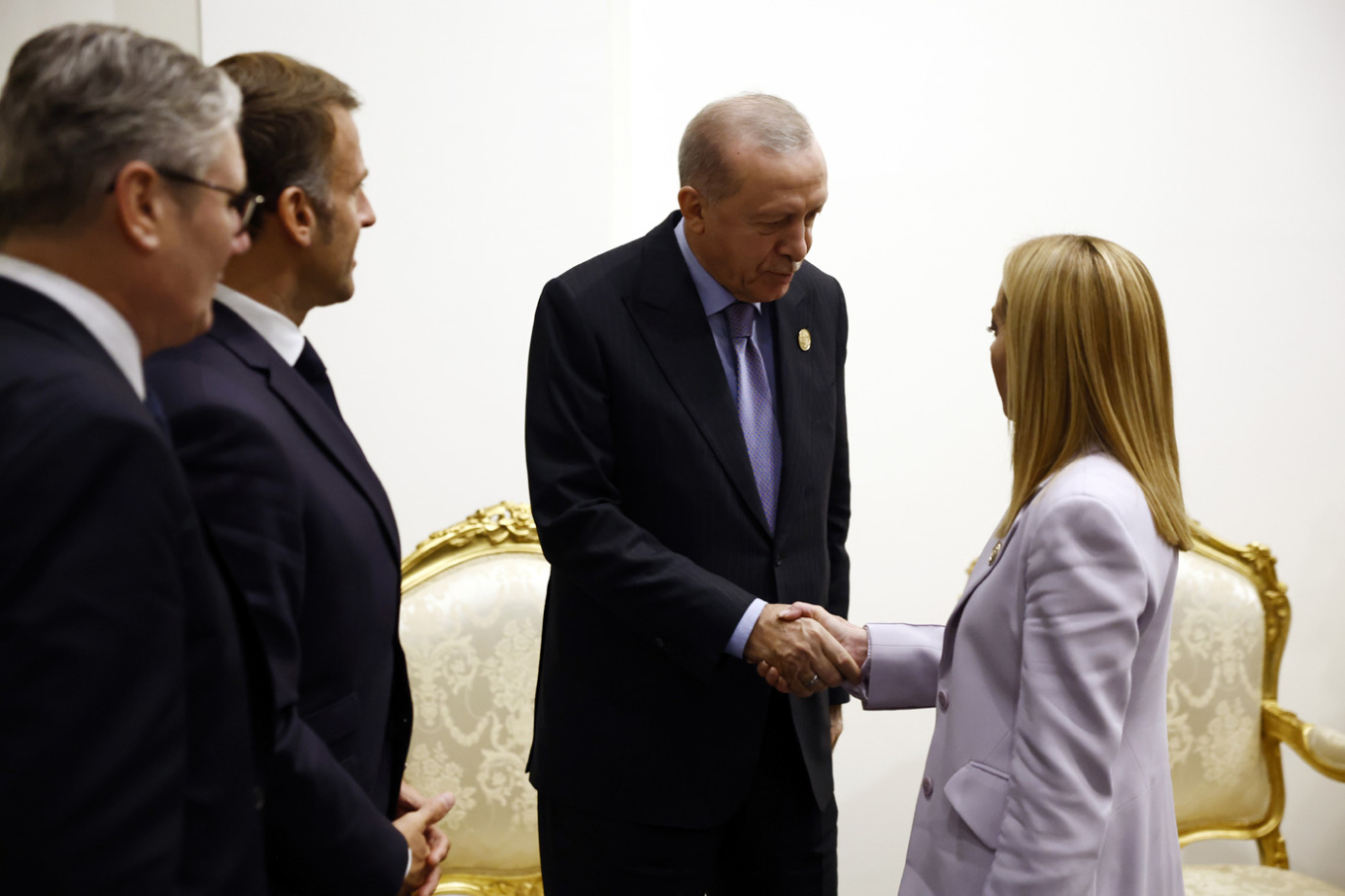
Turkish President Recep Tayyip Erdoğan and Italian Prime Minister Giorgia Meloni
According to the same reports, Erdoğan ordered his plane to circle in the air until Abdel Fattah el-Sisi and the American side assured him that the Israeli prime minister would not be attending the summit.
In any case, the U.S. president made it clear that he values Erdoğan — and it remains to be seen whether his earlier statement in Washington, that he had asked “for a few things” from the Turkish president in order to view the F-35 issue favorably, is indeed related to Turkey’s stance in facilitating the Gaza ceasefire agreement.
“I don’t know why, but I like tough people more than mild, easygoing people. Maybe it’s a matter of personality — I don’t know. But this gentleman from a place called Turkey has one of the strongest armies in the world. In fact, the army is even stronger than most people realize. If you look at some of the recent conflicts, they were always on the front line — and they were winning. Yet even when they were winning, they didn’t brag or demand recognition. He just wants to be left alone. He’s truly a ‘tough guy,’ but he’s my friend. And whenever I needed him, he was always there for me. So I want to thank President Erdoğan,”
was the American president’s glowing tribute to his Turkish counterpart.
Through this process, Turkey has also drawn closer to Egypt, and their shared interest in achieving a sustainable solution for Gaza is creating a community of goals that facilitates efforts to restore relations between Ankara and Cairo.
However, it is clear that if Turkey and Erdoğan wish to maintain an active role in developments, this cannot happen through a continued refusal to coexist with Israel and its legitimate representative, Prime Minister Benjamin Netanyahu.
This will undoubtedly prove to be a difficult test for the Turkish president.
In Israel and in Sharm el-Sheikh, the first pages of Trump’s plan for a New Middle East of “peace and prosperity” have begun to be written — though many chapters remain, for now, unwritten.
Ask me anything
Explore related questions